India- Australia Relations | Audio News
Автор: International Relations
Загружено: 2020-09-25
Просмотров: 14
Описание:
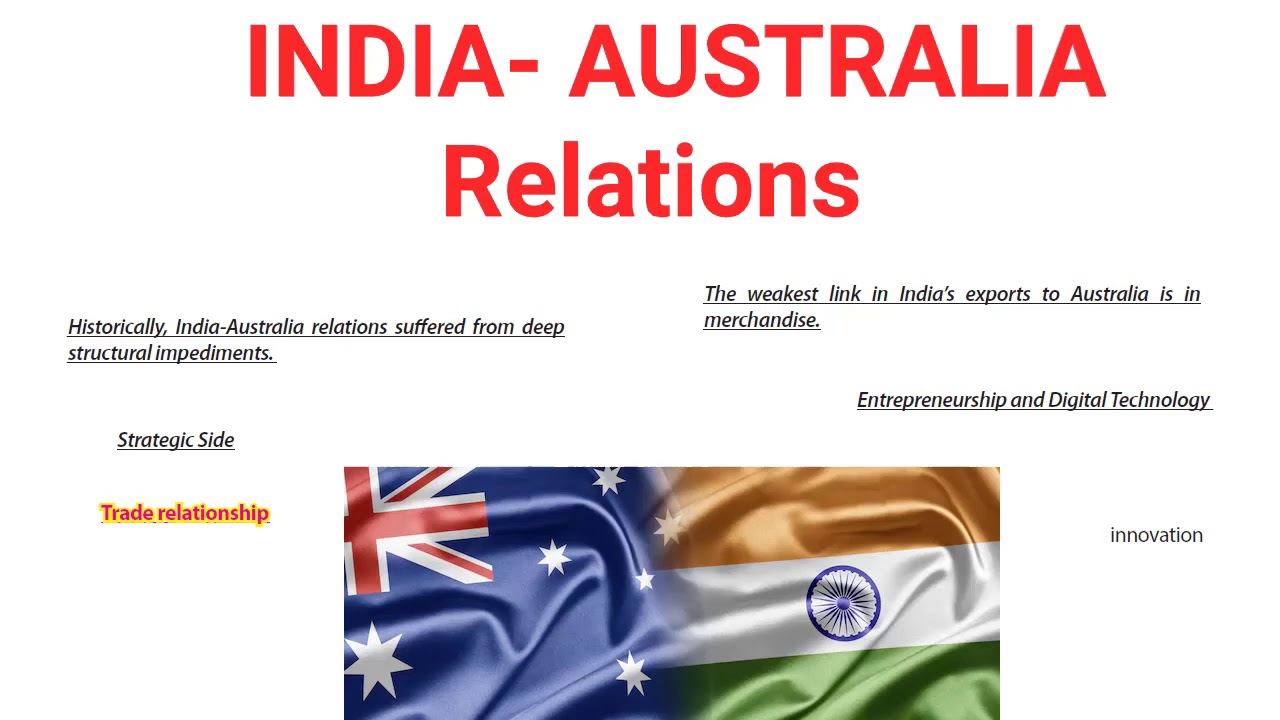
India and Australia share a strong bilateral relationship
based on historic ties, cultural links and extensive
people-to-people connections.
• As large democracies, the two countries play a central
role in strengthening geopolitical cooperation and
maintaining peace and security.
Historically, India-Australia relations suffered from deep
structural impediments.
• The first was the logic of the Cold War, during which
Australia decided to be among Britain and the United
States’ closest allies, while India initially opted for nonalignment.
This led to a number of disagreements and
misunderstandings.
As India achieved Independence, for example,
Australian leaders advocated to their British
counterparts that the strategically important
Andaman and Nicobar Islands be retained by the
empire.
• The second complicating factor was India’s nuclear
status outside the nuclear Non-Proliferation Treaty
(NPT).
This resulted in Australia taking a particularly
strong stance against India’s 1998 nuclear tests,
which came soon after French nuclear tests in
the South Pacific.
However, the 2008 waiver granted to India by
the Nuclear Suppliers Group, the subsequent
lifting by Australia of its uranium ban against
NPT non-signatories, and a bilateral civil nuclear
agreement in 2014-2015 largely addressed the
matter.
• Third, the relationship historically suffered from a lack
of economic content. This has changed.
India is one of the largest export destination for
Australia, and Australia is a top 20 trade partner
for India.
Yet, merchandise trade remains below potential
• Fourth, the relationship was previously held back by
an absence of people-to-people content.
In recent years, however, Indian immigrants
have been among the largest contributors to
Australia’s population growth.
In addition to the massive influx of Indian
students, Indian tourists are also visiting Australia
in larger numbers.
Strategic Side
• India-Australia relations have experienced a major
upswing. This is evident in a growing number of
military exercises involving all three services, as well
as staff talks and military training initiatives.
• In 2019, the countries took part in large-scale antisubmarine
warfare exercises in the Bay of Bengal.
• The establishment of a bilateral 2+2 dialogue
(involving senior foreign and defence ministry
officials) represent more heft and purpose in strategic
coordination.
Trade relationship
• The trade between the two countries has been at a
modest $31 billion, largely composed of resources
like coal and other minerals.
Issue Area
• Negotiations on a Free Trade Agreement, which
began in 2011, have not moved forward significantly.
• It is important for India to concentrate on various
underdeveloped and undervalued sectors such as
agriculture, education, tourism and services.
• Adani Group’s coal project in Australia has been
hampered by regulatory delays and difficulty in
securing financing amid a passionate environmental
protest movement.
India Economic Strategy 2035 Report
• It was prepared by former Foreign Secretary of
Australia Peter Varghese for the government of
Australia which lays down a comprehensive road map
for strengthening Australia’s trade engagement with
India.
• This report recommends that Australia strive by 2035
to lift India into our top three export markets, to make
India the third largest destination in Asia for Australian
outward investment, and to bring India into the inner
circle of Australia’s strategic partnerships, and with
people to people ties as close as any in Asia.
Entrepreneurship and Digital Technology
India-Australia trade has been steadily evolving into
a new architecture underpinned by developments in
digital technology, the rise of a younger generation of
entrepreneurs, and a noticeable shift in the trade basket
from resources to services.
• Technology and young entrepreneurship make a
formidable combination and should set the agenda
for the future of bilateral trade relations.
About 80% of the Australian small and mediumsized
enterprises are managed by young
professionals.
• Young Australians, like young Indians, carry the
compelling vision of 21st century globalization,
multiculturism and quality education.
What adds strengths to this process is a great
deal of social engineering, people-to people
contacts, and knowledge partnerships.
The young can see issues like immigration and
outsourcing with far more equanimity than the
older generation.
Young Australians are thus emerging as great
champions of India-Australia trade relations.
• There is also recognition that Australia is a laboratory
of ideas, innovation, technology-led growth and
university-industry partnerships. India is a large
and demographically young market with a love for
innovation and an appetite for new products and
services. These synergies should add momentum to a
growing engagement in trade relations.
Повторяем попытку...
Доступные форматы для скачивания:
Скачать видео
-
Информация по загрузке: