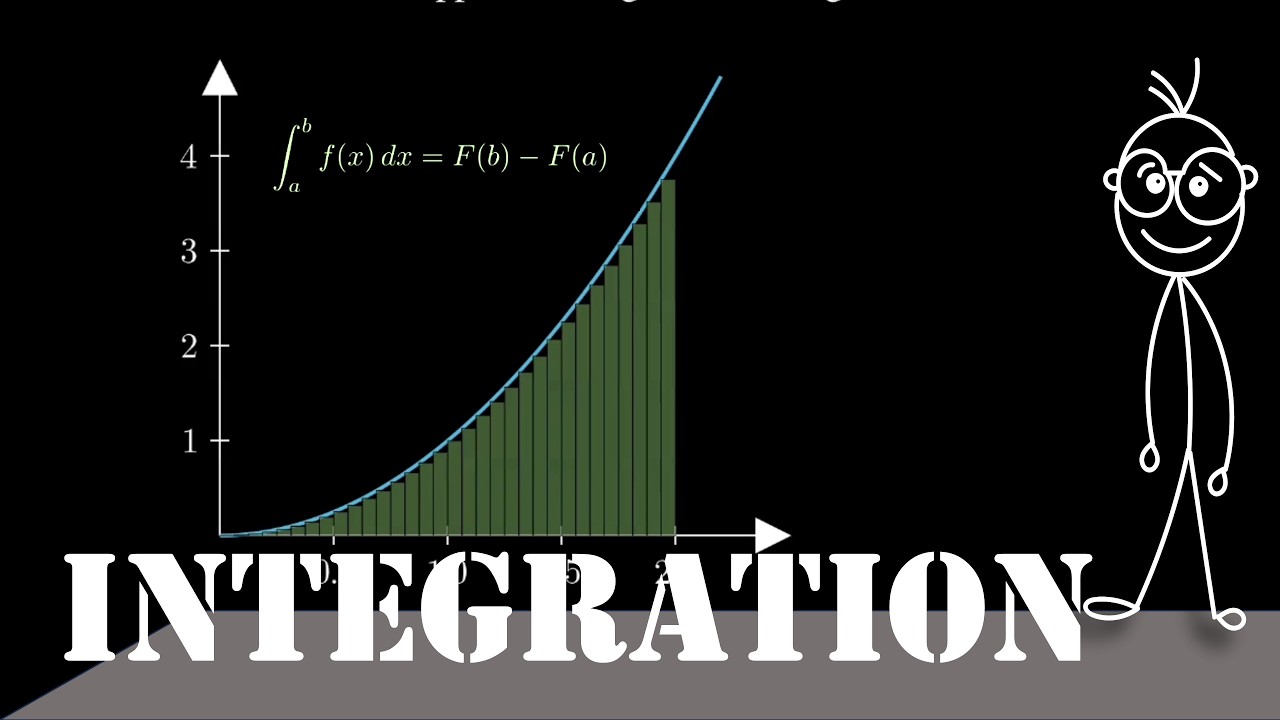
Calculus 1 — 24.2: The Rectangular Approximation Method
Автор: Ludium
Загружено: 2026-02-23
Просмотров: 8
Описание:
How do you find the area under a curve when no simple formula exists? This video builds the idea from scratch: slice an interval into subintervals, construct rectangles, sum their areas, and watch the approximation improve as the number of rectangles grows. By the end, you'll see exactly how the summation Σ f(xₖ*)·Δx becomes the definite integral ∫f(x)dx as n approaches infinity.
Key concepts covered:
• Why curved regions require a new approach beyond basic area formulas
• Partitioning an interval [a, b] into n equal subintervals of width Δx = (b−a)/n
• Choosing sample points (left endpoint, right endpoint, midpoint) within each subinterval
• Building rectangles with height f(xₖ*) and base Δx, then summing their areas
• Worked example: approximating the area under f(x) = x² + 1 on [0, 3] with right-endpoint rectangles (n = 3 gives 17 vs. true area of 12)
• Visualizing overshoot and undershoot error regions as n increases from 4 to 200
• Why the choice of sample point becomes irrelevant as Δx shrinks toward zero (continuity)
• The transition from Riemann sum to definite integral: Σ stretches into ∫ and Δx shrinks into dx
• The definite integral as the limit of rectangle sums: partition, build, sum, take the limit
━━━━━━━━━━━━━━━━━━━━━━━━
SOURCE MATERIALS
The source materials for this video are from • Calculus 1 Lecture 4.3: Area Under a Curv...
Повторяем попытку...

Доступные форматы для скачивания:
Скачать видео
-
Информация по загрузке: