Ludwig van Beethoven - Grosse Fuge, Op.133 (Furtwängler - Berliner Philharmoniker)
Автор: Momrad Carko
Загружено: 2024-02-14
Просмотров: 1814
Описание:
Ludwig van Beethoven (1770 - 1827)
⸻⸻⸻⸻⸻
Grosse Fuge, Op.133 (1826)
⸻⸻⸻⸻⸻
Wilhelm Furtwängler (1886 - 1954)
Berliner Philharmoniker
Recorded in 1952
⸻⸻⸻⸻⸻⸻⸻
The Grosse Fuge, Op.133, is a single-movement composition for string quartet by Ludwig van Beethoven. An immense double fugue, it was universally condemned by contemporary music critics.
⸻⸻⸻⸻⸻⸻⸻
A reviewer writing for the Allgemeine musikalische Zeitung in 1826 described the fugue as "incomprehensible, like Chinese" and "a confusion of Babel". However, critical opinion of the work has risen steadily since the early 20th century and it is now considered among Beethoven's greatest achievements.
⸻⸻⸻⸻⸻⸻⸻
The Grosse Fuge was originally composed as the final movement of Beethoven's Quartet No. 13 in B♭ major, Op. 130, written in 1825; but Beethoven's publisher was concerned about the dismal commercial prospects of the piece and wanted the composer to replace the fugue with a new finale. Beethoven complied, and the Grosse Fuge was published as a separate work in 1827 as Op. 133.
⸻⸻⸻⸻⸻⸻⸻
Dozens of analyses have attempted to delve into the structure of the Grosse Fuge, with conflicting results. The work has been described as an expansion of the formal Baroque grand fugue, as a multi-movement work rolled into a single piece, and as a symphonic poem in sonata form.
⸻⸻⸻⸻⸻⸻⸻
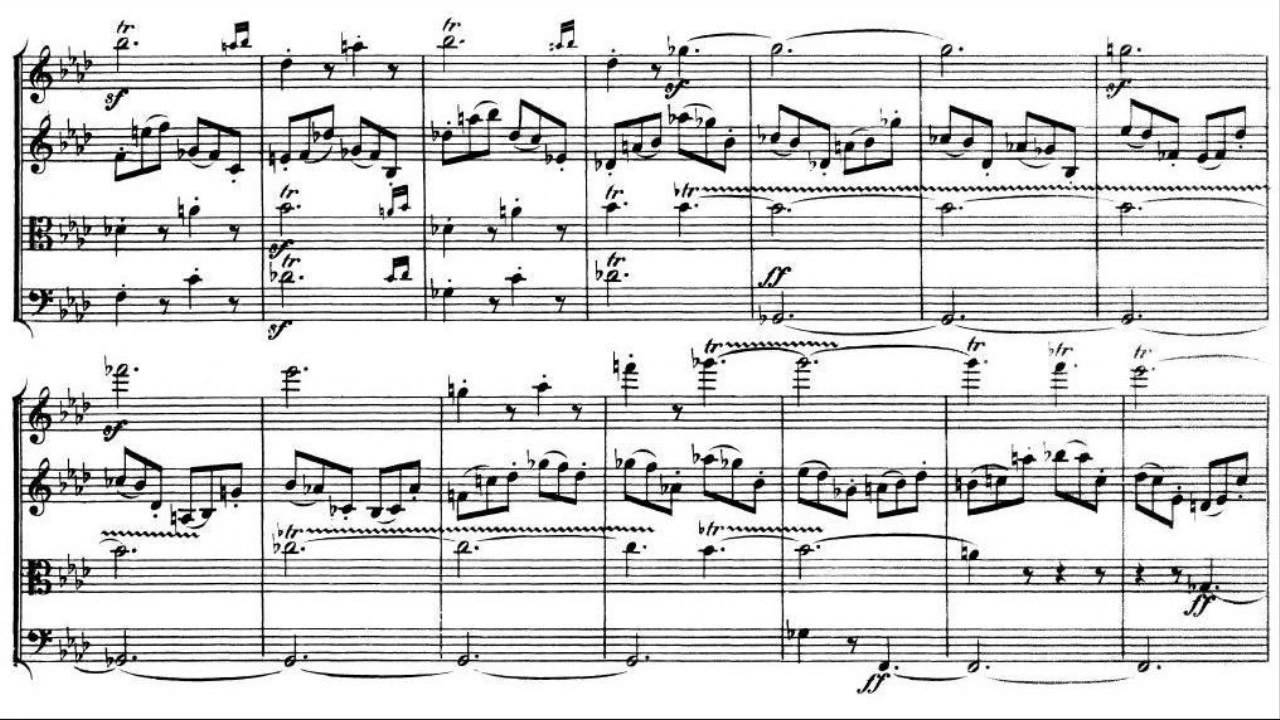
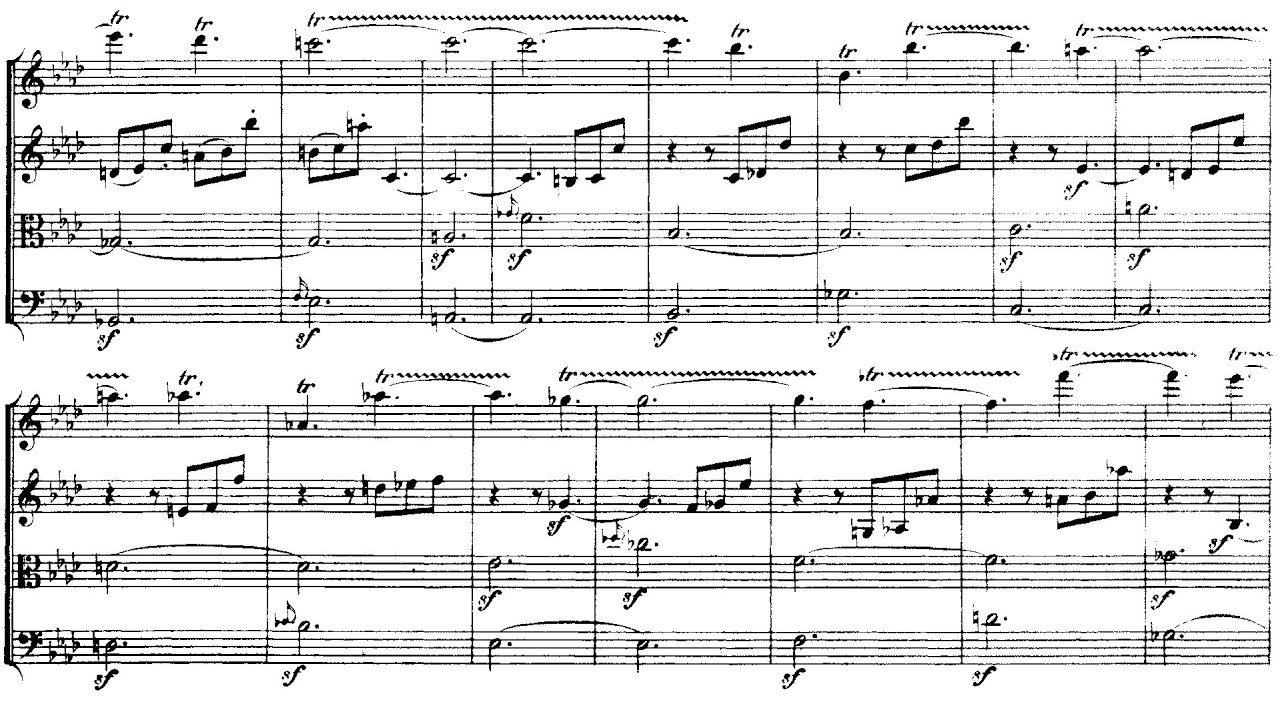
The quartet opens with a 24-bar Overtura, which introduces one of the two themes of the fugue, a tune closely related to the one which opens the string quartet opus 132. Beethoven then plunges into a violent and dissonant double fugue, with a second subject of dramatically leaping tones, and the four instruments of the quartet bursting out in triplets, dotted figures, and cross-rhythms.
Following this opening fugal section is a series of sections, in contrasting keys, rhythms and tempi. Sections often break off suddenly, without real preparation, to create a structural texture that is jagged and surprising. Toward the end, there is a slowing, with long pauses, leading into a recapitulation of the overture, and on to a rushing finale that ends the movement.
Like some of Beethoven's other late finales, such as the one from the Ninth Symphony, the Fugue can be seen as a multi-movement form contained within a single large movement. Each of the smaller sections is built on a transformation of the original theme. In addition, the Große Fuge is an example of a compositional process Beethoven explored late in life: a combination of elements of variation form, sonata form, and fugue. The lyrical section in G♭ has the weight of an independent slow movement; some commentators have even attempted to analyze the entire piece in terms of sonata form.
⸻⸻⸻⸻⸻⸻⸻
After the first performance of the Quartet both critics and audience were astonished, and not in a good way. The last movement horrified them! Beethoven did not attend the premiere in March 1826, he rather made himself comfortable at a tavern. Friends and colleagues brought him the news after, reporting that the middle movements were very well received, in fact the audience demanded a repeat. Beethoven was disappointed and furious, he said, “…and why didn’t they encore the Fugue? That alone should have been repeated! Cattle! Asses!”
Since its first performance in 1826 this work is probably the most polarizing one from Beethoven.
Opinions on the Grosse Fuge since it's premiere:
“incomprehensible, like Chinese”,
“a confusion of Babel”,
“the most problematic single work in Beethoven’s output and … doubtless in the entire literature of music”,
“It will scarcely ever touch the heart.”,
“Impersonal, hostile objectivity.”,
“Its extraordinarily crabbed and cruel technical difficulties usually make it sound dry and dully ponderous in performance.”
“This fugue is one of the two works by Beethoven—the other being the fugue from the piano sonata, Op. 106—which should be excluded from performance.”
Stravinsky said: “The Great Fugue … now seems to me the most perfect miracle in music. It is also the most absolutely contemporary piece of music I know, and contemporary forever … Hardly birthmarked by its age, the Great Fugue is, in rhythm alone, more subtle than any music of my own century … I love it beyond everything.”
According to Glenn Gould: “For me, the ‘Grosse Fuge’ is not only the greatest work Beethoven ever wrote but just about the most astonishing piece in musical literature.”
Повторяем попытку...
Доступные форматы для скачивания:
Скачать видео
-
Информация по загрузке: