ycliper

Популярное

Музыка Кино и Анимация Автомобили Животные Спорт Путешествия Игры Юмор

Интересные видео

2025 Сериалы Трейлеры Новости Как сделать Видеоуроки Diy своими руками

Топ запросов

смотреть а4 schoolboy runaway турецкий сериал смотреть мультфильмы эдисон
Скачать

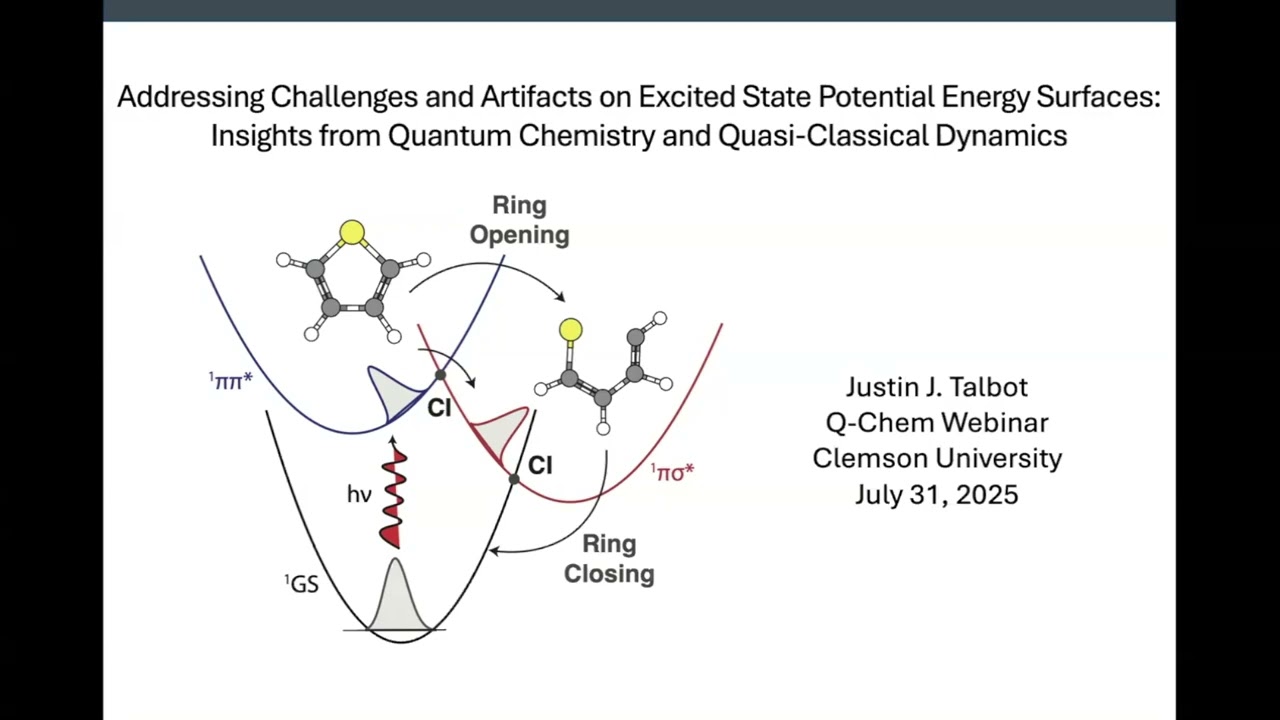
2025 Nick Besley Award: Justin Talbot

Автор: QChemSoftware

Загружено: 2025-08-11

Просмотров: 192

Описание: This special webinar event was presented by Justin Talbot, the recipient of the 2025 Nick Besley Award.

Abstract:

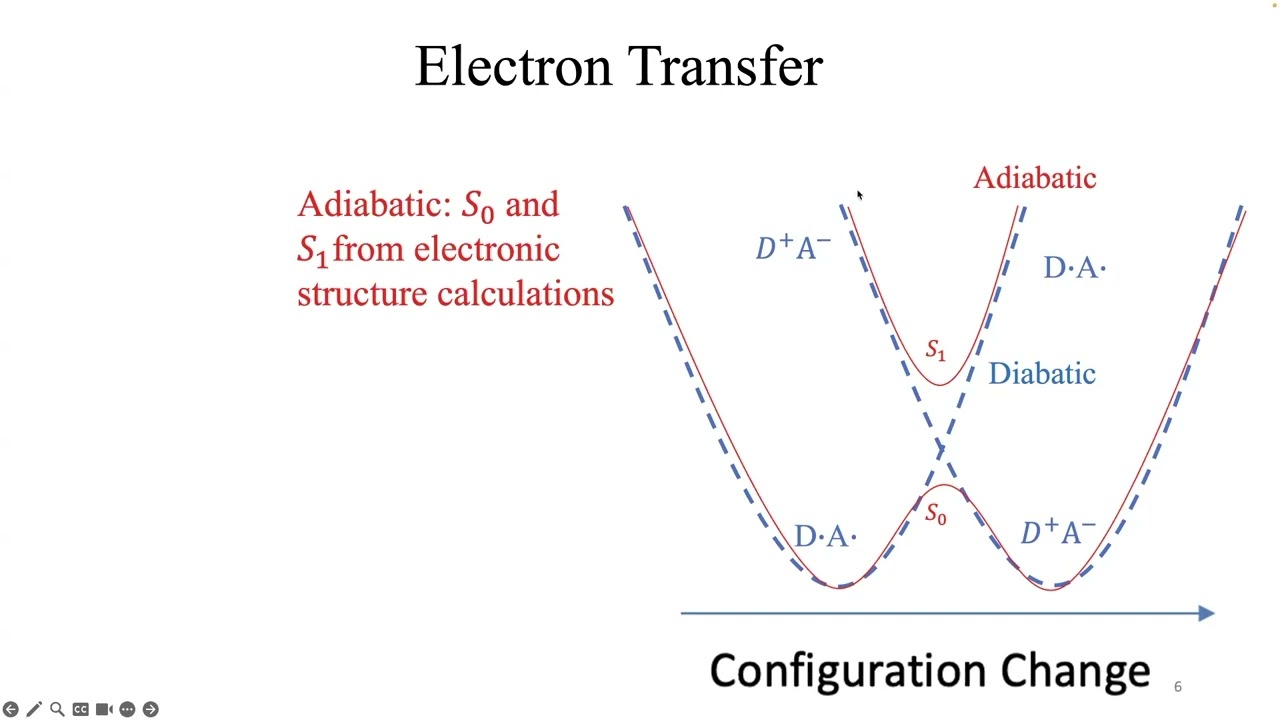
Elucidating the important role that nonadiabatic transitions play in renewable energy catalysis, biological systems, and atmospheric chemistry is a current challenge for computational chemistry. Key difficulties include building a sufficiently accurate representation of the excited-state potential energy surfaces and their couplings. To address these challenges, Justin Talbot and collaborators have incorporated an ab initio treatment of electronic structure theory—including the analytical evaluation of non-adiabatic couplings—with the symmetric quasi-classical Meyer-Miller model, which treats electronic and nuclear motions on an equal footing using classical mechanics.

In this talk, he will discuss the benefits and pitfalls of such an approach and illustrate, using small gas-phase molecules as examples, how it might be employed to understand and predict the complex dynamics relevant to solar energy catalysis, photoinduced isomerization, and energy flow within molecules. Additionally, he will discuss how some predicted minimum energy excited state configurations can be unphysical—existing only within the construct of the Born-Oppenheimer approximation. Using ab initio calculations and Landau-Zener dynamics, he will present some examples of these “fantastical” minimum energy configurations, show how they correspond to unphysically high harmonic frequencies, and demonstrate how they collapse within femtoseconds to lower-energy electronic states.

About the Presenter:

Prof. Talbot earned his BS in physics and applied mathematics and his PhD in physical chemistry at the University of Utah, where he worked with Prof. Ryan Steele in applications and methods development for vibrational structure theory. He then did a postdoc at UC Berkeley, where he worked with Prof. Martin Head-Gordon, Dr. Stephen Cotton, and Prof. Bill Miller to study electronic structure and nonadiabatic molecular dynamics. He is now an assistant professor at Clemson University, where he leads a research group focused on ab initio electronic structure methods and molecular dynamics simulations, with applications in solar and green energy. He has also made significant contributions to Q-Chem specifically, including development of novel methods for computational vibrational spectroscopy and nonadiabatic dynamics.

About the Award:

The Nick Besley Award was established to recognize excellence in the development or application of new methods for computational spectroscopy in the Q-Chem open-teamware community project. It commemorates the contributions of Prof. Nick Besley, who is remembered for his multi-faceted contributions to electronic excited-state theory and methodology, with particular application to the prediction and rationalization of X-ray spectra.

Не удается загрузить Youtube-плеер. Проверьте блокировку Youtube в вашей сети.
Повторяем попытку...
2025 Nick Besley Award: Justin Talbot

Поделиться в:

Доступные форматы для скачивания:

Скачать видео

  • Информация по загрузке:
Скачать аудио

Похожие видео

Nonadiabatic Molecular Dynamics by Multiconfiguration Pair-Density Functional Theory

Nonadiabatic Molecular Dynamics by Multiconfiguration Pair-Density Functional Theory

2025 Michael Wormit Award: Mathew Chow

2025 Michael Wormit Award: Mathew Chow

Q-Chem Webinar 72: Multiscale free energy simulations of biochemical reactions using QMHub

Q-Chem Webinar 72: Multiscale free energy simulations of biochemical reactions using QMHub

Черные дыры, звезды и LRD | Вселенная — не симуляция | Джефф Цвееринк и Хью Росс

Черные дыры, звезды и LRD | Вселенная — не симуляция | Джефф Цвееринк и Хью Росс

Wildstein ujawnia: dlaczego Tusk stawia na ludzi z mroczną przeszłością? | Republika Dzień

Wildstein ujawnia: dlaczego Tusk stawia na ludzi z mroczną przeszłością? | Republika Dzień

Pałac Prezydencki. Posiedzenie Rady Bezpieczeństwa Narodowego

Pałac Prezydencki. Posiedzenie Rady Bezpieczeństwa Narodowego

Webinar 79: Nuclear-Electronic Orbital ab initio Wavefunction Methods in Q-Chem

Webinar 79: Nuclear-Electronic Orbital ab initio Wavefunction Methods in Q-Chem

Webinar 76 — Q-Cloud

Webinar 76 — Q-Cloud

Richard Feynman: Explains Why LIGHT does not move

Richard Feynman: Explains Why LIGHT does not move

2024 Besley Award (Kevin Carter-Fenk): EA-TDDFT for Calculating X-ray Absorption Spectra

2024 Besley Award (Kevin Carter-Fenk): EA-TDDFT for Calculating X-ray Absorption Spectra

Nawrocki grzmi: na litość boską,musimy wiedzieć,czy marszałek ma dostęp do informacji ściśle tajnych

Nawrocki grzmi: na litość boską,musimy wiedzieć,czy marszałek ma dostęp do informacji ściśle tajnych

Квантовая химия 10.8 – Теория LCAO-MO

Квантовая химия 10.8 – Теория LCAO-MO

Mikhail Gromov - Mistakes in Diagnosis and Mistakes in Judgement

Mikhail Gromov - Mistakes in Diagnosis and Mistakes in Judgement

2024 Wormit Award (Adam Rettig): PBC Development In Q-Chem

2024 Wormit Award (Adam Rettig): PBC Development In Q-Chem

Conor McClune - Multiplex perturbation reveals unexpected components of Taxol biosynthesis

Conor McClune - Multiplex perturbation reveals unexpected components of Taxol biosynthesis

Webinar 82: Constrained CASSCF and Tight-Binding Calculations in Q-Chem

Webinar 82: Constrained CASSCF and Tight-Binding Calculations in Q-Chem

TRUMP WKRACZA NA TEREN WPŁYWÓW PUTINA. ARMENIA I AZERBEJŻDŻAN BLIŻEJ USA

TRUMP WKRACZA NA TEREN WPŁYWÓW PUTINA. ARMENIA I AZERBEJŻDŻAN BLIŻEJ USA

Max Pinheiro Jr | Nonadiabatic Molecular Dynamics with Machine Learning | Lecture

Max Pinheiro Jr | Nonadiabatic Molecular Dynamics with Machine Learning | Lecture

Webinar 84: Modern Quantum Chemistry in Q-Chem 6.4

Webinar 84: Modern Quantum Chemistry in Q-Chem 6.4

Q-Chem Webinar 71: Development of NEO Methods in Q-Chem 6

Q-Chem Webinar 71: Development of NEO Methods in Q-Chem 6

© 2025 ycliper. Все права защищены.


  • Контакты
  • О нас
  • Политика конфиденциальности


Контакты для правообладателей: [email protected]