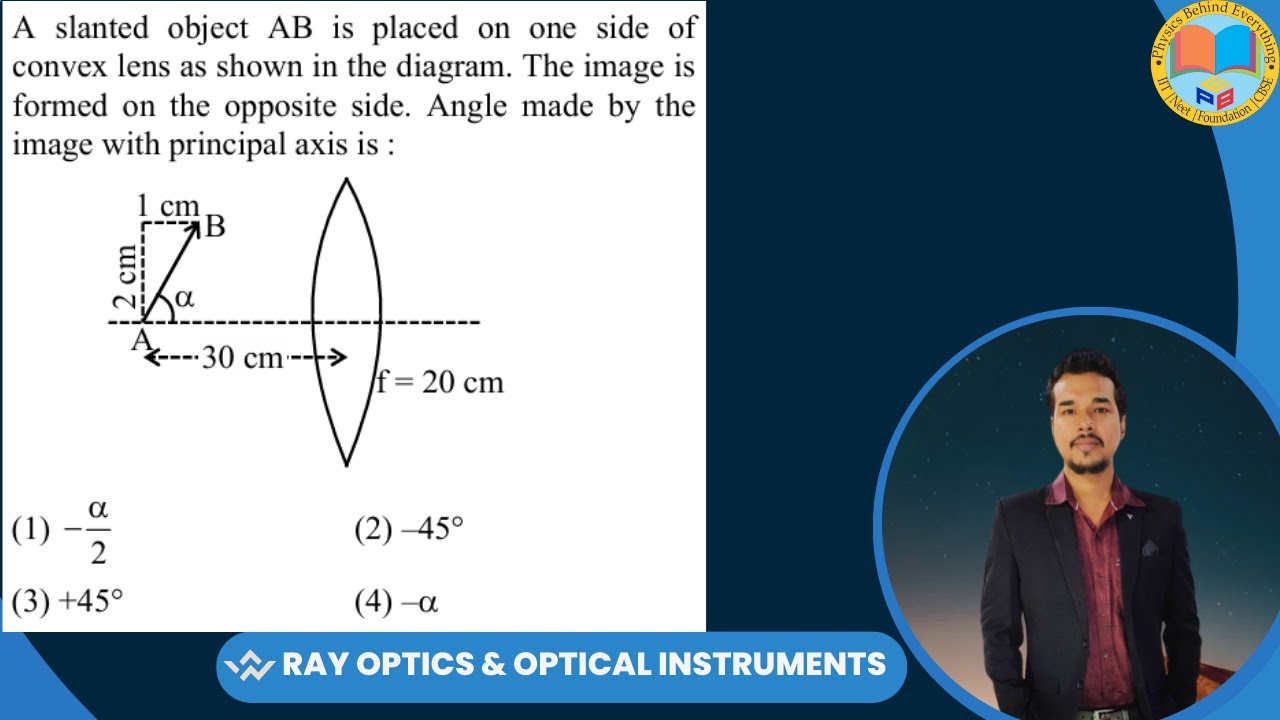
A slanted object AB is placed on one side of convex lens as shown in the diagram. The image is forme
Автор: Physics Behind Everything
Загружено: 2026-01-20
Просмотров: 12
Описание:
A slanted object AB is placed on one side of convex lens as shown in the diagram. The image is formed on the opposite side. Angle made by the image with principal axis is :
(1) -- α/2 (2) –45° (3) +45° (4) -- α
📝 JEE Mains 2025: Ray Optics Theory & Image Orientation
*Part 1: The Geometry of Slanted Objects*
Most standard JEE problems deal with "erect" objects placed perpendicular to the principal axis. However, the 2025 April session introduced a "slanted" object . When an object is tilted at an angle with the principal axis, every point on the object (, , and everything in between) exists at a different object distance () from the optical center of the lens.
Because the image distance () is a function of the object distance (), each point on the slanted object will be mapped to a specific point on the other side of the lens, creating a slanted image. The core theoretical challenge is determining the new angle this image makes with the principal axis.
*Part 2: Transverse vs. Longitudinal Magnification*
To understand the slope of the image, we must distinguish between two types of magnification that occur simultaneously:
*Transverse (Lateral) Magnification ():* This relates to the height of the object. It describes how "tall" the image is compared to the object at any specific point along the axis.
*Longitudinal (Axial) Magnification ():* This relates to the "stretch" or "compression" of the object along the principal axis. Theoretically, for small objects, the longitudinal magnification is proportional to the square of the transverse magnification ().
The final angle of the image is a result of the competition between these two magnifications. While the height is scaled by , the length along the axis is scaled by .
*Part 3: The Tangent of the Angle*
The slope of any line in a coordinate system is defined by the ratio of its vertical change to its horizontal change. In the case of a lens:
1. The *vertical change* corresponds to the image height (related to transverse magnification).
2. The *horizontal change* corresponds to the image length along the axis (related to longitudinal magnification).
Theoretically, the tangent of the angle made by the image is the ratio of the change in image height to the change in image position. When you factor in the relationship where longitudinal magnification is the square of lateral magnification, the resulting slope of the image relates back to the original slope of the object in a very specific, symmetric way.
*Part 4: The Inversion Principle*
A key theoretical aspect of a real image formed by a convex lens is that it is **inverted**.
*Vertical Inversion:* The image is flipped upside down relative to the object.
*Horizontal "Inversion":* Because the image moves in the same direction as the object along the axis, but at a different rate, the slant of the image will be "flipped" or mirrored relative to the principal axis.
If the object is slanted "upwards" at an angle , the theory of optical mapping suggests the image will be slanted "downwards" to maintain the symmetry of the light rays passing through the optical center.
*Part 5: Why NTA Included This in 2025*
This problem was designed to separate students who merely memorize the lens formula from those who understand the **differential nature of optics**. It requires a conceptual grasp of:
How small displacements in object space translate to displacements in image space.
The coordinate geometry of optical paths.
The preservation (or lack thereof) of angles during refraction through spherical surfaces.
---
🏷️ SEO-Based Hashtags
#JEEMains2025 #RayOptics #PhysicsTheory #JEEPreparation #ConvexLens #Magnification #OpticsTheory #NTA #AprilAttempt2025 #IITJEE2026 #PhysicsConcepts #ImageFormation #EngineeringAspirants #ScienceExplained #IITJEEPrep #LightRefraction
---
Join this channel to get access to perks:
/ @physicsbehindeverything
Повторяем попытку...
Доступные форматы для скачивания:
Скачать видео
-
Информация по загрузке: