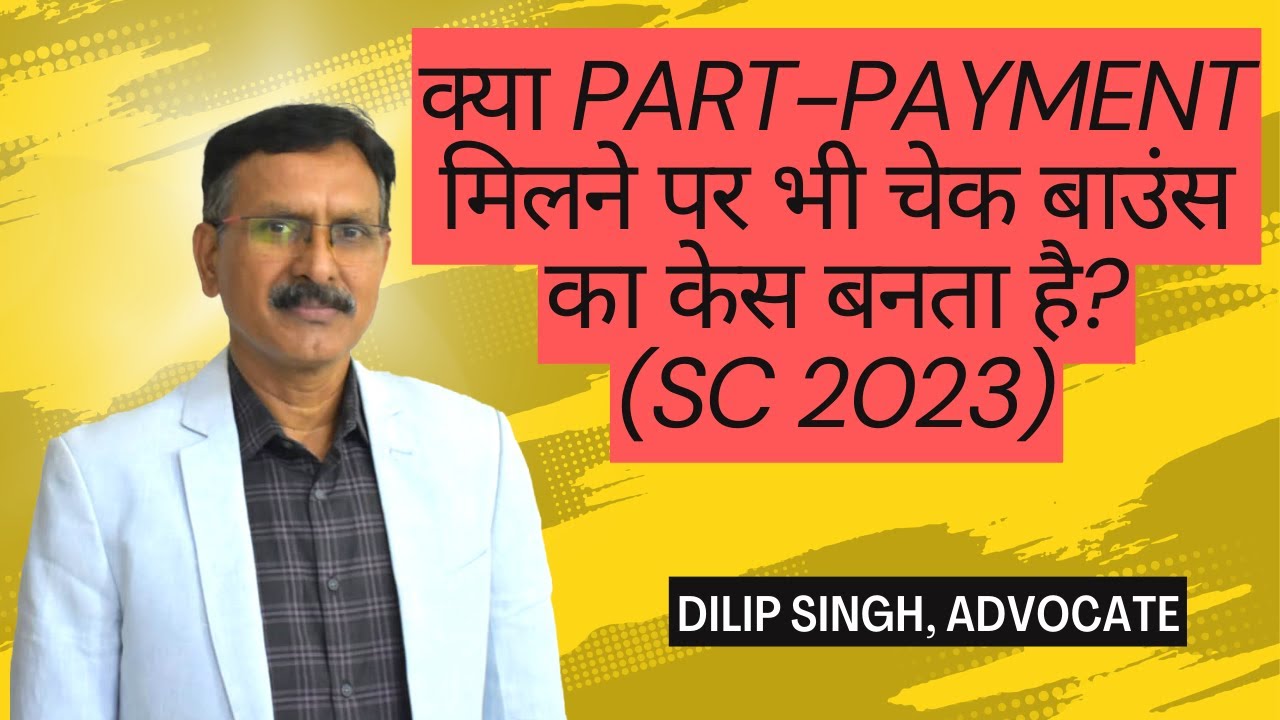
क्या part-payment मिलने पर भी चेक बाउंस का केस बनता है? (SC 2023)
Автор: LEGAL OUTLOOK... By Dilip Singh
Загружено: 2023-02-19
Просмотров: 13820
Описание:
#chequebouncecase #Dishonor_of_cheque #supremecourtofindia #partpayment_Chequebounce
on October 11, 2022. The DB was of Justice Dr D Y Chandrachud & Justice Hima Kohli
Whether the offence under Section 138 of the Act would be committed if the dishonoured cheque does not represent the enforceable debt at the time of encashment?
JU D G M E N T Dr Dhananjaya Y Chandrachud, J
Dashrathbhai Patel gave a loan of Rs.20 Lacs to Hitesh Patel and took security cheque of this amount. He presents the cheque and it gets dishonored. He demands this amount in notice and then files complaint.
The Trial Court acquitted the accused Hitesh Patel on the ground that a sum of Rs.4,09,3015 was paid after issue of claque so the cheque does not reflect the actual debt. The demand was bad.
The High Court of Gujarat also dismissed the appeal on the ground that the notice of demand issued under Section 138 of the Act is not valid. The part -payment made by the accused ought to have been reflected in the statutory notice issued by the complainant.
Criminal Appeal No. 1497 of 2022
Dashrathbhai Trikambhai Patel
Vs
Hitesh Mahendrabhai Patel & Anr.
This judgment is very good as it provides the way out for complainant and saves accused if proper way is not followed. What is way out for the complainant whose major part of payment is yet to be made?
First Legal point, I would like to share is that :( The term ‘debt or other liability’ used in Section 138 must be a ‘legally enforceable debt or other liability’. Thus, the demand made in the statutory notice must be for a sum that is legally enforceable.
Complainant raised a very genuine apprehension that it would lead to a possibility where the drawer of the cheque could evade prosecution under Section 138 by paying a small amount of the debt while defaulting on the remaining payment.
Answer lies in Section 56 of NI Act, which stipulates that if there is an endorsement on a negotiable instrument that a part of the sum mentioned in the cheque has been paid, then the instrument may be negotiated for the balance.
TWO IMPORTANT STEPS NEED TO TAKE:
1. Under Section 56 read with Section 15 of NI Act, an endorsement may be made by recording the part-payment of the debt in the cheque or in a note appended to the cheque at the backside of cheque. When such an endorsement is made, the instrument could still be used to negotiate the balance amount.
If the unendorsed cheque is dishonoured on presentation, the offence under Section 138 would not be attracted since the cheque does not represent a legally enforceable debt at the time of encashment.
2. This is another important step: The demand notice needs to disclose the part payment made. The demand should be of actual amount due.
Supreme court dismissed the appeal of complainant. Because the cheque was neither endorsed as required nor the legal notice disclosed the part payment made by the accused after the drawing of cheque and before presentation of cheque.
Free Legal advice to solve your day to day legal problem.
Better legal information to enrich your legal outlook.
Legal discussion to improve your legal understanding.
An informed discussion on recent and important judgment of Supreme Court & High Courts for lawyers and laymen. We discuss the proposition of law laid down by the Court in the backdrop of the facts and the relevant provision of laws.
Повторяем попытку...
Доступные форматы для скачивания:
Скачать видео
-
Информация по загрузке: