Difference Between Synthesized and Inherited Attributes | Compiler Design | Attribute Grammar
Автор: Easy Computer Engineering
Загружено: 2020-03-27
Просмотров: 16831
Описание:
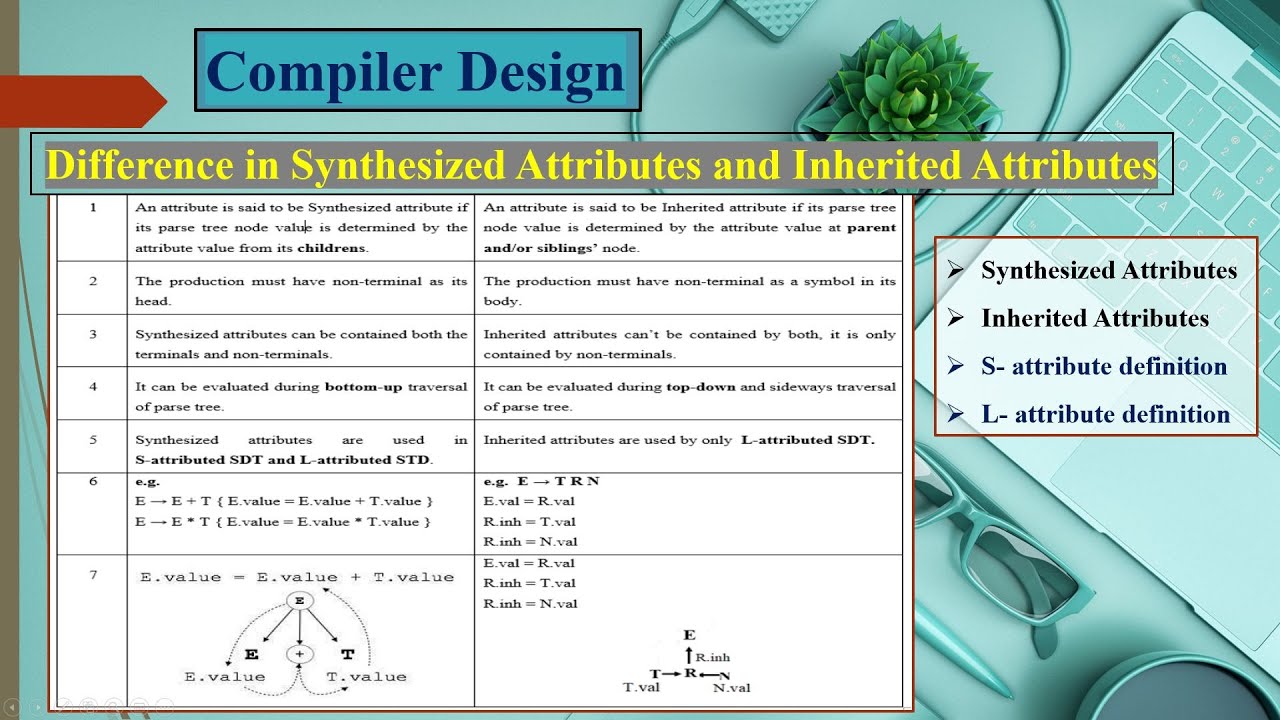
In this video, we explore the key differences between Synthesized Attributes and Inherited Attributes in Syntax-Directed Translation (SDT) and Attribute Grammar. We also discuss S-attributed and L-attributed definitions and how attributes are computed in parse trees.
🔹 What You’ll Learn:
✅ Introduction to Attribute Grammar
🔸 What are Synthesized Attributes & Inherited Attributes?
🔸 How do attributes help in syntax-directed translation (SDT)?
✅ Key Differences Between Synthesized & Inherited Attributes:
🔸 Synthesized Attributes:
Derived from children to parent nodes in the parse tree.
Computed during bottom-up traversal.
Used in S-attributed SDT & L-attributed SDT.
🔸 Inherited Attributes:
Derived from parent and sibling nodes.
Computed during top-down or sideways traversal.
Used in L-attributed SDT only.
✅ Step-by-Step Examples:
🔸 Synthesized Attribute Example:
E → E + T { E.value = E.value + T.value } E → E * T { E.value = E.value * T.value }
🔸 Inherited Attribute Example:
E → T R N E.val = R.val R.inh = E.val
✅ Parse Tree Representation:
🔸 Visualizing how attributes are passed in the tree.
🔸 Using attribute dependency graphs for evaluation order.
✅ Advantages of Using Attribute Grammar:
🔸 Synthesized Attributes are easier to compute in bottom-up parsing.
🔸 Inherited Attributes allow more flexible grammar definitions.
✅ Final Conclusion:
🔸 How S-attributed & L-attributed SDT impact Compiler Design.
🔸 Encouragement to watch upcoming videos on Syntax-Directed Translation & Intermediate Code Generation.
📌 This video is perfect for students learning Compiler Design, Attribute Grammar, and SDT Concepts.
📌 Like, Share & Subscribe for More Compiler Design Tutorials! 🚀
Повторяем попытку...
Доступные форматы для скачивания:
Скачать видео
-
Информация по загрузке:


