Viscous Fingering Revisited – General Criterium for Onset & Darcy Scale Wavelength (Steffen Berg)
Автор: PoreLab
Загружено: 2024-11-18
Просмотров: 211
Описание:
Title: Viscous Fingering Revisited – General Criterium for Onset & Darcy Scale Wavelength
Speaker: Dr. Steffen Berg
Affiliation: Shell Global Solutions International B.V. in the Netherlands
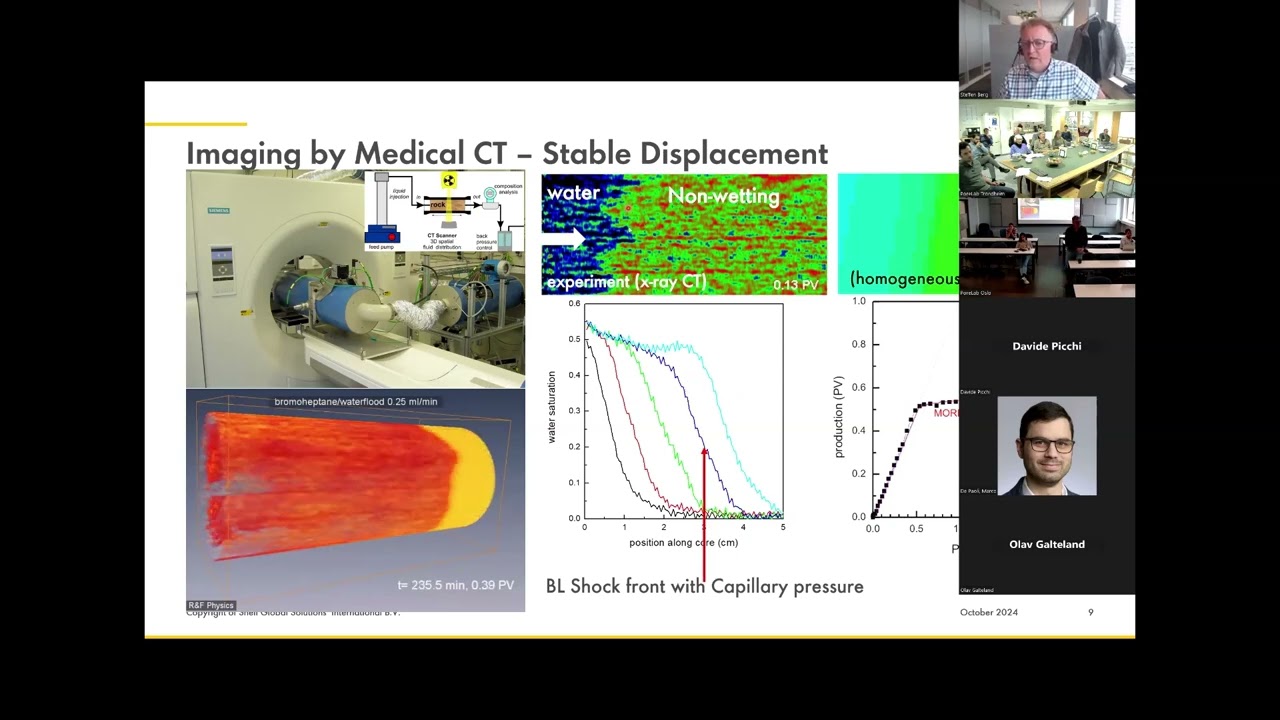
Abstract: Viscous fingering is a hydrodynamic instability occurring when a fluid with higher mobility (lower viscosity) displaces a fluid with lower mobility (higher viscosity), observed in flow in channels, between plates (Hele-Shaw cell) and in porous media. Since for typical CCS scenarios in deep saline aquifers the injected CO2 is supercritical with a viscosity about a factor 20 less than the displaced brine the question arises whether CCS could be viscous-unstable.
The fundamental difficulty with answering this question is that in the literature many different stability criteria are presented, which predict either stable or unstable displacement, depending on the choice of the criteria. The root cause of the issue is that the traditional criteria follow the concepts of the linear stability analysis by Saffman & Taylor for Hele-Shaw cells where saturation is either zero or one, while in a porous media saturation profiles exist due the fractional flow physics. Here we present a novel, general criteria that honors the saturation profiles in porous media. It is based on the simple argument that instability causes flow in a perturbation to accelerate. The novel criteria is general and contains all traditional criteria as limiting cases. According to the novel criteria, CCS could indeed be viscous-unstable, which is confirmed by numerical simulation.
Given a potentially unstable displacement the next question is what the associated finger wavelength would be. Knowledge of this wavelength would allow to select numerical grids for field scale simulation accordingly to resolve fingers. Numerical simulations reveal that the Saffman & Taylor based expressions are orders of magnitude too small and incorrect in scaling behavior with interfacial tension, velocity and permeability, which points to a much more conceptual issue. Instead of a capillary restoring force, the counter-acting mechanisms for Darcy-scale immiscible fingering is mobility blending in the capillary dispersion zone at the displacement front. This picture is consistent with the linear stability analysis by Yortsos & Hickernell and King & Dunayevsky, who point out that in porous media there is a short wavelength instability (typically pore scale) and a long-wavelength instability, which differ in scaling behavior. Only the latter is relevant for Darcy scale observations. Using numerical simulation we confirm the scaling relationships, the mobility blending mechanism in the capillary dispersion zone, and provide a few field-relevant examples as indication for typical finger wavelengths.
Повторяем попытку...
Доступные форматы для скачивания:
Скачать видео
-
Информация по загрузке:




![Пожалуй, главное заблуждение об электричестве [Veritasium]](https://image.4k-video.ru/id-video/6Hv2GLtnf2c)


![Лампа накаливания — возможно, лучшее изобретение [Veritasium]](https://image.4k-video.ru/id-video/JstcTHp-IKM)


