Why Did The PRR S2 TURBINE FAIL ACTUALLY?
Автор: Legendary Locomotives
Загружено: 2025-12-02
Просмотров: 7535
Описание:
Why Did The PRR S2 TURBINE FAIL ACTUALLY?
Subscribe: @legendarylocomotives
September 1944. Baldwin Locomotive Works was drowning. Steam locomotive sales had crashed from thirty percent to two percent between 1940 and 1948, and by 1949 there would be zero demand left. The company had already gone bankrupt in 1935, and their desperate gamble on the S1 and T1 duplex locomotives had failed catastrophically, costing both Baldwin and Pennsylvania Railroad massive losses at the worst possible time. They had one last shot to save steam power and the coal industry that depended on it.
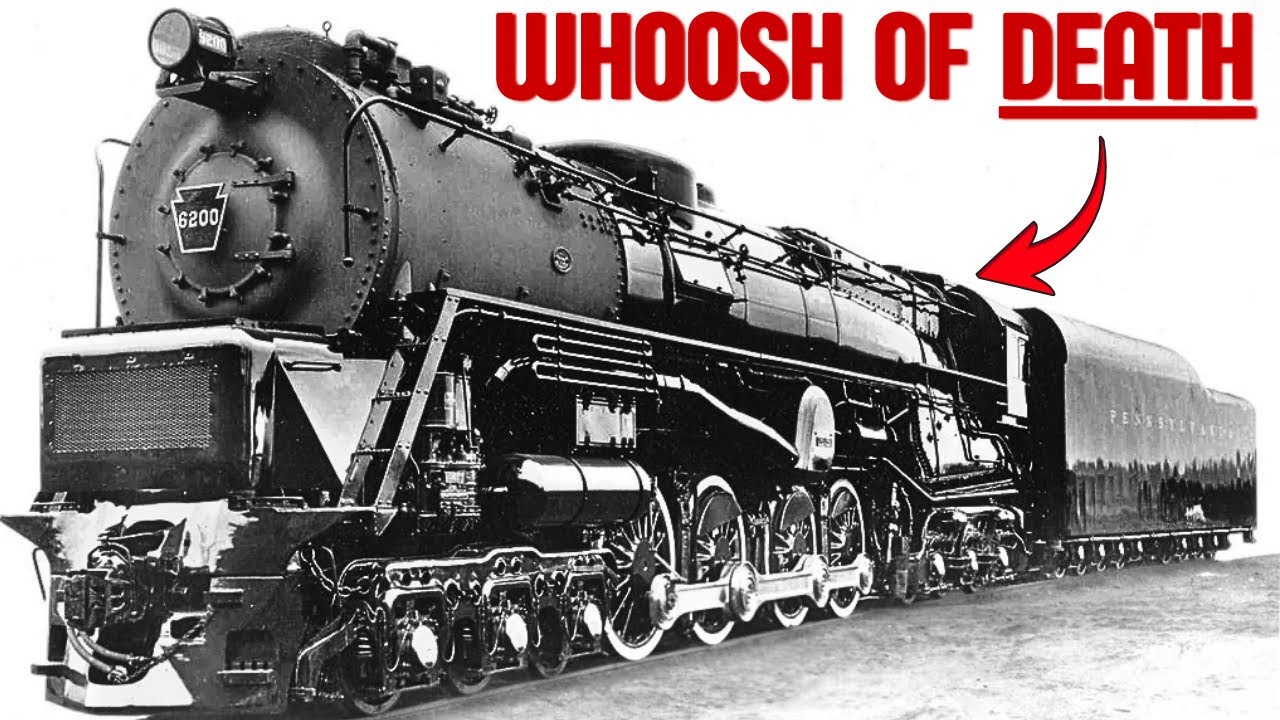
Baldwin and Westinghouse adapted Navy battleship turbine technology for the rails, creating number 6200, the only six eight six wheel arrangement ever built. This 500-ton beast stretched 122 feet long and made a science fiction "whoosh" sound instead of the traditional steam locomotive "chuff chuff" that everyone expected. The forward turbine spun at 9,000 rpm producing 6,900 horsepower with ninety-seven percent mechanical efficiency, which meant only three percent of energy got wasted in the drivetrain.
The S2 pulled Pennsylvania Railroad's most prestigious trains including The Broadway Limited on the Chicago to Crestline route. On March 30th, 1945 it hauled a seventeen-car passenger train at 110 miles per hour for thirty miles with engineer Flaya Cartwright and fireman M.E. Brown at the controls. British locomotive engineer E.S. Cox rode in the cab and reported the locomotive maintained over 100 mph for twelve consecutive minutes. Above forty miles per hour it could outpull a triple-unit EMD E7 diesel, and at seventy mph it hit peak efficiency where everything worked beautifully.
But below thirty miles per hour the S2 became a disaster. The turbine gulped steam faster than the boiler could generate it, and pressure dropped from 310 psi down to 85 psi. The firebox ran too hot and broke stay bolts. Pennsylvania Railroad had mated a conventional firetube boiler to this advanced turbine without any modifications to handle the massive steam demand, and that fatal design compromise killed the entire concept.
The S2 made its final public appearance at the July 1948 Chicago Railroad Fair where 2.5 million visitors saw it displayed with a T1 duplex. August 1949 brought severe turbine damage. The railroad stored it at Crestline and Altoona, officially retired it in 1952, and scrapped it in 1953 after running only 103,000 miles in five years.
Lionel Corporation's toy replicas sold better than the real locomotive ever performed. Baldwin's five experimental turbines all failed. Westinghouse had to buy twenty-one percent of Baldwin's stock in July 1948 just to keep the company alive. Baldwin merged with Lima-Hamilton in 1950 and stopped building locomotives completely by 1956.
Повторяем попытку...
Доступные форматы для скачивания:
Скачать видео
-
Информация по загрузке: