Clutches Explained | Types of Clutches & Working Principle | Theory of Machines
Автор: The CAD Engineer
Загружено: 2026-03-15
Просмотров: 9
Описание:
Join Telegram channel to download ppt:
https://t.me/TheCADEngineer
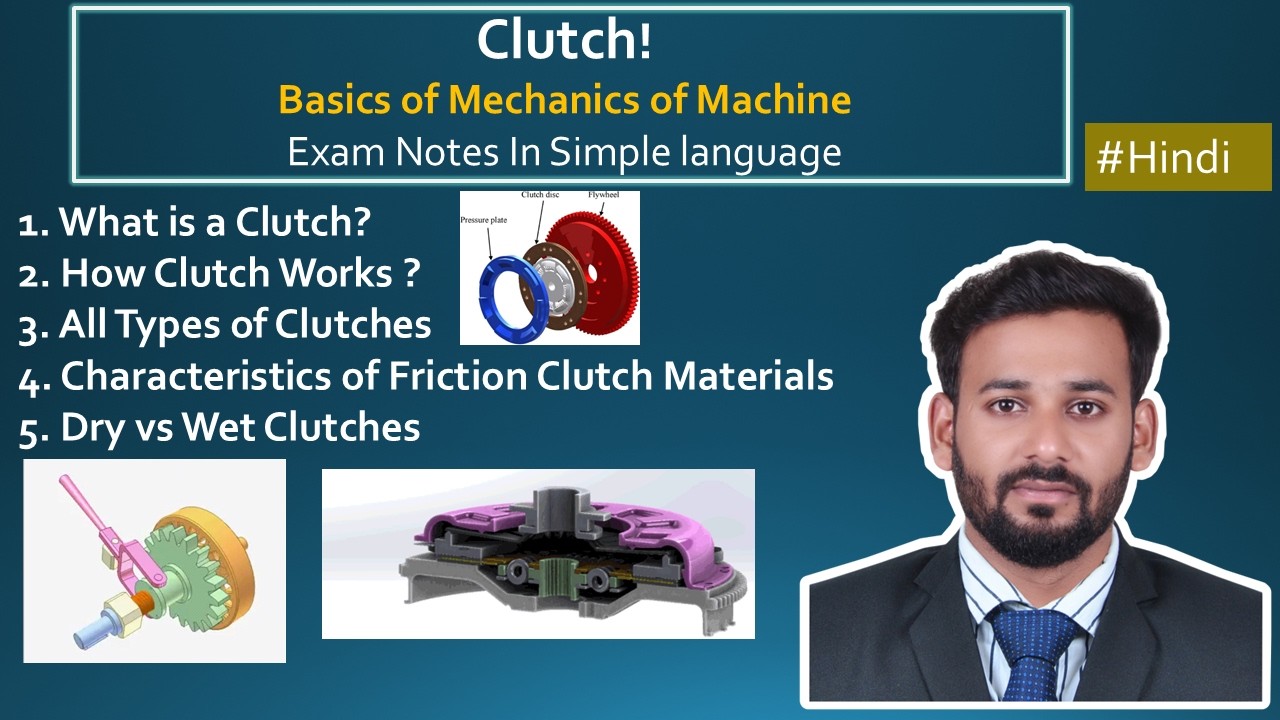
In this video, we will learn about Clutches, an important mechanical device used in power transmission systems. A clutch is used to connect and disconnect the driving shaft from the driven shaft, allowing machines to start, stop, or change speed smoothly without stopping the engine.
A clutch works on the principle of friction between two rotating surfaces. When the clutch is engaged, the driving shaft and driven shaft rotate together and power is transmitted. When the clutch is disengaged, the power transmission is interrupted, allowing the driven shaft to stop or rotate independently.
Clutches are widely used in automobiles, machine tools, industrial machinery, and power transmission systems. In vehicles, clutches help the driver change gears smoothly and control the motion of the vehicle.
In this video, you will clearly understand the working principle of clutches, their types, and applications in mechanical systems. The explanation is simple and useful for mechanical engineering students, diploma students, and beginners studying Theory of Machines.
⚙ Topics Covered in This Video
• Introduction to Clutches
• Working Principle of Clutches
• Types of Clutches
• Positive Clutches
• Friction Clutches
• Centrifugal Clutch
• Applications of Clutches
🔧 Types of Clutches
Clutches are mainly classified into two major categories depending on the method of power transmission.
1. Positive Clutches
Positive clutches transmit power through direct mechanical engagement without slip. In this type, projections or jaws on one part fit into corresponding recesses in the other part. Examples include square jaw clutch and spiral jaw clutch.
2. Friction Clutches
Friction clutches transmit power through frictional contact between rotating surfaces. These are widely used in automobiles because they allow smooth engagement and disengagement.
Some common types of friction clutches include:
Single Plate Clutch – Commonly used in cars.
Multi Plate Clutch – Used in motorcycles and racing vehicles where high torque transmission is required.
Cone Clutch – Uses conical surfaces to transmit power through friction.
Centrifugal Clutch – Automatically engages based on rotational speed.
🔩 Important Concepts in Clutches
When the clutch plates come into contact, frictional force is generated between the surfaces. This friction transmits torque from the driving shaft to the driven shaft.
The efficiency of a clutch depends on factors such as:
Coefficient of friction between the contact surfaces
Applied axial force
Radius of friction surface
Condition of clutch material
🚗 Applications of Clutches
Clutches are widely used in many machines and mechanical systems such as:
Automobiles and motorcycles
Machine tools
Industrial machinery
Power transmission systems
Agricultural equipment
Because clutches allow smooth power transmission and controlled motion, they are essential components in modern mechanical systems.
This video will help you clearly understand the concept and types of clutches, which is very useful for mechanical engineering students, diploma students, and competitive exam preparation like GATE, SSC JE, and RRB JE.
Повторяем попытку...
Доступные форматы для скачивания:
Скачать видео
-
Информация по загрузке: