70th BPSC Final Result low results from Hindi medium
Автор: Pragyesh IAS
Загружено: 2026-06-24
Просмотров: 5670
Описание:
📍 Connect with Pragyesh IAS:
🔹 Contact Number: +91-6287766077
🔹 WhatsApp पर जुड़ें: https://chat.whatsapp.com/GMl9bBe6mNK...
🔹 Telegram Channel: https://t.me/pragyeshIASMENTOR
🔹 Telegram Group: https://t.me/+e0k-QZKN3vxlYmJl
🔹 Instagram: / pragyeshias
After the 70th BPSC Final Result, one major question is being raised: did Hindi-medium students perform unexpectedly poorly this time? If yes, was it simply a matter of candidate performance, or were there technical and procedural factors within the evaluation system that may have affected Hindi-medium candidates more?
In this video, we examine the issue from a factual, legal, and procedural perspective—not emotionally, and not as an allegation against any individual examiner, board, or institution. The core question is simple: when candidates are allowed to write the exam in both Hindi and English, does the evaluation system ensure real equality between both mediums?
At the outset, it is important to clarify that there is currently no publicly available official medium-wise data showing how many Hindi-medium candidates appeared in the Mains, how many reached the Interview stage, and how many were finally selected. Therefore, it would not be legally correct to claim that discrimination has been proved. However, considering the visible contrast between the 69th and 70th BPSC result patterns, it is absolutely necessary to ask serious questions about evaluation fairness.
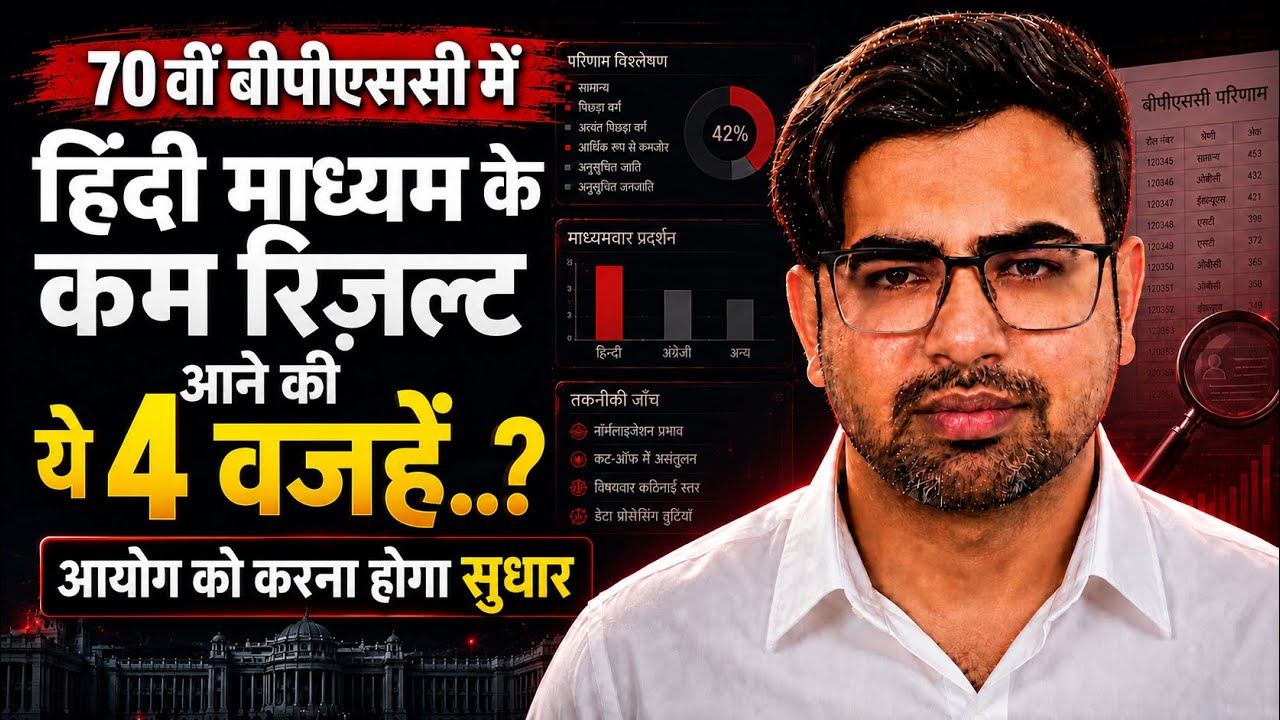
This video discusses four major technical and structural issues.
The first issue is the method of Mains copy evaluation. The video explains that evaluation may be done question-wise, meaning different questions from the same answer-book may be checked by different examiners. The problem arises if answer scripts are not separated by language, and the same examiner evaluates both Hindi and English answers. In such a system, the assumption is that the examiner is equally competent in evaluating both languages. But merely understanding a language and properly assessing the analytical quality of a civil-services-level answer written in that language are two different things.
The second issue is the absence of moderation and language-wise audit. Different examiners have different marking styles—some may be strict, some liberal, some presentation-oriented, and some content-oriented. If Hindi and English medium answers are evaluated in a mixed manner, it becomes important to examine whether both mediums received the same marking standard. The video asks whether any paper-wise or question-wise language audit was conducted to compare marks awarded to Hindi and English medium candidates. Without such an audit, how can language-neutral evaluation be demonstrated?
The third issue is the possible change in Essay marks. In the 69th BPSC cycle, there was significant discussion that Hindi-medium candidates scored well in the Essay paper. Essay evaluation depends heavily on language, expression, originality, flow, and depth of thought. But in the 70th BPSC, it is reported that awarding more than 180 marks was treated as exceptional and required special scrutiny or chief examiner approval. The practical effect of such a guideline may be that examiners became naturally cautious while awarding high marks, leading to compression in the high-score zone. If Hindi-medium candidates had earlier benefited from strong Essay scores, that advantage may have reduced this time.
The fourth issue is the Interview process. The presence of external experts or senior officers on interview boards is not wrong; in fact, it can improve the quality of interviews. But the question is whether a candidate answering in Hindi receives the same level of appreciation for administrative expression, conceptual clarity, and communication as a candidate answering in English.
00:00 — 70th BPSC Result and the big question around Hindi medium
02:05 — How Mains copy evaluation works: question-wise checking and mixed scripts
05:42 — Why moderation and language-wise audit matter
08:49 — Essay marks: 69th vs 70th BPSC
11:12 — Interview boards, language comfort, and Hindi expression
14:17 — Telangana Group-I case: what the court said and what we can learn
16:07 — What data should be demanded from BPSC?
18:54 — Final conclusion: not special treatment, but language-neutral evaluation
Key questions raised in this video:
Did Hindi-medium representation actually decline in the 70th BPSC?
Were answer scripts segregated by language?
Was the same examiner evaluating both Hindi and English scripts?
Was bilingual evaluation competence verified?
Was any language-wise moderation or audit conducted?
Did the 180+ Essay guideline compress high scoring?
Could interview language comfort have affected marks?
Will BPSC release medium-wise data?
This video is for students, teachers, legal observers, and civil services aspirants who want to understand the BPSC evaluation process in depth.
Повторяем попытку...
Доступные форматы для скачивания:
Скачать видео
-
Информация по загрузке: