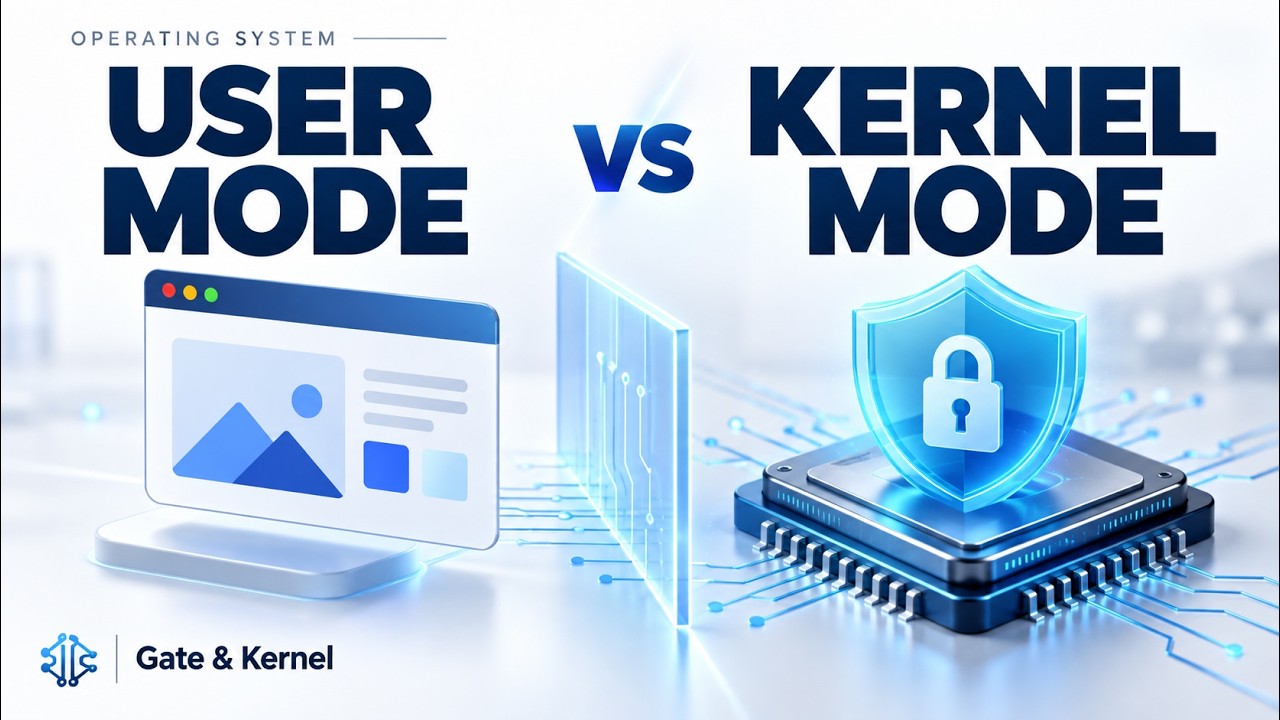
User Mode vs Kernel Mode Explained — Who Controls Your Operating System?
Автор: Gate & Kernel
Загружено: 2026-09-11
Просмотров: 418
Описание:
What stops an ordinary application from taking control of your entire computer? The answer starts with user mode, kernel mode, and the boundary enforced by your operating system and CPU.
In this 12-minute tutorial, we explain user mode vs kernel mode step by step—from CPU privileges and memory protection to system calls, interrupts, and context switching.
Follow a text editor as it opens and reads a file, and discover how an application requests kernel services without gaining unrestricted access to hardware.
You’ll learn:
• What user mode and kernel mode mean
• Why operating systems separate application and kernel privileges
• How page tables and the memory management unit (MMU) enforce memory protection
• How system calls transfer execution into the kernel
• How interrupts and exceptions differ from system calls
• Why a mode switch does not necessarily cause a context switch
• Why running as root or administrator does not put application code in kernel mode
• How RISC-V User, Supervisor, and Machine modes fit into the picture
New technical terms are explained as we go, with practical examples connecting software to processor behavior.
Gate & Kernel explores how computers work—from digital logic and CPUs to programming and operating systems. Subscribe to follow the operating systems series.
Next: How a system call carries a request into the kernel and brings the result back.
#UserMode #KernelMode #OperatingSystem #SystemCalls #MemoryProtection #ContextSwitching #Linux #RISCV #ComputerScience #GateAndKernel
00:00 How Your Operating System Keeps Apps Under Control
00:47 What Does CPU Mode Mean?
01:35 Why Different Privileges Matter
02:22 What Programs Can Do in User Mode
03:23 What the Kernel Can Do in Kernel Mode
04:17 How Hardware Enforces Memory Protection
05:18 How System Calls Request Kernel Services
06:20 Example: Opening and Reading a File
07:36 Interrupts, Exceptions, and Kernel Entry
08:34 Mode Switch vs Context Switch
09:25 Why Administrator Access Is Not Kernel Mode
10:13 RISC-V Privilege Levels: U, S, and M Modes
11:11 Conclusion and What Comes Next
Повторяем попытку...
Доступные форматы для скачивания:
Скачать видео
-
Информация по загрузке: