Dr. Andreas Maier- Preference or abundance
Автор: Archaeology TAU
Загружено: 2018-06-04
Просмотров: 130
Описание:
Lecturer : Dr. Andreas Maier from the Institut für Ur - und Frühgeschichte, University of Erlangen - Nuremberg
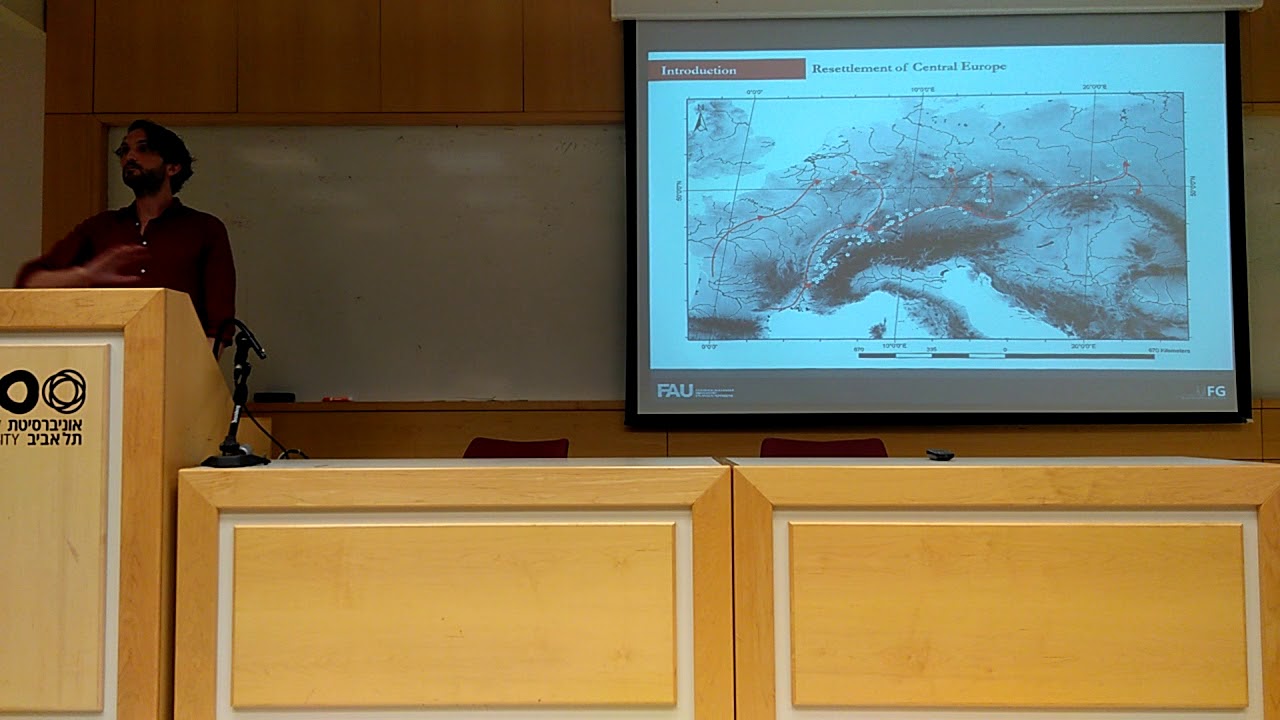
During the period of the Magdalenian (ca. 20,000 – 14,000 calBP) the habitable part of Central Europe was divided into three different vegetation zones. In the southwestern part, a herb- dominated steppe-tundra prevailed, whereas the northwestern part was characterized by a dryer and grass-dominated tundra-steppe. Both biomes, however, were virtually treeless. In the eastern part, in contrast, palynological analyses indicate the sporadic presence of trees in scattered stands
also during the colder period of the Oldest Dryas (ca. 17.000 – 14,700 calBP).
Given that horses feed predominantly on grasses whereas reindeer were probably better adapted to the steppe-tundra environment, the latter thus probably had competitive advantages in the southwestern part of Central Europe, while the former were probably more abundant in eastern Central European and the tundra-steppe environments of the northwest. If hunting preferences were the main factor for the composition of the faunal assemblages, this inferred background distribution of abundances should – if at all – only play a marginal role in the composition of the faunal assemblages of Magdalenian sites. However, the archaeological observations show a clear spatial trend with a predominance of reindeer in the southwestern part of Central Europe shifting
gradually to horse-dominated assemblages in the northwestern and eastern part.Other species likewise show identifiable trends in their spatial distribution. Saiga bones, for instance, only
occur north of the Saône-Danube-Vistula line, and woolly rhinoceros remains are predominantly reported in eastern Central Europe.These observations suggest that the proportion of species among Late Upper Paleolithic hunting remains reflects mainly the abundances of these animals
in the vicinity of a site, rather than hunting preferences.
A conspicuous match between the spatial distribution of faunal remains and the number of representations of a certain animal class, such as horse, reindeer, woolly rhinoceros, or musk ox
can likewise be observed in the archaeological record. Whereas representations of cervids are most numerous in the southwestern part of the investigated area, images of horses prevail in the northwestern and eastern part. Thus, it seems that those animals which were preferentially hunted and hence presumably more common in the environment also served as inspiration for representations more often than did less common ones.
Повторяем попытку...
Доступные форматы для скачивания:
Скачать видео
-
Информация по загрузке: