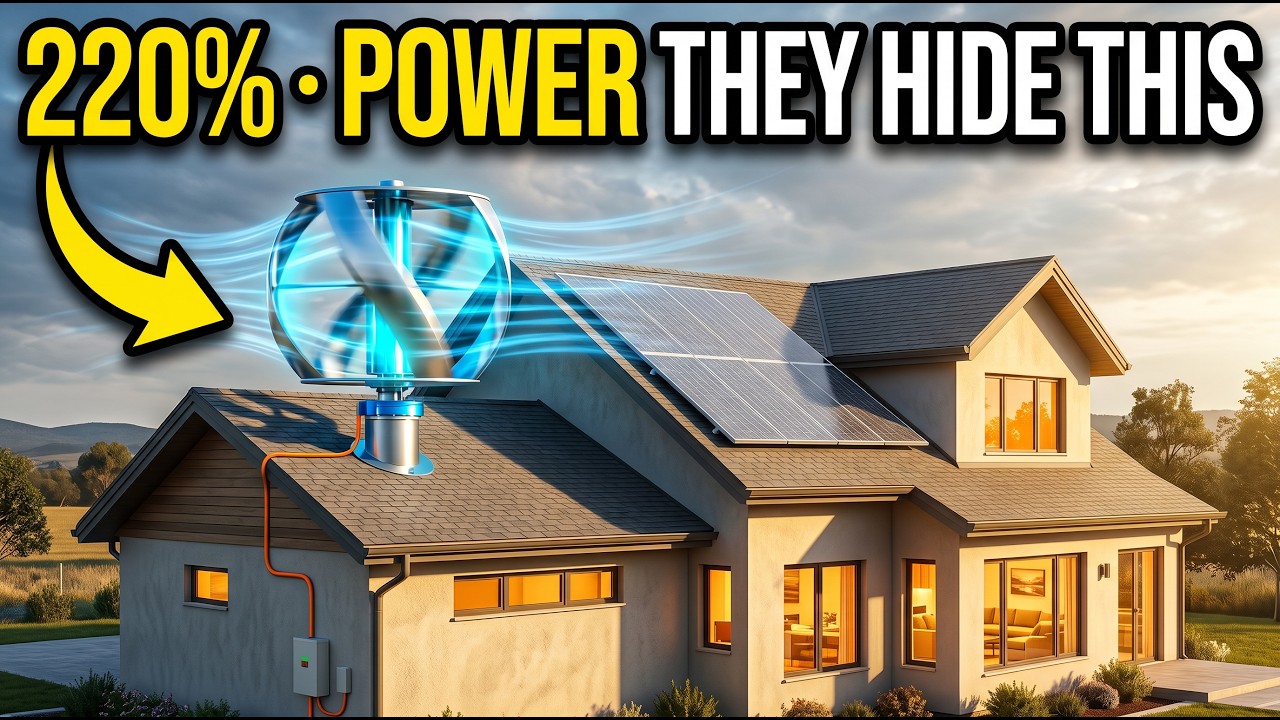
This $80 Roof Turbine Makes 220% More Power Than Any Solar Panel. Why Is the Energy Industry Silent?
Автор: Builds With Eli Yoder
Загружено: 2026-06-11
Просмотров: 7538
Описание:
� The Energy Trap — Full Off-Grid Manual:
https://energy-trap-vol1.netlify.app
The same roof turbine technology that powered Welsh farmhouses in 1957 still works today, costs under a hundred dollars to build, and outperforms residential solar panels in most American climates. So why has almost nobody heard of it, and why do energy companies keep pretending it doesn't exist?
In 1957, a Welsh roofer bolted a hand-bent piece of sheet metal to a farmhouse ridge and powered two light bulbs in eleven-mile-per-hour winds. That design vanished from public record for fifty years while the residential energy industry convinced homeowners that rooftop solar was their only option. But the physics never changed. Wind accelerates as it travels up a pitched roof, reaching speeds thirty to eighty percent faster than ground level by the time it crests the ridge. That acceleration, documented in studies by the National Renewable Energy Laboratory and the Building Research Establishment, translates to a massive increase in available power. A standard ridge-mounted turbine occupying twenty linear feet of roof produces between three and a half to five kilowatt-hours per day in average wind conditions. A solar panel covering the same space produces about one point six kilowatt-hours. The difference is not marginal. It is more than double, sometimes triple, and it comes from the single most wind-rich square foot of real estate most homeowners own but never use.
The Amish never forgot this. Drive through Holmes County, Ohio, or Lancaster County, Pennsylvania, and you will see low-profile turbines running along barn and house ridges. These are not expensive commercial units. They are hand-fabricated devices built from salvaged materials, some of which have been spinning continuously for over thirty years with minimal maintenance. One bishop reported total upkeep costs of less than two hundred dollars across three decades. Compare that to residential solar systems, which the Department of Energy reports have a median replacement window of nineteen years and inverter failures costing thousands of dollars within the first decade. A working ridge turbine can be built from hardware store materials and a salvaged car alternator for under a hundred dollars. The frame is conduit or two-by-fours. The blades are cut from six-inch PVC pipe. The generator is a junkyard alternator. Installation takes about six hours with no prior experience. It works in ninety-two percent of the continental United States, requires almost no maintenance, and produces usable electricity in winds as low as four miles per hour.
So why has the residential renewable industry spent two decades burying this technology? Because nobody profits from selling you a hundred-dollar device when they can sell a twenty-five-thousand-dollar solar array with federal tax credits attached. Ridge turbines threaten a business model built on complexity, permits, and installer fees. The result is that most American homeowners believe their only option is a south-facing panel system, while the most energy-rich part of their property spins uselessly in the breeze. The technology works. The math is public. The materials are cheap. And the only thing stopping you from building one is the silence of an industry that benefits from keeping you dependent on expensive systems you do not need.
Повторяем попытку...
Доступные форматы для скачивания:
Скачать видео
-
Информация по загрузке: