Pac-Man 99 - Apr 12 21 B (The Legend of Valkyrie, Xevious, Baraduke, Toy Pop, The Return of Ishtar)
Автор: Overhazard
Загружено: 2021-04-14
Просмотров: 983
Описание:
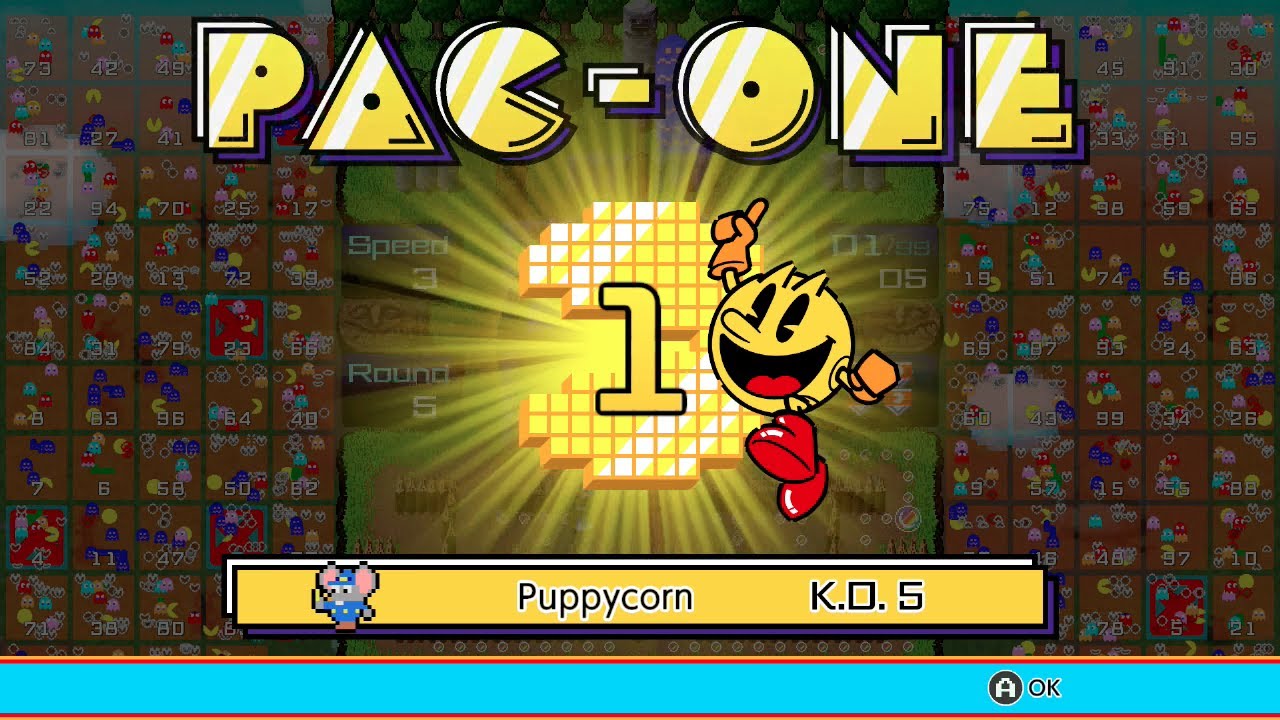
There were 5 more DLC skins I hadn't yet shown, so I might as well cram them into one video. I think people are starting to lose patience here, so I think this was the best decision for the time. After this, I'll show a bit of Puyo Puyo Tetris 2, if any of you miss that. (Online matches, for the record.)
The previous video had players getting more aggressive, flooding the mazes with red Jammer Pac-Men later on but also filling them fairly early on too. The other key here is survivability--these were some of the longest matches I had playing Pac-Man 99 up to this point, probably because I started to encounter players really good at keeping themselves away from both Ghosts and Power Pellets. It can be easy to spot: If only a few players are left but hardly any Jammer Pac-Men spawn, you're fighting such a player.
Match #1
Skin: The Legend of "Valkyrie"
Like any medium, a successful example will soon have many imitators, some more obvious than others. It doesn't get much more obvious than The Legend of Valkyrie, Namco's take on The Legend of Zelda. It's about a valkyrie named Valkyrie (well, a demigoddess, technically) who descends from the heavens to settle a war on the ground over usage of the Golden Seed, which could be grown into a tree that would grant its owner the power to take over the world. Down in the mortal realm, she gains new weapons, explores dungeons, fights bosses, and buys and sells equipment and supplies. You can see the adventure game look right from this skin's appearance, and the Bonus Fruit reflect her powerups in a shield, a sword, a book of spells, and an armored dress.
Match #2
Skin: Xevious
Probably the most famous of the games with skins featured here, at least in the western world (and no doubt due to Atari heavily promoting it back in the day), Xevious is a top-down vertical shooter following the ship Solvalou, which has blasters to fight aerial enemies and bombs dropped down to fight terrestrial and naval enemies. Every now and then, a mothership appears, which would be one of the earliest instances in video gaming of an end-of-stage boss. (Xevious came out in 1983, preceding Mario Bros., though not Pac-Man or Donkey Kong.) If the Solvalou's attacks sound a lot like Amul's, that's because Dragon Spirit is a fantasy-themed sequel to the science fiction Xevious.
Match #3
Skin: Baraduke
Toby Masuno is a space marine, from the 8-bit era of video games, who explores lonely, desolate locations with vast labyrinthine structures both aboveground and underground, and uses an arm cannon to fight the hostile creates and machines within. Sounds a lot like Metroid, does it not? How about if I add in the fact that clearing the game reveals Toby is a woman? Unlike Valkyrie, which was clearly made to cash in on the success of a Nintendo franchise, Baraduke actually beat Metroid to release by a year, which means their similarities were most certainly a coincidence--or that Gunpei Yokoi was inspired by Baraduke. And yet this one's a lot more obscure... (Doesn't have the Metroidvania kind of progression, however.)
Match #4
Skin: Toy Pop
Toy Pop was a multidirectional shooter, and yes, you play as Pinocchio in it. Though technically, he goes by "Pino." (I am pretty sure the original novel had reached the public domain by that time.) Co-op play was available, and Player 2 played as Acha, a doll with blue hair. And also shoots things. Gameplay consists of opening presents found around the stage to get stat boosts and weapons; most enemies can only be defeated with a particular weapon. Each stage has four golden hearts, some of which are hidden, and collecting all of them clears the stage. The premise is that Pino and Acha are ascending a tower to free their land from the evil wizard Mahou. (That's about it.) Me, I find it amusing that one of the enemies chosen for this skin is a cymbal-clashing monkey.
Match #5
Skin: The Return of Ishtar
The Return of Ishtar is a sequel to The Tower of Druaga. Like in the first game, you explore one dungeon after another, searching for tools needed to clear them. Since I didn't get the chance to speak of Druaga much due to me explaining the rules of Pac-Man 99, that game, and Ishtar with it, would hide those tools in rather obscure ways, difficult to impossible to actually find if you didn't know about it in advance. This could include checking a featureless tile to defeating all of the enemies in a room in a particular order. In Japan, this led to arcade-goers sharing notes by attaching notebooks to Druaga and Ishtar machines and led to close-knit communities. No such thing anywhere else. The Return of Ishtar picks up immediately where Druaga left off: Gilgamesh and Ki reached the top of the tower and defeated Druaga, and now they have to come back down and fight through the remaining enemies who want revenge. As Gilgamesh was the player character and icon in the Druaga skin, Ki takes that honor for the Ishtar skin.
Повторяем попытку...
Доступные форматы для скачивания:
Скачать видео
-
Информация по загрузке:

![Game Boy Longplay [092] Hugo 2](https://image.4k-video.ru/id-video/YWmxTqI6UJE)


![Sonic & Sega All-Stars Racing (Wii) All-Stars Moves [HD Texture Pack]](https://image.4k-video.ru/id-video/6eTLPIVeVKE)




![Namco Museum Long-play Xbox [Played on Xbox 360]](https://image.4k-video.ru/id-video/vm9x6yZ4bWE)

