Passages 1: Unit 1 (Lesson B): Every family is different.
Автор: Teacher Martinez
Загружено: 2024-10-27
Просмотров: 1396
Описание:
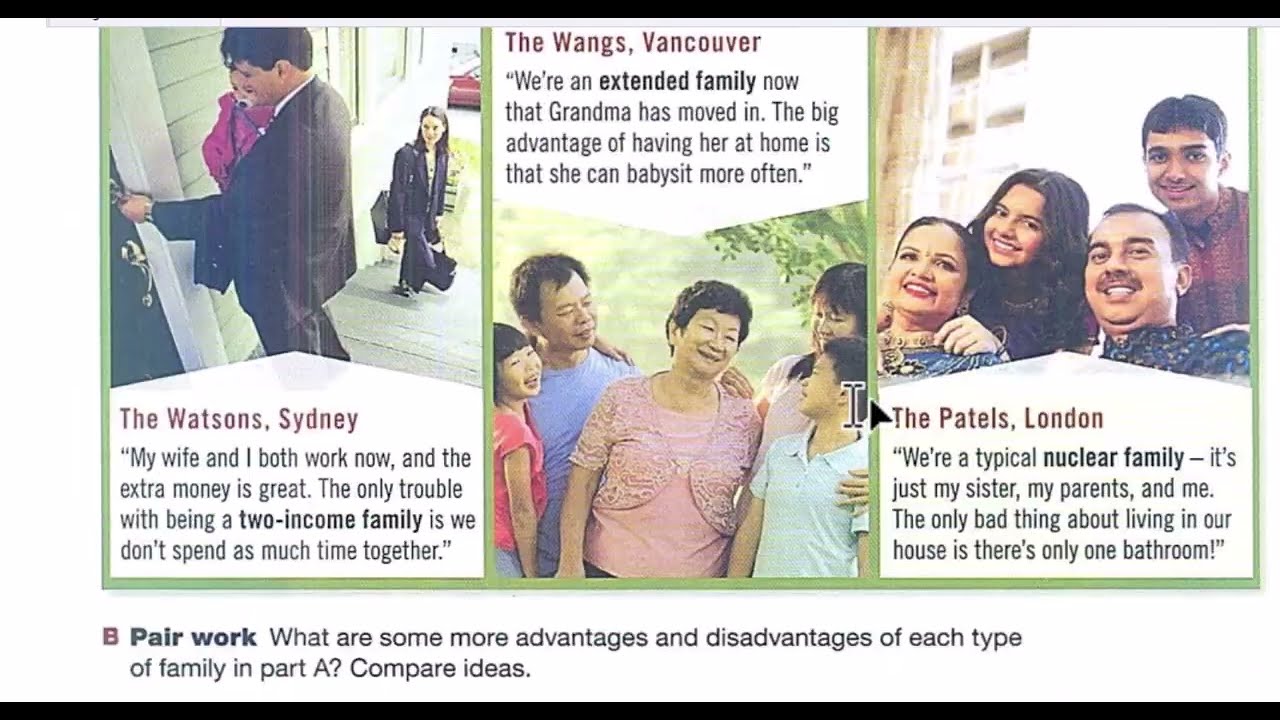
In this video, we'll learn about different types of families and how they use language to describe their relationships. We'll also focus on grammar, specifically noun clauses and prepositions followed by gerunds.
Grammar Focus:
Noun clauses: A noun clause is a part of a sentence that functions as a noun. It has its own subject and verb. For example:
"What Paul said is that he is happy."
"The thing that I like best about my family is that they are always there for me."
"I don't know who is coming to the party."
Noun clauses are often used after the verb "be." They can also be used as the subject of a sentence, as the object of a verb, or as the object of a preposition.
Prepositions followed by gerunds: A gerund is a verb form that ends in "-ing" and is used as a noun. Gerunds are often used after prepositions. For example:
"I'm looking forward to seeing my family."
"He is interested in learning English."
"She is afraid of making mistakes."
Vocabulary Focus:
Compound family terms:
Grandparents
Parents
Children
Siblings
Cousins
Uncles
Aunts
Nephews
Nieces
Family reunion: A gathering of family members to celebrate a special occasion.
Listening Activity:
Listen to Victor tell a friend about his family reunion. What were they celebrating at the reunion?
Vocabulary Plus:
See page 130a4 for a list of additional family terms.
Additional Activities:
Create a family tree: Draw a family tree to represent your own family or the family of a friend.
Write a story about your family: Write a short story about your family, using some of the vocabulary and grammar that you learned in this video.
Interview a family member: Interview a family member about their childhood memories and experiences.
Thank you for watching!
Повторяем попытку...
Доступные форматы для скачивания:
Скачать видео
-
Информация по загрузке: