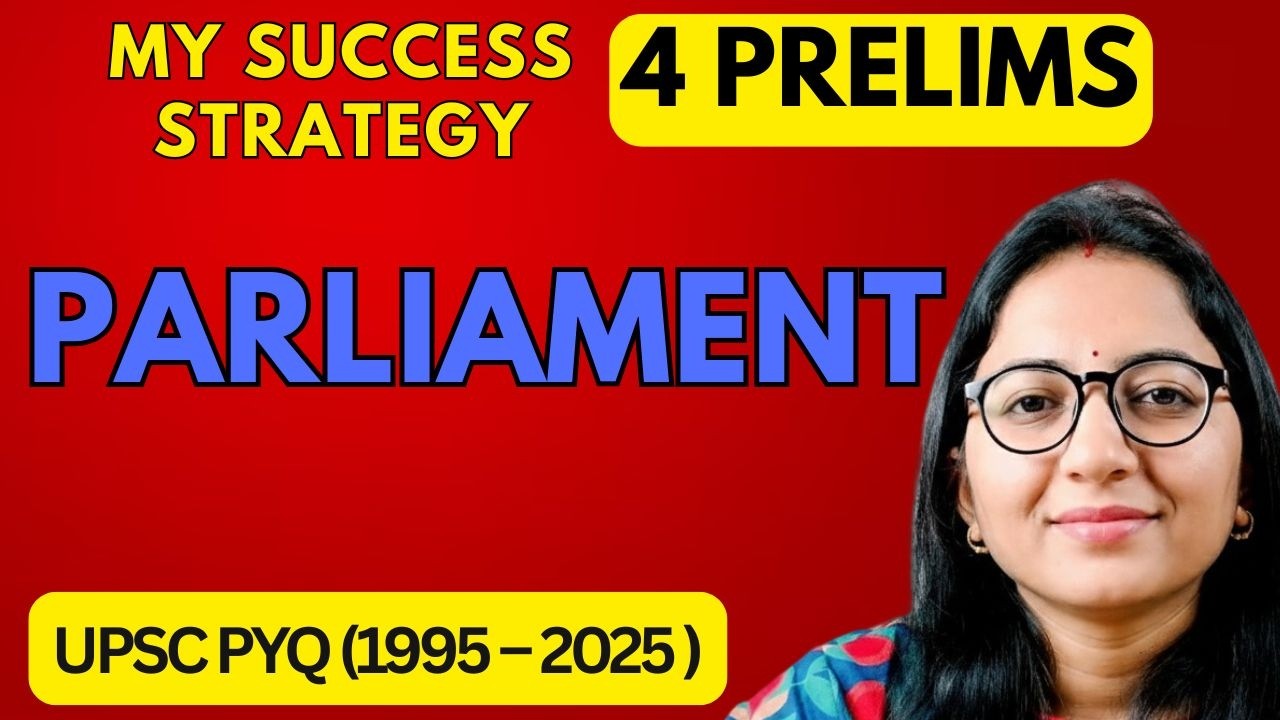
Parliamentary Committees | UPSC Polity PYQ Analysis (1995–2025) EP-11.1
Автор: Prita Gaurav Singh
Загружено: 2026-02-24
Просмотров: 24
Описание:
Parliamentary Committees exam ke liye jitni important hain, students ke liye utni hi confusing. Most aspirants get these wrong in Prelims — especially PAC, Estimates, DRSCs and Ethics Committee.
In this episode of the PYQ Decoding Series (1995–2025), we decode Parliamentary Committees using the same personal notes that helped me clear 4 UPSC Prelims.
What we cover in this episode:
• 4 Core Features: What exactly defines a Parliamentary Committee, and how it differs from a Consultative Committee.
• Financial Committees: PAC, Estimates Committee and Committee on Public Undertakings – composition, functions, and why the Estimates Committee is called the “Continuous Economy Committee”.
• DRSCs (Departmentally Related Standing Committees): Why they examine Demands for Grants before voting, how they work, and how they differ from the Estimates Committee.
• Ethics & Privileges Committees: Real-world cases like the “Cash for Query” scandal to understand the role of the Ethics Committee and privileges of MPs.
• PYQ Decoding (1995–2025): We solve actual UPSC Polity PYQs to see how questions are framed on membership rules, powers and purpose of different
Parliamentary Committees.
If you are a serious aspirant appearing for the upcoming UPSC CSE Prelims, don’t miss this focused, intellectually rigorous “Real Talk” session on one of the most high yield areas of Indian Polity.
⏰ Timestamps:
00:00 Introduction: Importance for Prelims & My Clearing Secret
01:00 What defines a Parliamentary Committee? (4 Key Features)
02:11 Why Consultative Committees are NOT Parliamentary Committees
02:32 Can Committees call for outside Experts?
02:59 The Concept of "Mini Parliament" & Delegation
04:09 Addressing Lack of Time, Expertise, and Privacy
04:59 Constitutional Recognition (Art. 105 & 118)
05:17 Types of Committees: Standing vs. Ad Hoc
06:31 Are Committee Recommendations Binding?
06:45 Can Ministers be Members? (The Golden Rule)
08:01 When are Ministers allowed to join Committees?
09:11 The Big Three: Financial Committees Overview
09:32 Public Accounts Committee (PAC) & CAG Reports
10:04 Estimates Committee: Purpose & Scope
10:26 Committee on Public Undertakings (COPU)
10:40 Membership Breakdown: Lok Sabha vs. Rajya Sabha
11:03 Appointment of Chairmen & Conventions
11:46 Origins: Pre-Independence vs. Post-Independence
12:15 Common Rules for Financial Committees
12:44 Miscellaneous Points: Friend, Philosopher & Guide
13:28 PYQ Analysis: Financial Committee Composition (2003)
14:43 PYQ Analysis: Ministry of Parliamentary Affairs Role
15:40 PYQ Analysis: PAC Chairmanship & Membership (2007)
16:42 PYQ Analysis: PAC Scope & CAG Reports (2013)
17:47 PYQ Analysis: Largest Committee of Parliament (2014)
More from the PYQ Decoding Series:
Watch the full playlist for 30 years of UPSC Polity PYQs decoded topic wise: Parliament, Fundamental Rights, DPSPs, Federalism and more.
For doubts / follow up topics:
Comment your questions on Parliamentary Committees (PAC, DRSCs, Ethics, Privileges etc.) and I’ll try to take them up in future PYQ sessions.
🔗 Connect with me: Subscribe for real talk on UPSC strategy and growth: / @pritagauravsingh Join my Telegram Channel: t.me/upscessentialsofficial
#upscprelims2026
#upscprelims #upscpolity #ParliamentaryCommittees #indianparliament #iasprelims #upsccse #upscpyq #laxmikanth #politypyq #PYQDecodingSeries #upscprelims2026
#parliamentarycommittees
#politypyq
#upsccse
#upscpreparation
Повторяем попытку...

Доступные форматы для скачивания:
Скачать видео
-
Информация по загрузке: