Waimangu Volcanic Valley, New Zealand
Автор: 8 FIFTY Productions L.L.C.
Загружено: 2017-01-04
Просмотров: 6097
Описание:
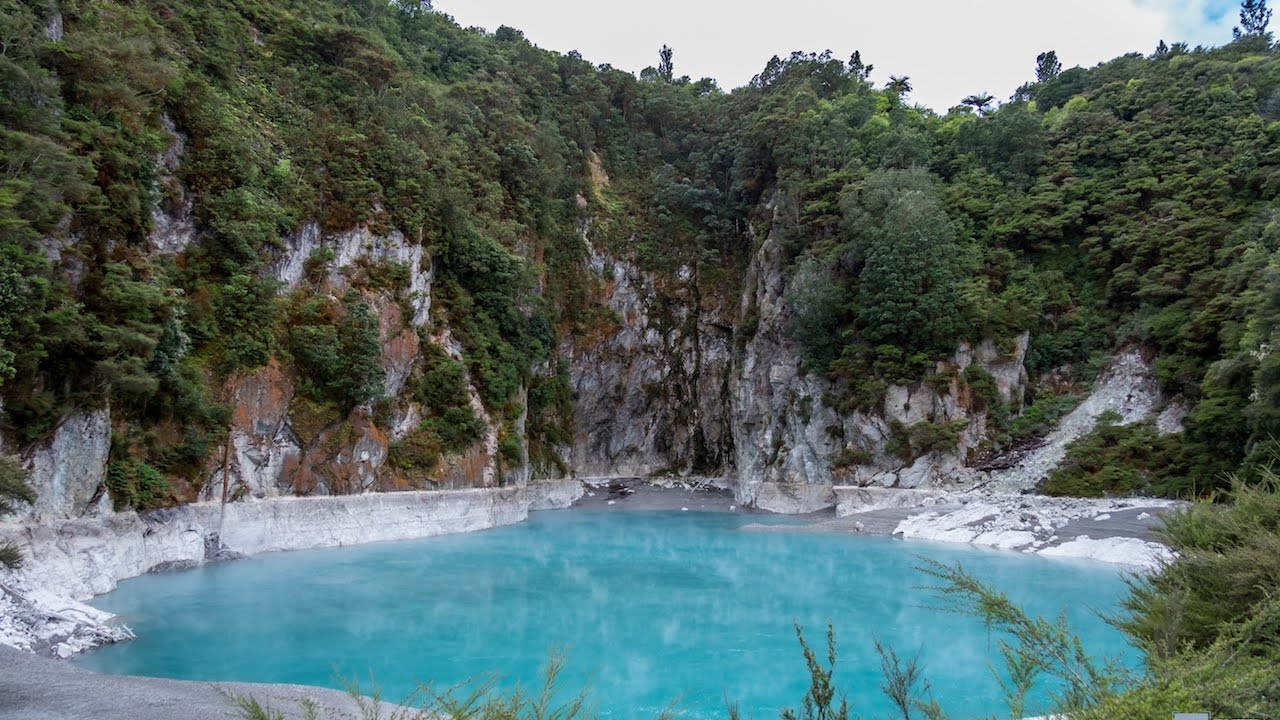
Waimangu Volcanic Rift Valley is the hydrothermal system created on 10 June 1886 by the volcanic eruption of Mount Tarawera, on the North Island of New Zealand. It encompasses Lake Rotomahana, the former site of the Pink and White Terraces, as well as the location of the Waimangu Geyser, which was active from 1900 to 1904. The area has been increasingly accessible as a tourist attraction and contains Frying Pan Lake, which is the largest hot spring in the world, and the steaming and usually pale blue Inferno Crater Lake, the largest geyser-like feature in the world although the geyser itself cannot be seen since it plays at the bottom of the lake.
Waimangu means 'black water' in Māori, the indigenous language of New Zealand. This name comes from the water that was thrown up by the Waimangu Geyser, which was black with mud and rocks.
As a rare eco-system completely naturally re-established following a volcanic eruption, Waimangu is protected as a Scenic Reserve, administered by the Department of Conservation NZ. The developing local native forest is the only current New Zealand instance of vegetation re-establishing from complete devastation without any human influence such as planting. Many of Waimangu's geothermal features are ranked as Category A - extremely important, of international significance.
The largest volcanic eruption in the past 700 years in New Zealand, the 1886 Mount Tarawera eruption, created the geo-thermal area of the Waimangu Volcanic Rift Valley. The valley lies at the south-western end of the 17-kilometre (11 mi) rift created in this one-day eruption. All vegetation in the Waimangu Valley was completely destroyed by the eruption and the area was covered in mud and volcanic ash on average 20 metres (66 ft) thick.
Over the decade following the Mount Tarawera eruption, hydrothermal surface activity and geothermal features permanently established themselves in the Waimangu Valley, even though no such activity had been reported there before 1886. Plant life slowly re-established itself around the turn of the century as the new soil began to settle and stabilise. -Wiki
Contact - [email protected]
Like - Facebook.com/8FiftyProductions
Follow - Instagram @8FiftyProductions
Повторяем попытку...
Доступные форматы для скачивания:
Скачать видео
-
Информация по загрузке: