Types of Confirmations
Автор: Rutgers Accounting Web
Загружено: 2015-07-16
Просмотров: 3272
Описание:
Introduction to the principles and concepts of the audit as an attestation service offered by the accounting profession. Primary emphasis is placed on Generally Accepted Auditing Standards, the role of the CPA/auditor in evidence collection, analytical review procedures and reporting, the CPA/auditor's ethical and legal responsibilities, the role of the Securities and Exchange Commission as well as other constituencies. Audit testing, including statistical sampling, internal control issues, and audit programs are discussed. --
Description:
Auditors must design and perform analytical procedures (including year-to-year comparisons of sales, accounts receivable, allowance for doubtful accounts, bad debts, etc, and ratio analysis). Auditors must also design tests of details of balances (confirming that recorded accounts receivables exist, included, accurate, properly classified, correctness of cutoff, stated at realizable value, the client has rights to it, and it is accurately presented and disclosed).
Substantive analytical procedures include ratios used for comparative purposes, which include receivables turnover and days outstanding in accounts receivable, aging categories on aged trial balance of accounts receivable, bad debts expense as a percent of revenue, allowance for uncollectible accounts as a percent of accounts receivable or credit sales, and large account balances compared to last period.
Confirmation is the process of obtaining information from third parties about the account receivable balance. Confirmation is a good source of evidence about the existence of the account receivable. The confirmation process should be controlled by the auditor.
Auditing standards require accounts receivable confirmation unless accounts receivable are immaterial, the auditor considers confirmations ineffective evidence because response rates will likely be inadequate or unreliable, and the combined level of inherent risk and control risk is low and other substantive evidence can be accumulated to provide sufficient evidence.
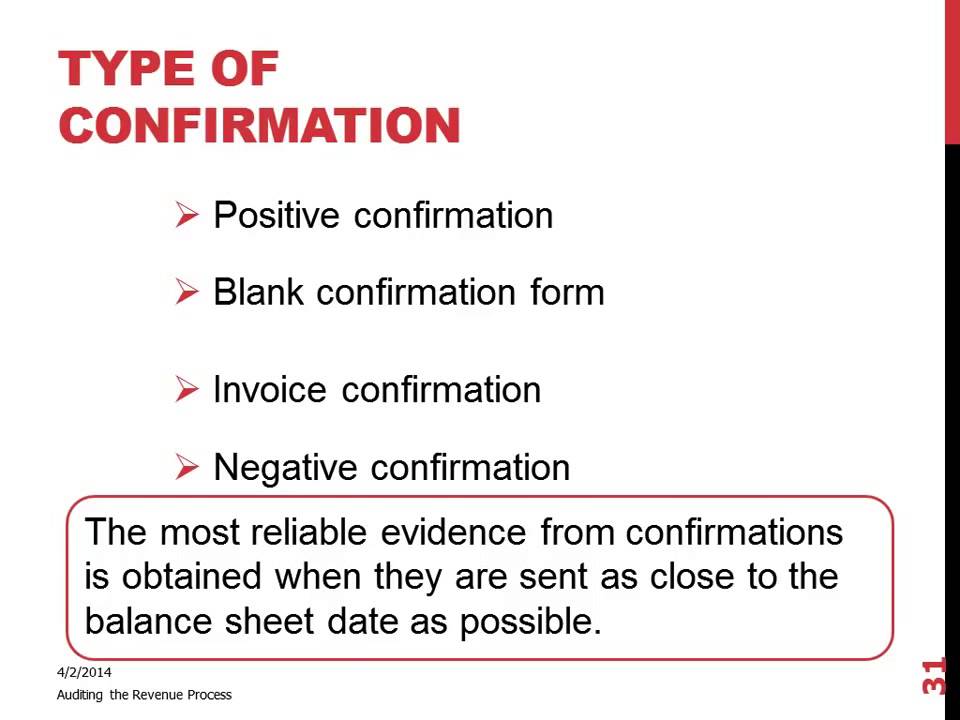
There are positive confirmations, blank confirmation forms, invoice confirmations, and negative confirmations. The most reliable evidence from confirmations is obtained when they are sent as close to the balance sheet date as possible. After the items for confirmation have been selected, the auditor m ust maintain control of the confirmations until they are returned from the customer. When positive confirmations are used, SAS 67 requires follow-up procedures for confirmations not returned by the customer.
Alternative procedures include subsequent cash receipts (examining remittance advices, entries in the cash receipts records) duplicate sales invoices (verifying the actual issuance of an invoice and the billing date), and shipping documents (verify shipment and cutoff tests). When the auditor has completed the planned substantive procedures, the likely misstatement (projected misstatement plus an allowance for sampling risk) for accounts receivable is determined. When the misstatement is less than the toleration benchmark, the account is accepted as fairly presented. When the misstatement is greater than the toleration benchmark, the account is rejected, and is not considered fairly presented.
The auditor's testing of control for revenue processing impacts the detection risk and therefor the level of substantive procedures impacted by the controls.
We've just uploaded brand-new "auditing" videos on our channel!
Check them out here: • Auditing: Prof. Helen Brown-Liburd (Fall 2...
Make sure to check out our latest content. Don't forget to like, subscribe, and hit the bell icon to stay updated with all our future uploads. Thanks for watching!
Повторяем попытку...
Доступные форматы для скачивания:
Скачать видео
-
Информация по загрузке: