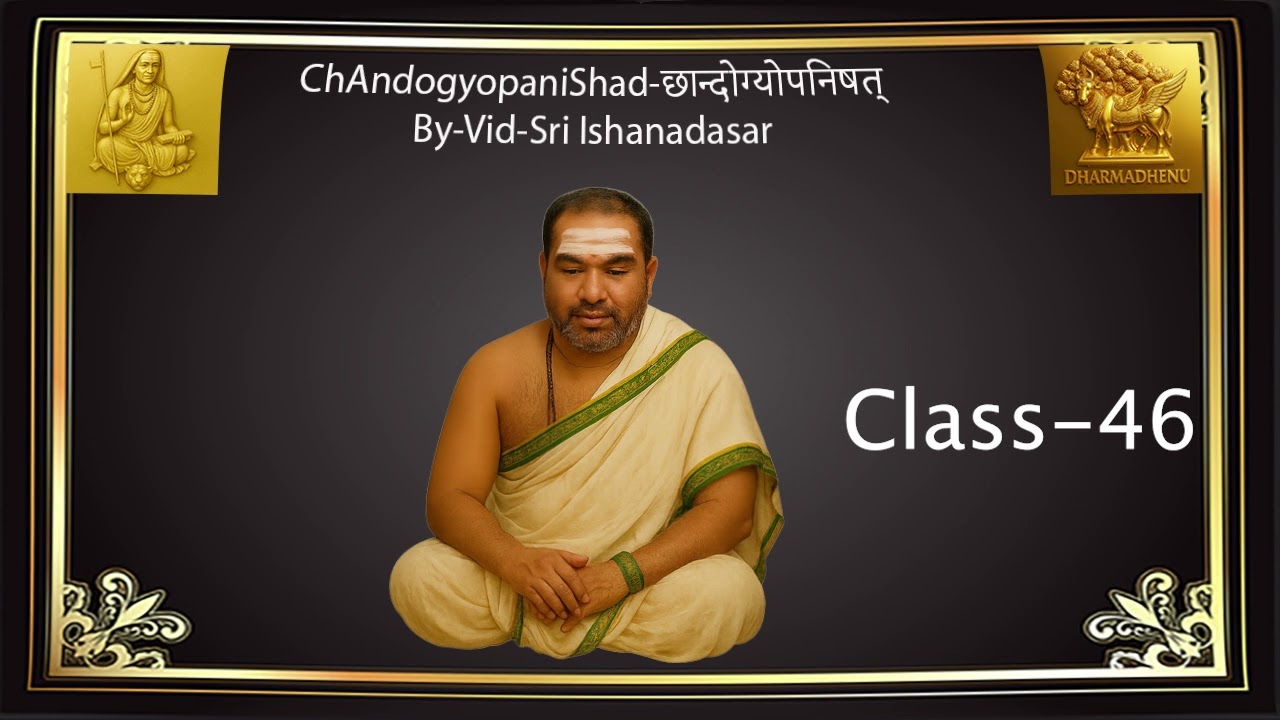
ChAndogyopaniShad-छान्दोग्योपनिषत्-by By-Vid-Sri Ishanadasar in Simple Tamil
Автор: Dharmadhenu-धर्मधेनु
Загружено: 2026-02-25
Просмотров: 7
Описание:
Class-48
he Chāndogya Upaniṣad is one of the oldest and most important Upaniṣads, and it is part of the Sāma Veda.
It is composed of eight chapters (or prapāṭhakas), which are traditionally divided into two main parts:
The first five chapters deal with Karma Kanda (rituals) and Upāsana Kanda (worship and meditation), including the significance of the sacred syllable Om (called Udgītha).
The last three chapters (6, 7, and 8) form the Jñāna Kanda, dedicated to Brahma Vidyā (the supreme knowledge of the Self).
Core Teachings
The central theme of the Chāndogya Upaniṣad is the fundamental unity of the individual soul ($\bar{A}$tman) with the ultimate reality (Brahman).
The most famous teaching is the Mahāvākya (Great Saying) from the dialogue between the sage Uddālaka $\bar{A}$ruṇi and his son, Śvetaketu:
"Tat Tvam Asi" (तत् त्वम् असि), which translates to "That Thou Art" or "You are That." This phrase repeatedly asserts that the individual self is one with the universal Self/Brahman.
Other key concepts include:
Oneness of Existence: The text uses analogies, like knowing one object of clay, gold, or iron means knowing all objects made of that material, to demonstrate that all differences are merely superficial "name and form" and the underlying essence is one, which is Brahman (referred to as "Being" or Sat).
Importance of Knowledge and Meditation: It emphasizes that true realization comes from inner knowledge (jñāna) and meditation (dhyāna), rather than from mere scriptural study or ritualistic practices.
Dahara Vidyā: Meditation on the small space (dahara ākāśa) within the heart, which is taught to contain the entire universe and is the residence of Brahman.
The Power of Om: The sacred syllable Om is presented as the essence of all chants and the fundamental vibration of existence.
The Path of the Soul after Death: It describes the "doctrine of the five fires" (Pañcāgni Vidyā) and the two paths for the soul after death: the path of the gods (Devayāna) for the knowers of wisdom, and the path of the ancestors (Pitṛyāna) for those who performed charity and rituals.
Повторяем попытку...
Доступные форматы для скачивания:
Скачать видео
-
Информация по загрузке: