Andreas Malikopoulos: "Optimal Path Planning and Coordination for Connected and Automated Vehicles"
Автор: Institute for Pure & Applied Mathematics (IPAM)
Загружено: 2020-11-10
Просмотров: 456
Описание:
Mathematical Challenges and Opportunities for Autonomous Vehicles 2020
Workshop II: Safe Operation of Connected and Autonomous Vehicle Fleets
"Optimal Path Planning and Coordination for Connected and Automated Vehicles"
Andreas Malikopoulos - University of Delaware
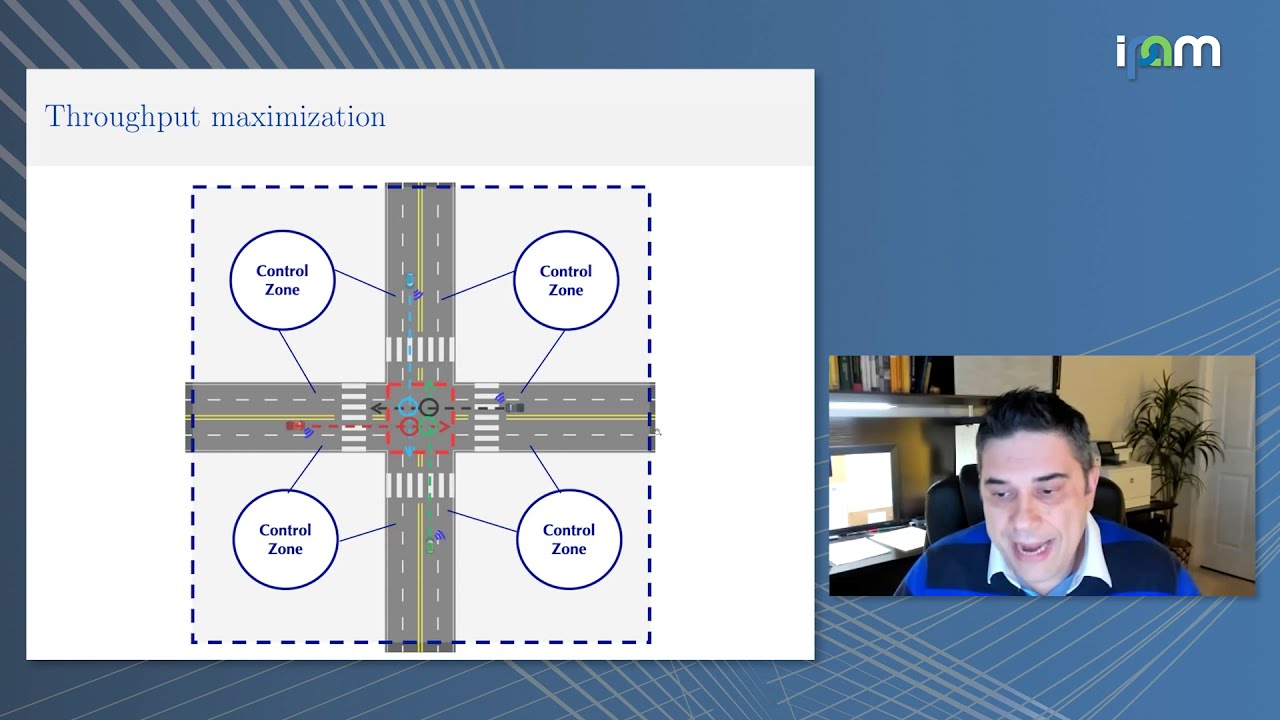
Abstract: Connected and automated vehicles (CAVs) provide the most intriguing opportunity for enabling users to better monitor transportation network conditions and make better operating decisions to improve safety and reduce pollution, energy consumption, and travel delays. CAVs are typical cyber-physical systems where the cyber component (e.g., data and shared information through vehicle-to-vehicle and vehicle-to-infrastructure communication) can aim at optimally controlling the physical entities (e.g., CAVs, non-CAVs). The cyber-physical nature of such systems is associated with significant control challenges and gives rise to a new level of complexity in modeling and control. As we move to increasingly complex emerging mobility systems, new control approaches are needed to optimize the impact on system behavior of the interplay between vehicles at different traffic scenarios. In this talk, I will present a decentralized control framework for coordination of CAVs in different traffic scenarios, e.g., merging at roadways and roundabouts, crossing unsignalized intersections, cruising in congested traffic, passing through speed reduction zones, and lane-merging or passing maneuvers. The framework includes: (1) an upper-level optimization that yields for each CAV its optimal path, including the time and lane, to pass through a given traffic scenario by alleviating congestion; and (2) a low-level optimization that yields for each CAV its optimal control input (acceleration/deceleration) to achieve the optimal path and time derived in the upper-level. I will provide a geometric duality framework using hyperplanes to prove strong duality of the upper-level optimization problem. The latter implies that the optimal path and time for each CAV does not activate any of the state, control, and safety constraints of the low-level optimization, thus allowing for online implementation.
Institute for Pure and Applied Mathematics, UCLA
October 29, 2020
For more information: https://www.ipam.ucla.edu/avws2
Повторяем попытку...
Доступные форматы для скачивания:
Скачать видео
-
Информация по загрузке: