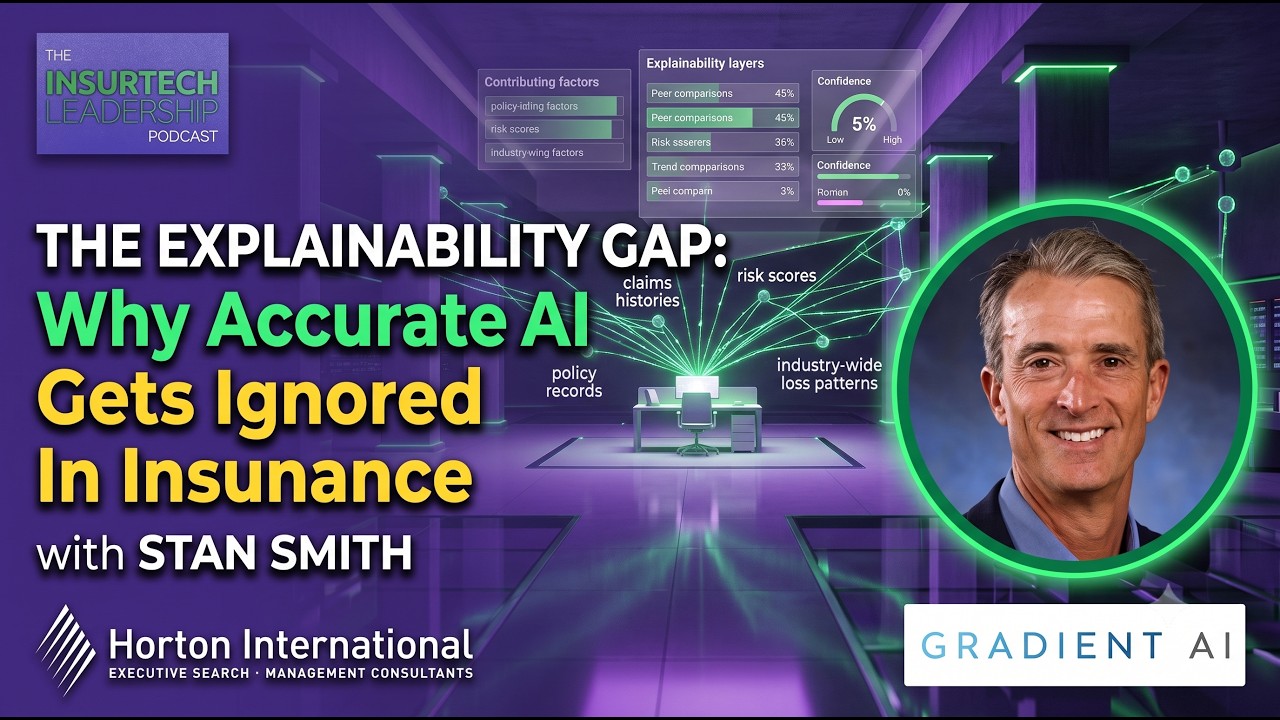
The Explainability Gap: Why Accurate AI Gets Ignored in Insurance
Автор: The Insurtech Leadership Podcast
Загружено: 2026-07-07
Просмотров: 3
Описание:
Introduction
What makes an underwriter act on an AI's answer? Not the accuracy of the model, according to Stan Smith, but whether the person can see how the model got there. Josh Hollander sits down with the founder and CEO of Gradient AI, whose platform is trained on a contributory data lake of tens of millions of policies and claims, to talk about explainability as the last mile of AI adoption, what regulators actually want to see, and the A/B test that put a hard dollar figure on AI-managed claims.
Guest Bio
Stan Smith is the founder and CEO of Gradient AI, which builds AI that insurers use to underwrite risk and manage claims across both P&C and health. He started the business inside Milliman, bought it out in 2018, and has since raised roughly $90 million in growth capital and grown from about a dozen clients to several hundred. Before Gradient, he built a machine-learning startup that predicted supplier performance from pooled supply chain data, the same contributory model that now powers Gradient's data flywheel.
Key Topics
-Explainability is the last mile - A correct number the underwriter cannot interrogate gets ignored, and a number with visible reasoning gets used, disagreed with productively, and trusted over time.
-What regulators actually want - They are not auditing the math; they regulate inputs and outputs, with the sharpest focus on personal lines, like Massachusetts barring personal credit in personal auto underwriting.
-GLMs versus AI - Linear models stay popular because they are explainable, but they miss subtleties in the signal, and Stan argues that trade-off costs accuracy the industry does not have to give up.
-The $7 million A/B test - A large self-insured employer held part of a roughly 20,000-claim book out of Gradient's claims management and measured $7 million in savings on the AI-managed side.
-The contributory flywheel - Clients share data because Milliman-era trust made it safe, and the pooled data makes every client's models better, which is what in-house builds cannot replicate.
-The MVP trap - Carriers that build internally usually stall at a minimally viable product, over budget and behind schedule, while vendors iterating across hundreds of clients keep compounding.
-What got us here won't get us there - Stan's scaling mantra: priorities, execution discipline, and accountability have to change every year, without losing startup speed.
Notable Quotes
"If the person is not confident as to how the model came to that conclusion, they can just pass, even though the model might have given them some important directional information."
"They measured a seven million dollar improvement in their loss costs on the claims we were managing versus the claims in their A test."
"What they build in-house tends to be a minimally viable product. They've told me this. I haven't said it to them."
"My constant mantra to the team is: what got us here won't get us there."
Stan Smith
Resources
Guest:
Gradient AI: https://www.gradientai.com/
Stan Smith on LinkedIn: / stan-smith-5029246
Host & Organization:
Joshua R. Hollander on LinkedIn: / joshuarhollander
Horton International (USA): https://www.horton-usa.com/
Insurtech Leadership Podcast (LinkedIn Showcase): / insurtech-leadership-show
Subscribe & Review
If you enjoyed this episode, subscribe on your favorite platform and leave a review. The Insurtech Leadership Podcast is available on YouTube, Podbean, Apple Podcasts, and Spotify.
Повторяем попытку...
Доступные форматы для скачивания:
Скачать видео
-
Информация по загрузке: