ycliper

Популярное

Музыка Кино и Анимация Автомобили Животные Спорт Путешествия Игры Юмор

Интересные видео

2025 Сериалы Трейлеры Новости Как сделать Видеоуроки Diy своими руками

Топ запросов

смотреть а4 schoolboy runaway турецкий сериал смотреть мультфильмы эдисон
Скачать

McArdle's (Glycogen Storage Disease Type 5) lecture for USMLE

Автор: the study spot

Загружено: 2014-12-19

Просмотров: 28961

Описание: Simple handwritten lecture on the genetic disease known as Glycogen Storage Disease Type V also known as McArdle's Disease for Medical Students taking the USMLE. Discussing the pathophysiology, signs and symptoms of Glycogen Storage Disease as well as diagnosis, treatment and management of the condition

PATHOPHYSIOLOGY
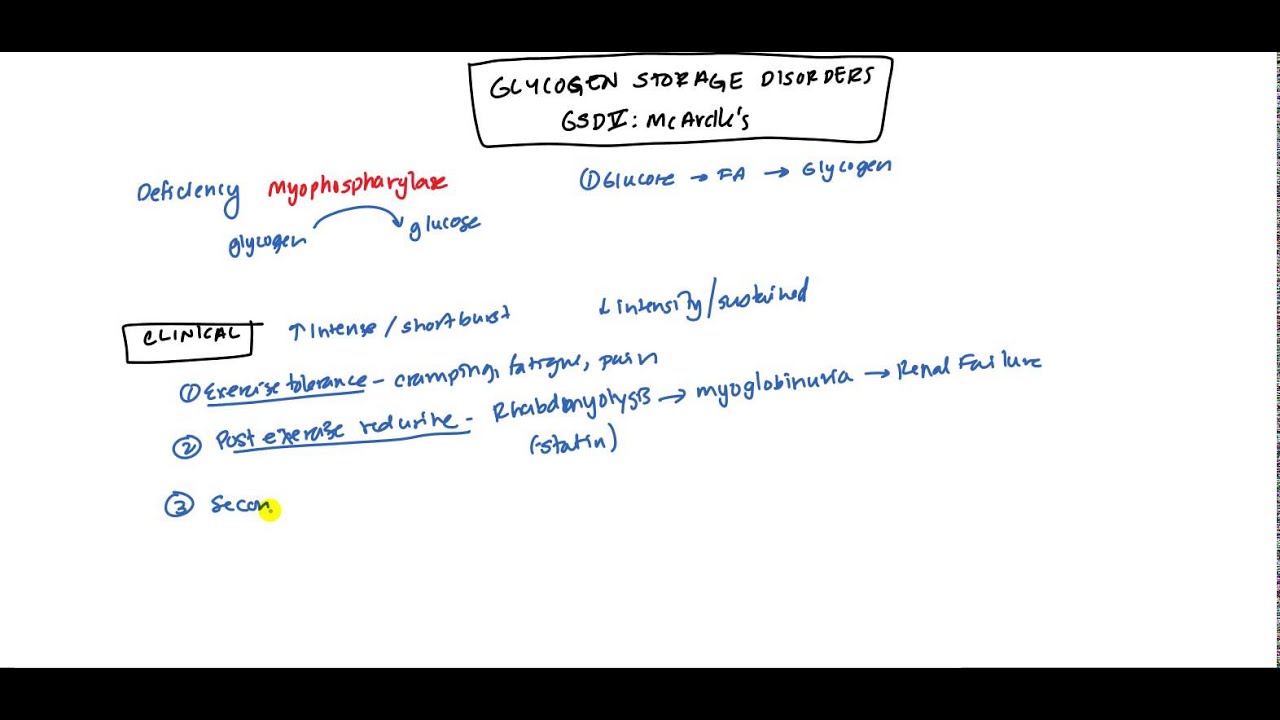
McArdle's is a Glycogen Storage Disease which is a genetic disease which is inherited in an autosomal recessive fashion. Deficiency of the enzyme Myophosphorylase enzyme which is responsible for converted glycogen to glucose in the muscle. Muscle first prefers to use glucose, then fatty acid and then glycogen.

CLINICAL
Only with high intensity or short burst exercises they become symptomatic. Even low intensity but sustained gives them symptoms. The primary symptom is exercise intolerance, muscle cramping, fatigue and pain depending on the muscle being used. Immediately afterwards they get post exercise red urine due to rhabdomyolysis. This leads to myoglobinuria and then released in urine and leads to Renal Failure. Therefore the use of statin is contra-indicated in these types of patients. There is also a second-wind phenomenon they tend to be okay. This is becuase they can replenish glucose and Fatty Acid store and use that instead of glycogen. Patients with McArdle's syndrome are diagnosed with the ischemic forearm test. This involves measuring initial Creatine Kinase, Ammonia and Lactate level. Place blood pressure cuffs and inflate it. THen ask them to do repetitive grasping 1-2/sec for 2-3 mins. Therefore it forces the muscle to depend on glycogen stores rather than glucose. Then take post venous samples looking at CK Ammonia, and lactate in 5, 10 20 minute increments and take urine sample for myoglobinuria. Creatine Kinase is measure of muscle destruction. Normally, an increase in lactate and increase ammonia. If after the tests there is decreased lactate and decreased ammonia. This means that the exercise was not strenous enough. If there is a decrease in lactate and increase in ammonia. This means that there is not enough glucose in the blood suggesting pathway distrubance. This will prompt for a muscle biopsy.

TREATMENT
McArdle's is generally treatd with diet, such as increasing protein. sucrose before exercise will also help to have long exercise.

Не удается загрузить Youtube-плеер. Проверьте блокировку Youtube в вашей сети.
Повторяем попытку...
McArdle's (Glycogen Storage Disease Type 5) lecture for USMLE

Поделиться в:

Доступные форматы для скачивания:

Скачать видео

  • Информация по загрузке:

Скачать аудио

Похожие видео

Pancreatic Hormones (Insulin, Glucagon, Somatostatin)

Pancreatic Hormones (Insulin, Glucagon, Somatostatin)

12DaysinMarch, Lysosomal Storage Disorders for USMLE Step One

12DaysinMarch, Lysosomal Storage Disorders for USMLE Step One

Von Gierke (Glycogen Storage Disease 1) for USMLE

Von Gierke (Glycogen Storage Disease 1) for USMLE

Von Gierke disease | Type I glycogen storage disease (GSD I) | Glycogen metabolism

Von Gierke disease | Type I glycogen storage disease (GSD I) | Glycogen metabolism

«Как гормоны управляют нашей жизнью». Лекция биолога Антона Терентьева

«Как гормоны управляют нашей жизнью». Лекция биолога Антона Терентьева

Pompe disease - causes, symptoms, diagnosis, treatment, pathology

Pompe disease - causes, symptoms, diagnosis, treatment, pathology

Phenylketonuria (Inborn Error of Metabolism) for USMLE

Phenylketonuria (Inborn Error of Metabolism) for USMLE

Болезнь Помпе (с мнемоническим кодом) – болезнь накопления гликогена II типа (БГ-II) – биохимия и...

Болезнь Помпе (с мнемоническим кодом) – болезнь накопления гликогена II типа (БГ-II) – биохимия и...

Glycogen Storage Diseases

Glycogen Storage Diseases

Mucopolysaccharide Storage Disease Type I: Hurler, Hurler-Scheie, and Scheie syndromes

Mucopolysaccharide Storage Disease Type I: Hurler, Hurler-Scheie, and Scheie syndromes

Phosphofructokinase deficiency Animation (Tarui disease / Glycogen-Storage Disease Type VII )  USMLE

Phosphofructokinase deficiency Animation (Tarui disease / Glycogen-Storage Disease Type VII ) USMLE

Анатомия за 22 минуты

Анатомия за 22 минуты

ГРУЗ ПРОШЛОГО В МОЗГЕ ЧЕЛОВЕКА | Дробышевский об эволюции нервной системы | НОО

ГРУЗ ПРОШЛОГО В МОЗГЕ ЧЕЛОВЕКА | Дробышевский об эволюции нервной системы | НОО

Анимация болезни фон Гирке / Болезнь накопления гликогена I типа (БГН I): Биохимия, USMLE, шаг 🔬

Анимация болезни фон Гирке / Болезнь накопления гликогена I типа (БГН I): Биохимия, USMLE, шаг 🔬

Lysosomal Storage Diseases  | Overview and What You Need to Know

Lysosomal Storage Diseases | Overview and What You Need to Know

🤯ГАЛЛЯМОВ: Путин до конца не верил, что ЭТО СЛУЧИТСЯ! Вот чем обернётся ВОЙНА в Иране: Москва В АУТЕ

🤯ГАЛЛЯМОВ: Путин до конца не верил, что ЭТО СЛУЧИТСЯ! Вот чем обернётся ВОЙНА в Иране: Москва В АУТЕ

Lysosomal Storage Diseases (HIGH YIELD UPDATE!)

Lysosomal Storage Diseases (HIGH YIELD UPDATE!)

McArdle's disease - Key Points - Clinical case

McArdle's disease - Key Points - Clinical case

Duchenne Muscular Dystrophy and Dystrophin

Duchenne Muscular Dystrophy and Dystrophin

What is AL amyloidosis?

What is AL amyloidosis?

© 2025 ycliper. Все права защищены.


  • Контакты
  • О нас
  • Политика конфиденциальности


Контакты для правообладателей: [email protected]