Medtner - Piano Sonata in G minor, Op. 22 (1910)
Автор: Alan Kuo
Загружено: 2017-11-26
Просмотров: 12597
Описание:
Hamish Milne, piano
Nikolai Medtner's one-movement Piano Sonata No. 5 in G minor, Op. 22 (1910) was once his most well-known sonata, and enjoyed the support of pianists such as Horowitz, Gilels, Prokofiev, and Moiseiwitsch. Horowitz included the work in his recitals in Russia, but, after immigrating to America, found that it could not satisfy the critics there and ceased to publicly perform it. One critic opined (incorrectly) of the sonata that "not a single phrase of it quickens the pulse"!
The form of the sonata is rigorously constructed yet fully organic; the form is made subordinate to the music, rather than the opposite. Heinrich Neuhaus wrote that "the sonata's trajectory is felt from the first to the last note as one uninterrupted line". As is typical of Medtner, the sonata uses highly elaborate motive-based writing, with nearly all of the material being drawn from the brief introduction. Op. 22's treatment of its motives is possibly the most intricate and dense in all of Medtner's sonatas, only rivaled by the A minor Op. 30 and the Minacciosa Op. 53, No. 2. The piano writing is highly virtuosic, and yet there is not a single wayward or superfluous note, nor one that is not essential to the musical argument. For all of the cerebralness in its method of composition, the sonata nonetheless has a powerful dramatic and emotional sweep, and, in my opinion, quite a few phrases that "quicken the pulse".
The sonata utilizes a unique key scheme; it moves upwards in thirds, cycling through all 7 pitches of the G minor scale and only returning to the tonic in the last stretch of the coda. According to his notes, Medtner inserted an earlier Prelude in F minor as the development section, though it is hardly possible to tell given how seamlessly it has been integrated into the larger work.
INTRODUCTION
0:00 The sonata opens with a emphatic 8-measure phrase, to be repeated at the end of the exposition and the very end of the work.
0:27 Allegro assai. All of the thematic material is laid out. It builds to a dominant pedal at 1:06, then launches into the
EXPOSITION
Theme Group 1
1:16 T1,1 - G minor
The first theme consists of nonstop 16th-notes, supported by terse chords in the left hand.
1:58 T1,2 - B-flat major
The left hand brings in a sunny chordal melody, while the right glitters above in cascading runs.
2:24 After a buildup consisting entirely of M1, TG1 ends with a series of violent staggered chords.
Theme Group 2 - D minor
3:00 T2 (drawn from the very first measure) enters "with timidness", as if hesitant to break the silence, but soon gathers momentum and pours forth passionately.
Closing
4:30 The lengthy closing section revisits all of the material of the exposition - T1,1 is combined with T2 over agitated scalar runs; T1,2 appears in a doleful canon (5:00); and the staggered chords that concluded TG1 (5:30) usher in a placid M6 (5:41).
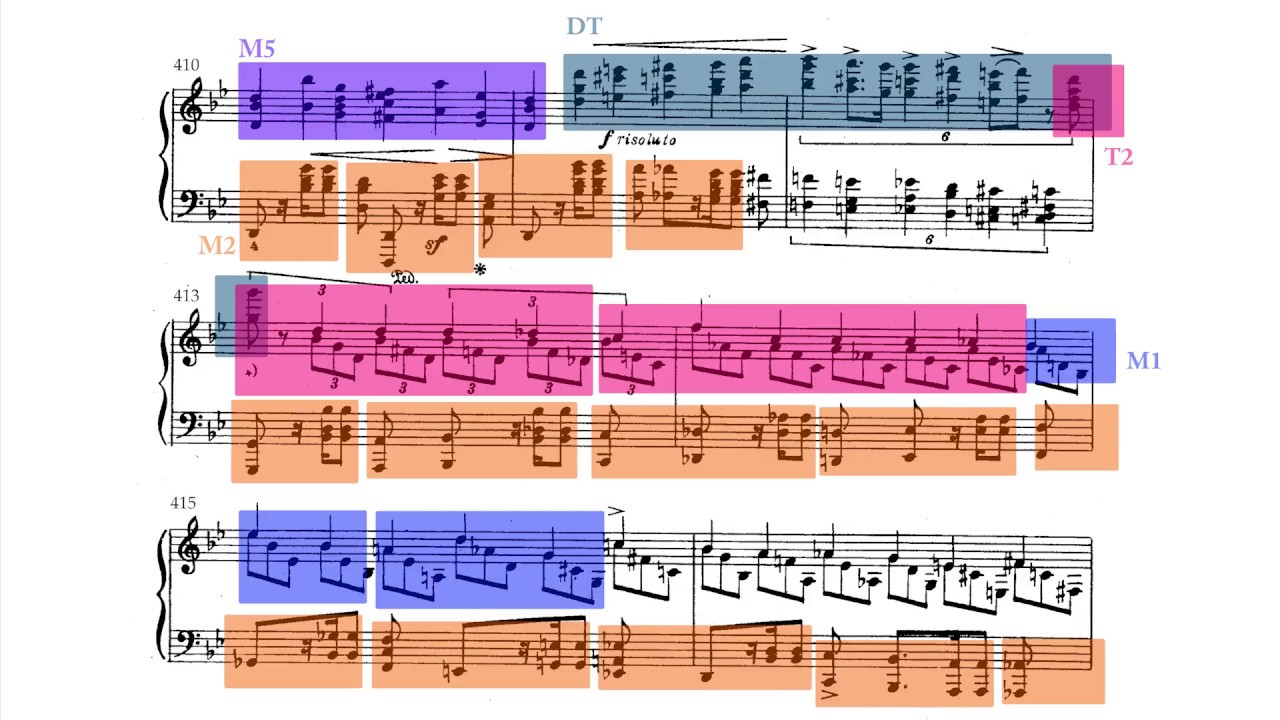
6:00 The development theme (DT) is foreshadowed here, growing directly out of M3 - the leap in M3 is gradually decreased from a 6th, to a 4th (6:00), to a 3rd (6:18), then finally to a 2nd(6:32).
6:22 An incredible buildup passage with M5 gradually rising in the right hand, T2 ringing out amidst triplets in the left hand, and modulation through several distant keys.
6:39 A massive reprise of the opening 8 measures, now with M5 pealing out above, ends the exposition.
DEVELOPMENT
F minor
A
7:00 The impetuous drive of the exposition vanishes and is replaced with utter desolation. M2 is repeated obsessively in static chords.
7:56 The music takes a steady 8th-note pace and moves to the relative major. The development theme is finally heard in full (8:27).
B
8:40 The heart of the work. M2 and a fragment of T1,2 are underpinned by soft arpeggiated tremors, then echoed by resonant octaves above.
A
9:24
10:00 Climax of the development, returning to F minor. The two hands move in imitation.
RECAPITULATION
Theme Group 1 - A minor (!)
11:04 T1,1
Rather than being a direct repetition of the exposition, the recapitulation begins in medias res, demonstrating Medtner's organic approach to sonata form. The same motives, accompanimental figures, and basic structure are used, but otherwise the music is transformed entirely and is far more chromatic and modulatory.
11:53 T1,2
12:18 Chords
Theme Group 2 - C minor
12:55 More or less a repetition of the exposition until 14:02, where the music takes on the character of a cadenza, featuring two virtuosic flourishes.
CODA
14:48 "E-flat major"
The introductory section makes a return, but half-diminished and 3rd-inversion sevenths keep the harmony off-balance in preparation for
15:38 G minor (finally)
The final stretch features Medtner's signature 8-against-3 rhythm in a whirlwind of chords tying together all the thematic material.
16:17 The RH quarter-notes are divided into triplets, creating a 9-against-8 rhythm.
16:27 The sonata concludes with a compressed version of the very first 8 measures.
16:39 That chord is tied! Don't play it!
Повторяем попытку...
Доступные форматы для скачивания:
Скачать видео
-
Информация по загрузке: