BrIAS Seminars: Giulia Fuochi
Автор: Brussels Institute for Advanced Studies (BrIAS)
Загружено: 2026-03-10
Просмотров: 3
Описание:
12.02.2026
Prof. Giulia Fuochi presents on "Deprovincialization and other pathways to intergroup and societal harmony."
Bio
Giulia Fuochi is assistant professor and researcher in social psychology at the University of Padova. Her work explores how people relate to others across group boundaries, with a focus on prejudice, intergroup contact, mindfulness, and openness toward diversity. She has published extensively on these topics in international journals.
Abstract
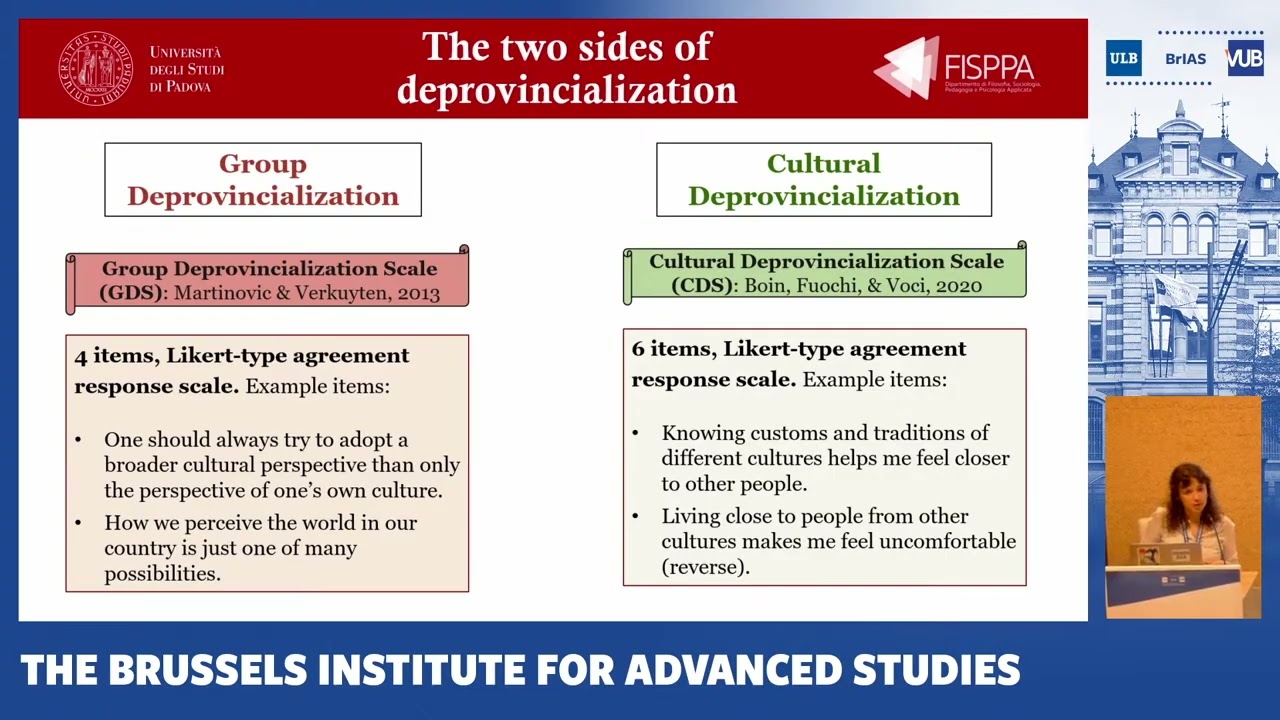
Recent decades have seen a rise in identity-based polarization in several democratic societies, exacerbating conflict among social groups. One process that may counteract this trend could be that of deprovincialization, a shift in perspective through which individuals come to view their own group’s norms and values as less absolute or superior, while becoming more open to and accepting of cultural differences. Deprovincialization typically emerges from positive intergroup contact – i.e., interactions between members of different social groups – but also entails a strong component of cognitive change, transforming how people interpret social diversity and group or national identity. This presentation will first shed light on the concept of deprovincialization, also illustrating its links with intergroup variables (intergroup contact, prejudice, and anxiety), socio-political dispositions (right-wing authoritarianism, social dominance orientation) and other individual tendencies (curiosity, values) through network analysis. Second, results from latent profile analysis, a person-centered approach that identifies latent subgroups of individuals based on similar patterns of responses across variables, will show how deprovincialization tends to cluster within profiles characterized by cognitive flexibility, curiosity, pro-diversity and anti-hierarchy beliefs. Third, the potential behavioral outcomes of deprovincialization in an experimental setting will be explored: participants exposed to an audio clip designed to elicit deprovincialization – compared to those assigned to an active control condition – reported lower levels of national ingroup identification (i.e., Italians), and, more importantly, stronger intentions to engage in collective action to improve the conditions of the outgroup (i.e., Arab people living in Italy). Overall, these findings highlight deprovincialization as a core mechanism for social change, fostering openness toward diversity and pluralism, reducing ethnocentrism, and mobilizing advantaged groups to support disadvantaged ones.
Повторяем попытку...
Доступные форматы для скачивания:
Скачать видео
-
Информация по загрузке: