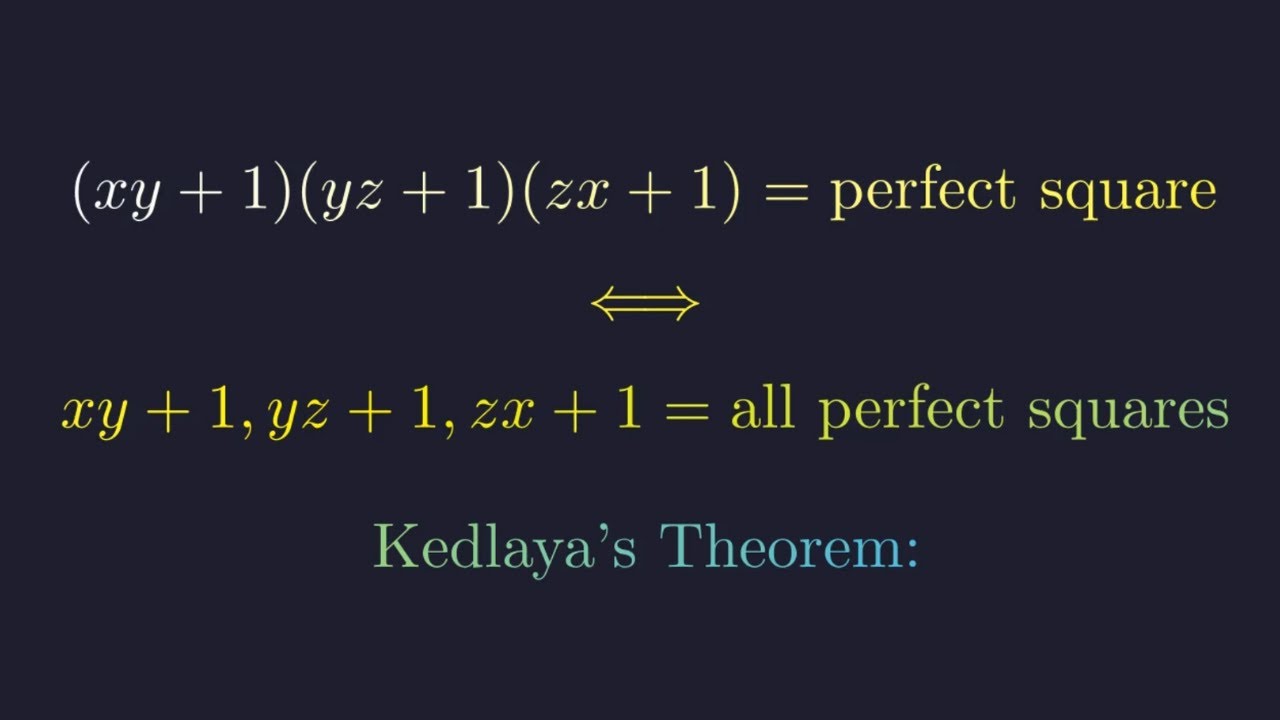
The Impossible Problem That's Actually Simple | Kedlaya's Theorem
Автор: Logic Unlocked
Загружено: 2025-10-11
Просмотров: 2348
Описание:
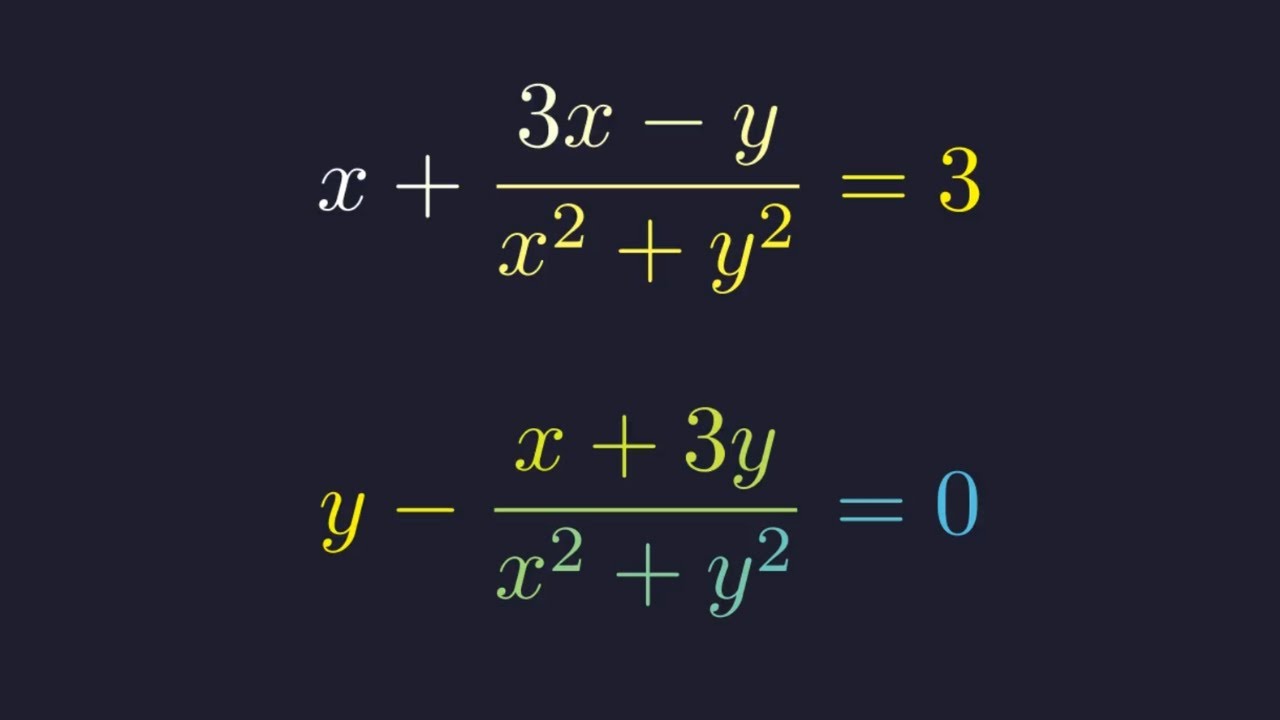
Join us as we explore a beautiful theorem in number theory by Kiran S. Kedlaya. At first glance, the condition for this product of three integers to be a perfect square seems impossibly complex. But the answer is stunningly elegant: it's a perfect square if and only if each of its three factors is a perfect square.
In this video, we provide a complete, rigorous proof from start to finish. We'll use the powerful method of the "minimal counterexample," a cornerstone of proof by contradiction inspired by Fermat's method of infinite descent. We will construct two crucial lemmas and show how they lead to an inescapable logical paradox, proving the theorem.
Stick around for two mind-bending bonuses:
Uncover a hidden family of solutions generated by a recurrence relation tied to the Golden Ratio.
Get a glimpse into an advanced alternative proof using the theory of Pell's Equation and Diophantine analysis.
Whether you're a math student or just a curious mind, this elegant proof is a perfect example of the hidden beauty and structure in mathematics.
Video Timestamps
00:00 - Introduction to Kedlaya's Theorem
00:24 - Part 1: The "If" Direction (Straightforward Proof)
01:08 - Part 2: The "Only If" Direction (Proof by Contradiction)
01:25 - Setting up the Minimal Counterexample
01:45 - Lemma 1: The Variables Must Be Distinct
03:43 - Lemma 2: A Counterexample Cannot Contain Consecutive Integers
06:08 - The Final Contradiction: Proving the Theorem
09:25 - Bonus 1: A Family of Solutions and the Golden Ratio
10:20 - Bonus 2: An Alternative View via Pell's Equation
11:23 - Thank You for Watching
Повторяем попытку...
Доступные форматы для скачивания:
Скачать видео
-
Информация по загрузке: