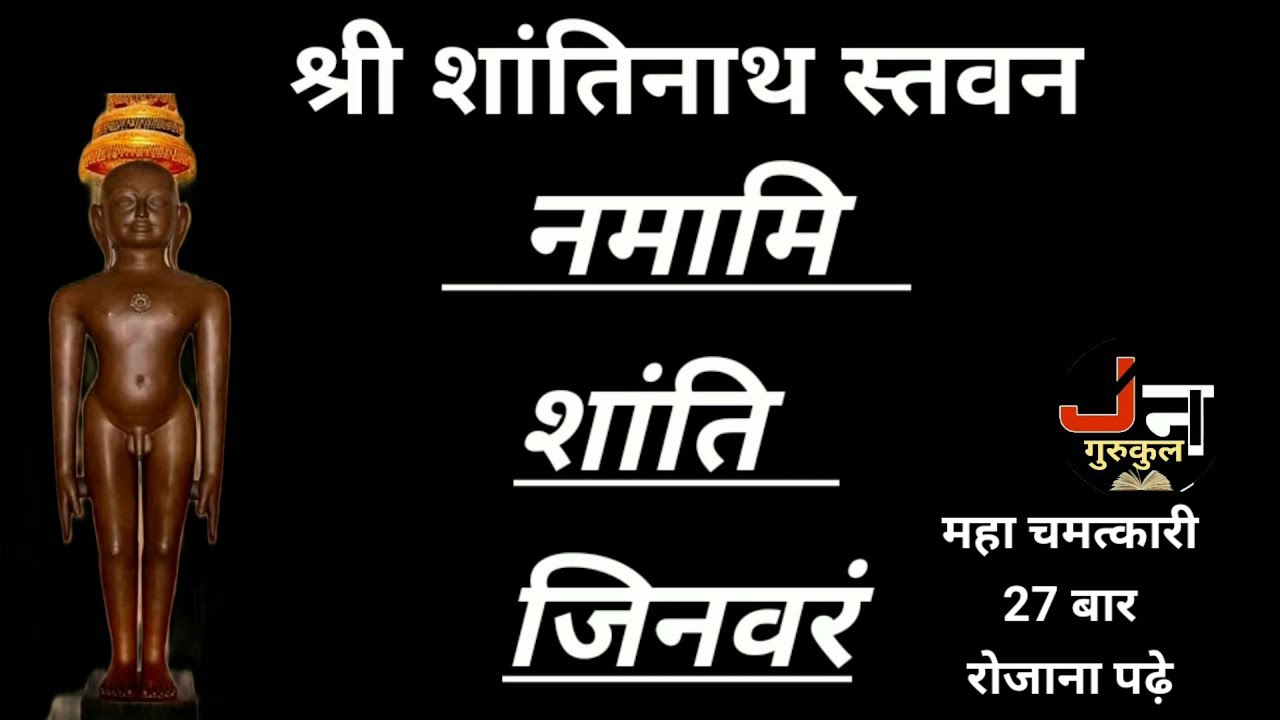
शांतिनाथ स्तवन ।।महा चमत्कारी स्तवन(हर दुख का निवारक स्त्रोत)27 बार रोज पढ़े | श्री शांतिनाथ स्तुति|
Автор: Jain Gurukul
Загружено: 2022-01-12
Просмотров: 20222
Описание:
शांतिनाथ स्तवन(हर दुख का निवारक स्त्रोत) |दिन में एक बार जरूर पढ़ें श्री शांतिनाथ स्तुति|with lyrics|
Jainism traditionally known as Jain Dharma, is an ancient Indian religion and a major world religious group. The three main pillars of Jainism are ahinsa (non-violence), anekantavada (non-absolutism), and aparigraha (non-attachment). Asceticism (abstinence from sensual pleasures) is an important principle. Jains take five main vows: ahinsa (non-violence), satya (truth), asteya (not stealing), brahmacharya (sexual continence), and aparigraha (non-possessiveness). These principles have affected Jain culture in many ways, such as leading to a predominantly vegetarian lifestyle. Parasparopagraho jivanam (the function of souls is to help one another) is the faith's motto and the Ṇamokara mantra is its most common and basic prayer.
Jainism traces its spiritual ideas and history through a succession of twenty-four leaders or Tirthankaras, with the first in the current time cycle being Rishabhadeva, whom the tradition holds to have lived millions of years ago; the twenty-third tirthankara Parshvanatha, whom historians date to 9th century BCE; and the twenty-fourth tirthankara, Mahavira around 600 BCE. Jainism is considered to be an eternal dharma with the tirthankaras guiding every time cycle of the cosmology.
Dravya (Substance)#shaantinaathstawan
Dravya means substances or entity in Sanskrit. According to Jain philosophy, the universe is made up of six eternal substances: sentient beings or souls (jiva), non-sentient substance or matter (pudgala), principle of motion (dharma), the principle of rest (adharma), space (akasa) and time (kala).
Tattva (Reality)
Tattva connotes reality or truth in Jain philosophy, and is the framework for salvation. According to Digambara Jains, there are seven tattvas: the sentient (jiva)living; the insentient (ajiva)non-living; the karmic influx to the soul (Asrava); mix of living and non living; bondage of karmic particles to the soul (Bandha. stoppage of karmic particles (Saṃvara); wiping away of past karmic particles (Nirjarā); and liberation (Moksha). Śvētāmbaras add two further tattvas, namely good karma (Punya) and bad karma (Paap).
Soul and karma
Classification of Saṃsari Jivas (transmigrating souls) in Jainism
According to Jainism, the existence of "a bound and ever changing soul" is a self-evident truth, an axiom which does not need to be proven. It maintains that there are numerous souls, but every one of them has three qualities (Guṇa): consciousness (chaitanya, the most important), bliss (sukha) and vibrational energy (virya).
Saṃsara
The conceptual framework of the Saṃsāra doctrine differs between Jainism and other Indian religions. Soul (jiva) is accepted as a truth, as in Hinduism but not Buddhism. The cycle of rebirths has a definite beginning and end in Jainism.[20] Jain theosophy asserts that each soul passes through 8,400,000 birth-situations as they circle through Saṃsāra,
Cosmology
Division of time in Jain cosmology.
Jain texts propound that the universe consists of many eternal lokas (realms of existence). As in Buddhism and Hinduism, both time and the universe are eternal, but the universe is transient.
God
Jain miniature painting of 24 tirthankaras, Jaipur, c. 1850
Jainism is a transtheistic religion,[41] holding that the universe was not created, and will exist forever. It is believed to be independent, having no creator, governor, judge, or destroyer.
Epistemology
Jain philosophy accepts three reliable means of knowledge (pramana). It holds that correct knowledge is based on perception (pratyaksa), inference (anumana) and testimony (sabda or the word of scriptures). These ideas are elaborated in Jain texts such as Tattvarthasūtra, Parvacanasara, Nandi and Anuyogadvarini. Some Jain texts add analogy (upamana) as the fourth reliable means, in a manner similar to epistemological theories found in other Indian religions. In Jainism, jnāna (knowledge) is said to be of five kinds – Kevala Jnana (Omniscience), Śrutu Jñāna (Scriptural Knowledge), Mati Jñāna (Sensory Knowledge), Avadhi Jñāna (Clairvoyance), and Manah prayāya Jñāna (Telepathy). According to the Jain text Tattvartha sūtra, the first two are indirect knowledge and the remaining three are direct knowledge.
Salvation, liberation
The three shikhar (top) of a Jain temple represents Ratnatraya (three jewels)
According to Jainism, purification of soul and liberation can be achieved through the path of four jewels: Samyak darśana (Correct View), meaning faith, acceptance of the truth of soul (jīva); Samyak gyana (Correct Knowledge), meaning undoubting knowledge of the tattvas; and Samyak charitra (Correct Conduct), meaning behavior consistent with the Five vows. Jain texts often add samyak tap (Correct Asceticism) as a fourth jewel, emphasizing belief in ascetic practices as the means to liberation (moksha). The four jewels are called moksha marg (the path of liberation).
Повторяем попытку...
Доступные форматы для скачивания:
Скачать видео
-
Информация по загрузке:


