Equilibrium Angle in Pulley and String System | Class 11 Physics | NoMoreClass
Автор: NoMoreClass
Загружено: 2025-08-28
Просмотров: 22
Описание:
Welcome to NoMoreClass (NMC), Bangalore's premier institute for mastering physics concepts critical for competitive exams like NEET, IIT, JEE, BITSAT, and Olympiads. Since 2018, under the expert leadership of Mr. Deepak Solanki—an IIT Roorkee alumnus with over 17 years of experience—NMC has continuously refined physics education to emphasize clarity, understanding, and engagement. Our comprehensive CloudClass platform offers interactive live lessons and recorded sessions, tailoring a flexible and effective learning pathway for students.
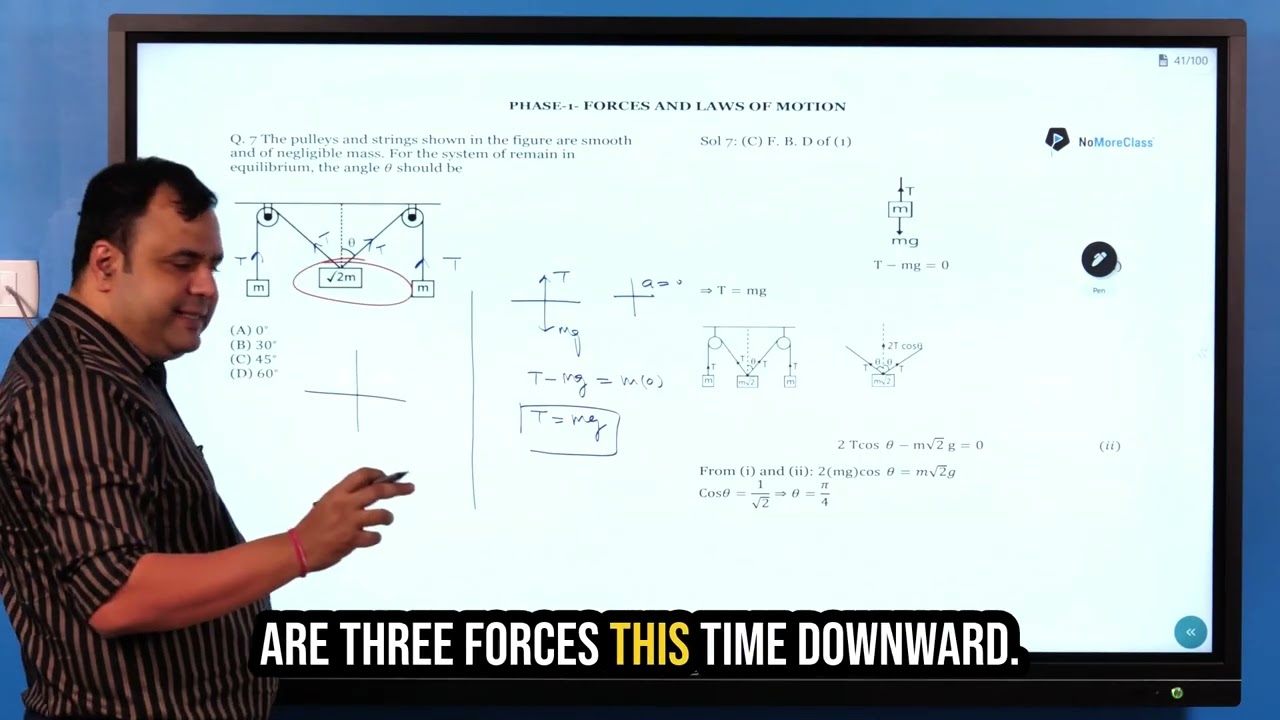
Today's session focuses on analyzing the equilibrium in a system involving pulleys and strings, specifically determining the angle (\theta) required to maintain equilibrium. This problem integrates core concepts of forces, tension, and symmetry in mechanical systems, an essential exploration for understanding equilibrium conditions.
Concept Overview:
This scenario illustrates the pivotal aspects of mechanical equilibrium in systems with pulleys and strings. Understanding these principles helps visualize the forces interacting within the system to determine the conditions required for maintaining balance.
Key Physics Principles:
Tension in Strings: When dealing with pulley systems, tension distribution remains constant along a single continuous string, assuming no friction and massless pulleys. This tension is key in achieving equilibrium.
Balance of Forces: For the system to remain in equilibrium, the resultant forces and torques must be zero. Analyzing these forces helps confirm that the masses are stable, without translational or rotational motion.
Symmetrical Equilibrium: Here, geometry plays a crucial role. By understanding how angles of tension interact symmetrically, we can deduce equilibrium angles effectively. The symmetry in pulley arrangements often simplifies solving for unknown angles.
Problem-Solving Strategy:
Force Component Analysis: Break down the forces acting at the angles to determine how they influence overall equilibrium. Balance the components along the directions parallel and perpendicular to the gravitational force.
Application of Mathematical Relationships: Use trigonometric identities relating to angles in equilibrium to structure equations that determine the desired angle (\theta).
Visualization and Symmetry: Visualize the forces at play by sketching force diagrams to see how symmetry impacts balance, simplifying complex force interactions.
Real-World Applications:
Understanding the equilibrium in pulley systems extends into real-world applications like engineering lifelines, cranes, automated lift systems, and cable cars—where ensuring balance and stability is crucial for safe operations.
About Mr. Deepak Solanki:
Mr. Deepak Solanki, founder of NMC, combines a background from IIT Roorkee with extensive teaching experience to deliver expert physics education. Through his vision, he makes complex topics approachable, fostering a deep understanding and analytic thinking. As an author of over 18 physics books, he bridges profound insights and practice, preparing students for both academic and competitive success.
Join NMC: Engage with us for profound insights into physics principles and expertly guided problem-solving. Elevate your understanding of forces, equilibrium, and dynamics to achieve mastery and academic excellence with NoMoreClass.
Повторяем попытку...
Доступные форматы для скачивания:
Скачать видео
-
Информация по загрузке:


