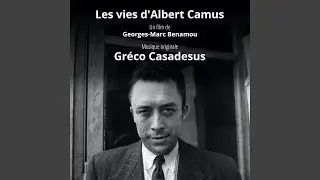
Albert Camus — between absurdity and an invincible summer.
Автор: ThisDayArchive
Загружено: 2026-01-03
Просмотров: 12
Описание:
"In the midst of winter, I found there was, within me, an invincible summer."
Albert Camus (1913–1960) was a French-Algerian philosopher, author, and journalist who remains one of the most influential thinkers of the 20th century. Notably, he died on January 4, 1960, making today the anniversary of his passing.
His life was a paradox of bleak philosophy and "invincible summer"—a term he used to describe the inner resilience of the human spirit.
1. Core Philosophy: Absurdism
Camus is the father of Absurdism. He believed that humans have an innate drive to find meaning and clarity in life, but the universe is "silent" and offers none.
The Absurd: This is the conflict between our search for meaning and the meaningless world. The Three Responses: Camus argued that when faced with the Absurd, one could: Commit suicide (which he rejected as a "confession that life is too much"). Take a "leap of faith" into religion (which he called "philosophical suicide"). Rebel: Accept the meaninglessness and live anyway with passion and freedom. Sisyphus: He used the myth of Sisyphus—condemned to roll a rock up a hill for eternity—as the ultimate hero. He famously concluded: "One must imagine Sisyphus happy." 2. Major Literary Works
Camus was a master of "lucid" prose, winning the Nobel Prize in Literature in 1957 at just 44 years old.
The Stranger (L'Étranger): A novel about Meursault, a detached man who kills an Arab on a beach and is eventually condemned more for his lack of emotional "performance" (like not crying at his mother's funeral) than for the murder itself. The Plague (La Peste): Often read as an allegory for the Nazi occupation of France, it tells the story of a doctor fighting an epidemic, showcasing human solidarity in the face of suffering. The Myth of Sisyphus: The definitive philosophical essay outlining his views on the Absurd. 3. A Life of Action
Unlike some "armchair philosophers," Camus lived his values:
The Resistance: During WWII, he was the editor-in-chief of Combat, an underground newspaper for the French Resistance. Political Integrity: He famously broke with Jean-Paul Sartre and other French intellectuals because he refused to support the violence of Stalin’s Soviet Union, arguing that "no cause is worth the death of an innocent person." 4. His Tragic Death
On January 4, 1960, Camus died in a car accident in Villeblevin, France.
The Irony: He had originally planned to take the train and had an unused train ticket in his pocket; however, his publisher, Michel Gallimard, convinced him to drive instead. The Manuscript: Found in the mud at the crash site was the unfinished manuscript of his most personal, autobiographical novel, The First Man.
#AlbertCamus #Existentialism #Absurdism #InvincibleSummer #Philosophy #LiteraryPhilosophy #20thCenturyThinkers #FrenchLiterature #TheMythOfSisyphus #TheStranger #HumanCondition #Resilience #IntellectualHistory #ThisDayInHistory #LiteratureShorts #PhilosophyShorts
Повторяем попытку...

Доступные форматы для скачивания:
Скачать видео
-
Информация по загрузке: