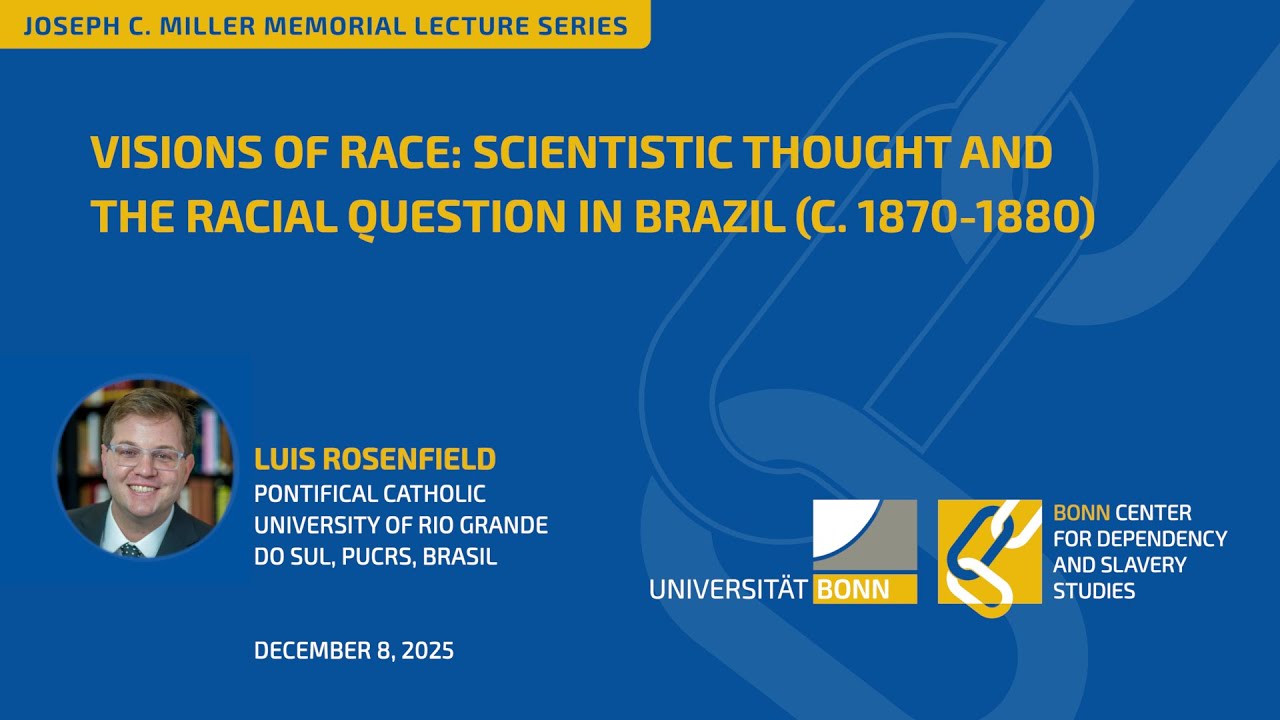
Visions of Race: Scientistic thought and the racial question in Brazil (c. 1870–1880)
Автор: Bonn Center for Dependency and Slavery Studies
Загружено: 2025-12-16
Просмотров: 53
Описание:
As part of the Joseph C. Miller Memorial Lectures, Luis Rosenfield from the Pontifical Catholic University of Rio Grande do Sul, PUCRS, Brazil, gave a lecture on Brazil in the 1870s and 1880s, where philosophical ideas inspired by Auguste Comte’s positivism played an important role at decisive moments of abolitionist agitation. However, the role played by race in
Brazilian scientistic thought at the end of the nineteenth century remains an open question. Under the mantle of nineteenth-century positivist and evolutionist ideas, the representation of race relations was treated in a variety of very different ways: While there were classical views of inferiority, subjugation, and condescension, some sources testify to the extreme opposite, speaking about the recognition of a ‘crime’ committed against enslaved populations and pointing to the need for spiritual and material
reparation. In the late nineteenth-century, slavery in Brazil was treated in a more nuanced way than in the United States, where it was more racialized in terms of the representation of enslaved persons as inferior on biological grounds. The phenomenon of Brazilian slavery was so ‘normalized’ that the
concept of racialization was mitigated in favor of the creation of the myth of the slave owner as a paternalistic figure, based on enlighment thinking and concerned for the well-being of his slaves. As a result, the racial issue was successfully invisibilized, which created a heavy burden in terms of strong asymmetrical dependencies. This lecture seeks to present an in-depth interpretation of the Brazilian intellectual panorama on the representation of the racial question in what can be described as the Naturalistic Scientism paradigm. The Naturalist Scientism paradigm consists of a worldview shared by many Brazilian intellectuals who used European positivist and evolutionist theories – such as Darwinists, Spencerists, and Haeckelian ideas – to produce autonomous and independent thougth in the country’s sociopolitical context.
Luis Rosenfield (PhD in Philosophy, Pontifical Catholic University of Rio Grande do Sul/PUCRS, 2021; PhD in Law, University of Vale do Rio dos Sinos/UNISINOS, 2019) is Permanent Professor in the History
and Philosophy departments at the PUCRS in Porto Alegre, Brazil. He recently held a postdoctoral fellowship at the Max Planck Institute for Legal History and Legal Theory in Frankfurt (MPI-LHLT, 2024-2025). He is the Leader of the History of Ideas and Intellectual History Research Group (GHI, CNPq-PUCRS); and a member of the Working Group Brazilian Philosophical Thought at the National Association for Graduate Studies in Philosophy (ANPOF), the Network for the Study of Fascisms, Authoritarianisms and Totalitarianisms and Transitions to Democracy (REFAT) and the Historical and Geographical Institute of Rio Grande do Sul (IHGRGS). Among his latest books are: Revolução conservadora: genealogia do constitucionalismo autoritário brasileiro (1930-1945) (Série História, 85)
(Porto Alegre: EdiPUCRS, 2021) and A Era Cientificista (1870-1904): história intelectual do positivismo no Brasil (Edições do Senado Federal) (Brasília: Senado Federal, 2025, in press). His research is centered on the study of philosophical positivism, evolutionism, eugenics and authoritarianism in Brazil in the broad time frame that begins in the 1870s until 1945. In 2019, he began a research project entitled “Francisco Campos: Intellectual Biography (1891-1968)”, in which he seeks to build an in-depth picture
of one of the main Brazilian authoritarian intellectuals of the twentieth century, who was responsible for drafting the 1937 Constitution and the Institutional Act No. 1 in 1964. In 2021, Rosenfield began a long-term research project on the development of positivist, evolutionist, and eugenic ideas, with a focus on the study of asymmetrical dependencies in Brazilian history, in the transition from the Monarchy to the Republic.
Повторяем попытку...
Доступные форматы для скачивания:
Скачать видео
-
Информация по загрузке:





![ARMIA PUTINA DRUGĄ ARMIĄ ŚWIATA? PRAWDZIWA SIŁA ROSJI [WOLSKI I BOJKE]](https://imager.clipsaver.ru/-0hLR4R3gvk/max.jpg)