Cyrix FasMath vs Intel 80387 — How a Tiny Startup Beat Intel Before It Built a CPU
Автор: Technological Origins
Загружено: 2026-08-26
Просмотров: 6995
Описание:
Cyrix FasMath vs Intel 80387 — How a Tiny Startup Beat Intel Before It Built a CPU
Cyrix FasMath vs Intel 80387 — How a Tiny Startup Beat Intel Before It Built a CPU
Cyrix FasMath vs Intel 80387 — How a Tiny Startup Beat Intel Before It Built a CPU
Cyrix FasMath vs Intel 80387 — How a Tiny Startup Beat Intel Before It Built a CPU
Cyrix FasMath vs Intel 80387 — How a Tiny Startup Beat Intel Before It Built a CPU
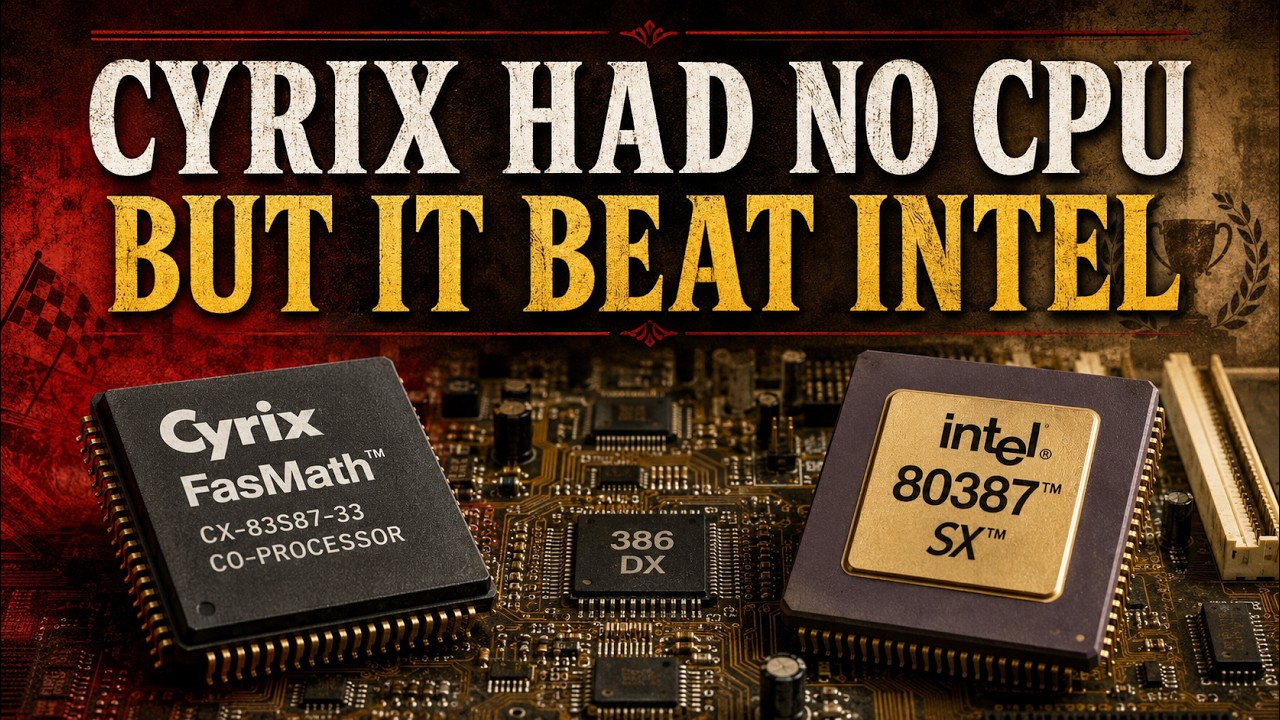
Before Cyrix became one of Intel’s most aggressive x86 CPU rivals, it entered the PC industry through a much smaller socket.
In the late 1980s, Intel’s 80386 was one of the most important processors in personal computing. But demanding floating-point mathematics still depended on a separate chip: the 80387 numerical coprocessor.
That created an opening.
Jerry Rogers and Tom Brightman founded Cyrix with a very different strategy from trying to challenge Intel’s complete CPU immediately. Their company focused first on the specialized floating-point hardware sitting beside the processor.
The result was FasMath.
Cyrix designed the 83D87 to operate inside the same x87 software environment as Intel’s 80387 while using its own internal implementation. The chip could run existing numerical software without requiring developers to adopt a new programming model.
Then the benchmarks arrived.
Independent testing showed that FasMath could outperform Intel’s own 80387 in important floating-point workloads, while some particularly expensive mathematical operations showed even larger differences.
Cyrix had no CPU product yet.
But inside one highly demanding part of Intel’s architecture, it had already demonstrated that Intel compatibility did not mean accepting Intel performance.
This documentary follows the creation of FasMath, explains why 386 computers needed separate math coprocessors, explores the engineering challenge of x87 compatibility, examines the performance battle against the 80387, and shows how Cyrix built credibility through numerical hardware before entering the CPU market.
It also follows the company’s fabless manufacturing relationship with SGS-Thomson, the patent and licensing conflict with Intel, and the transition from FasMath into Cyrix’s first complete x86 processors in 1992.
By then, another irony was already emerging.
Intel’s 486DX had begun integrating the floating-point unit directly into the CPU, gradually eliminating the separate coprocessor market that had created Cyrix’s first opportunity.
Yet FasMath had already served its most important purpose.
It proved that a small independent semiconductor company could enter an Intel-defined architectural environment, preserve compatibility, and still design a faster implementation.
Before Cyrix challenged Intel for the processor socket, FasMath had already proved its central argument: compatibility with Intel did not require being slower than Intel.
#Cyrix #CyrixFasMath #FasMath #Intel80387 #Intel386 #Intel80386 #MathCoprocessor #X87 #JerryRogers #TomBrightman #CyrixHistory #IntelHistory #CPUHistory #ProcessorHistory #ComputerHistory #PCHistory #TechHistory #RetroComputing #VintageComputing #RetroPC #FloatingPoint #FPU #SemiconductorHistory #ChipDesign #FablessSemiconductor #SGSThomson #X86History #HardwareHistory #ComputerDocumentary #TechDocumentary
Повторяем попытку...
Доступные форматы для скачивания:
Скачать видео
-
Информация по загрузке: