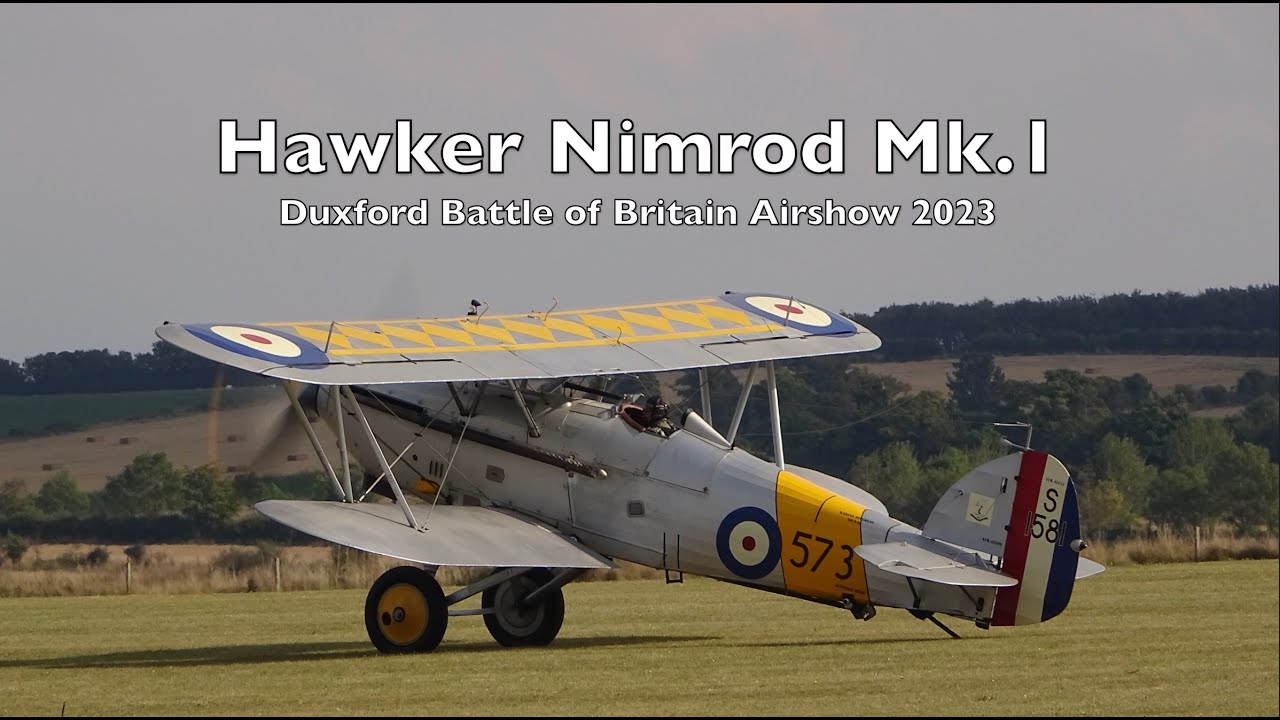
Hawker Nimrod Mk.1 - Duxford Battle of Britain Airshow 2023
Автор: High Flight
Загружено: 2023-10-08
Просмотров: 858
Описание:
Pete Kinsey flying the Fighter Collection's Hawker Nimrod Mk.1,S1581, G-BWWK, at the Imperial War Museum, Duxford on the first day of the Battle of Britain Airshow 2023.
This Nimrod was the third production aircraft built by Hawkers. It was delivered to 408 Fighter Flight as ‘573’ on HMS Glorious. The flight became 803 Naval Air Squadron (NAS) in April 1933. S1581 stayed aboard Glorious until written off in early 1938. She is believed to have then spent a number of years with an air or sea cadet squadron prior to being sold for scrap.
The substantial remains were recovered from Coley's scrapyard in Hounslow, West London in the early 1970s and donated to the RAF Museum. In the early 1980s they exchanged just the fuselage for a pair of Bristol Bulldog wings with Viv Bellamy, of Land’s End airport, who used the fuselage as patterns to make a non-authentic Hawker Fury replica for the then well known collector, Patrick Lindsay. The remains and other collected Hawker parts were purchased by The Historic Aircraft Collection, which later also got the wings from the RAF Museum.
The aircraft's history has been lost, though evidence from log books and photographs show it still in service on HMS Glorious, with 802 NAS in 1938 and ‘507’ painted on both sides of the rear fuselage. The last official record of the aircraft was of a category “W” landing accident in Malta during 1938.
The Royal Navy identity was found on a number of major components (fuel tank, the fuel tank mount, oil tank) as crudely painted 'Nimrod 81'. On a brass data plate on the oil tank was the date '10-12-31' and the manufacturer's serial of 41H.43617. On this evidence and the fact that it is a Nimrod 1 from the construction, it's fairly certain this aircraft is S.1581, as it was practice in the Navy at the time to brush crudely on major components an abbreviated serial, due to the frequent repairs needed after deck landings.
Restoration was completed by Aero Vintage Ltd and finished during the summer of 2000. The first flight was on the 7th July 2000 at RAF Henlow.
The aircraft was exchanged with The Fighter Collection, for a Hawker Hurricane, on 15 August 2002.
The Hawker Nimrod was a carrier-based single engine fighter built in the 1930s by Hawker Aircraft Limited.
A pair of naval aircraft were created as a private venture. These Sydney Camm designed prototypes included the Rolls-Royce Kestrel-powered aircraft, unofficially known as the Hawker Norn.It was this design that later became the prototype Hawker Nimrod. The second aircraft was the radial engined Hawker Hoopoe.
Encouraged by the success of the Hawker Fury biplane, Camm persevered with development of a machine, powered by the cleaner Rolls-Royce F.XIMS engine, later designated the Rolls-Royce Kestrel II MS.
Specification 16/30 was based on Camm’s proposal for a Kestrel-powered naval fighter design. Two airframes were built, one test flown and one for ground tests. Because this was a private venture, they did not carry RAF serials and the flight aircraft was given the company registration HN1.
After testing at Martlesham Heath, a contract was raised to purchase the prototype, which was then modified to the required production standard. At this time, it was issued with a serial number (S1577) and given the official name of Hawker Nimrod. The aircraft was flown in this form on 14th October 1931.
All Hawker Nimrod aircraft were designed to accept an interchangeable wheeled or float undercarriage and three production batches were ordered for a total of 54 aircraft, designated Hawker Nimrod I. One of these (K2823) had arrester gear and slightly swept, upper and lower wings, becoming in effect, the prototype Hawker Nimrod II.
The Hawker Nimrod II entered production in September 1933 with 27 ordered, three of which (K2909 to K2911) made use of a stainless steel structure.
The majority of Hawker Nimrod IIs were initially powered by the Rolls-Royce Kestrel IIS engine, with later aircraft receiving the 608hp Rolls-Royce Kestrel VFP engine, which was also retrofitted to the early machines.
A limited number of Nimrods were exported - 2 for Denmark powered by Rolls-Royce Kestrel IIIS engines, 1 to Japan where it was designated Hawker AXH and 1 to Portugal. 10 were made under licence in Denmark as the 'Nimrodderne', built at the Orlogsvaerftet Naval Dockyards.
Full Nimrod production comprised of the prototype, 54 Nimrod Is, 27 Nimrod IIs, 4 export and 10 licence-built aircraft, totalling 106 aircraft.
The Nimrod never fired her guns in anger, but served well with both the Home and Mediterranean Fleets. The last Nimrods to fly operationally were with 802 Naval Air Squadron (NAS), when they were replaced by Sea Gladiators at Hal Far, Malta, in May 1939. The very last Nimrod in Fleet Air Arm service was Mk.I S1582, which was being used as a hack with 753 NAS undertaking weather checks until she was retired in January 1942.
Video and Audio content is
Copyright © High Flight
Повторяем попытку...
Доступные форматы для скачивания:
Скачать видео
-
Информация по загрузке:


![The Polish-Built Hero Of Eastern Europe | PZL.24 [Aircraft Overview #94]](https://image.4k-video.ru/id-video/qM141DqhBJw)