8. Kevin Ahern's Biochemistry - Hemoglobin
Автор: Kevin Ahern's YouTube Videos - Lectures and More
Загружено: 2013-10-17
Просмотров: 14844
Описание:
1. Contact Kevin at [email protected]
2. Kevin's lectures with The Great Courses - https://www.thegreatcoursesplus.com/b...
3. Kevin's Lecturio videos for medical students - https://www.lecturio.com/medical-cour...
4. Course materials at https://kevingahern.com/biochemistry-...
5. Course video channel at • 1. Kevin Ahern's Biochemistry - Introduction
6. Metabolic Melodies at https://teeheetime.com/category/lyric...
7. Kevin's Free Biochemistry books - https://kevingahern.com/biochemistry-...
8. Kevin's Pre-med Audio course on Listenable - https://listenable.io/web/courses/143...
Highlights
1. X-ray crystallography allows one to determine the 3D coordinates of every atom in the crystal to within Angstroms.
2. Nuclear magnetic resonance (NMR) is a technique that uses the spin of certain nuclei, such as protons to study structure. It has the advantage of providing structural information about molecules in aqueous solution, instead of in crystal form.
Highlights Hemoglobin
1. Myoglobin and hemoglobin are involved in storing and carrying oxygen in the body.
2. Myoglobin holds oxygen tighter than hemoglobin and serves in a battery-like capacity in tissues to release oxygen when tissue oxygen concentration is very low.
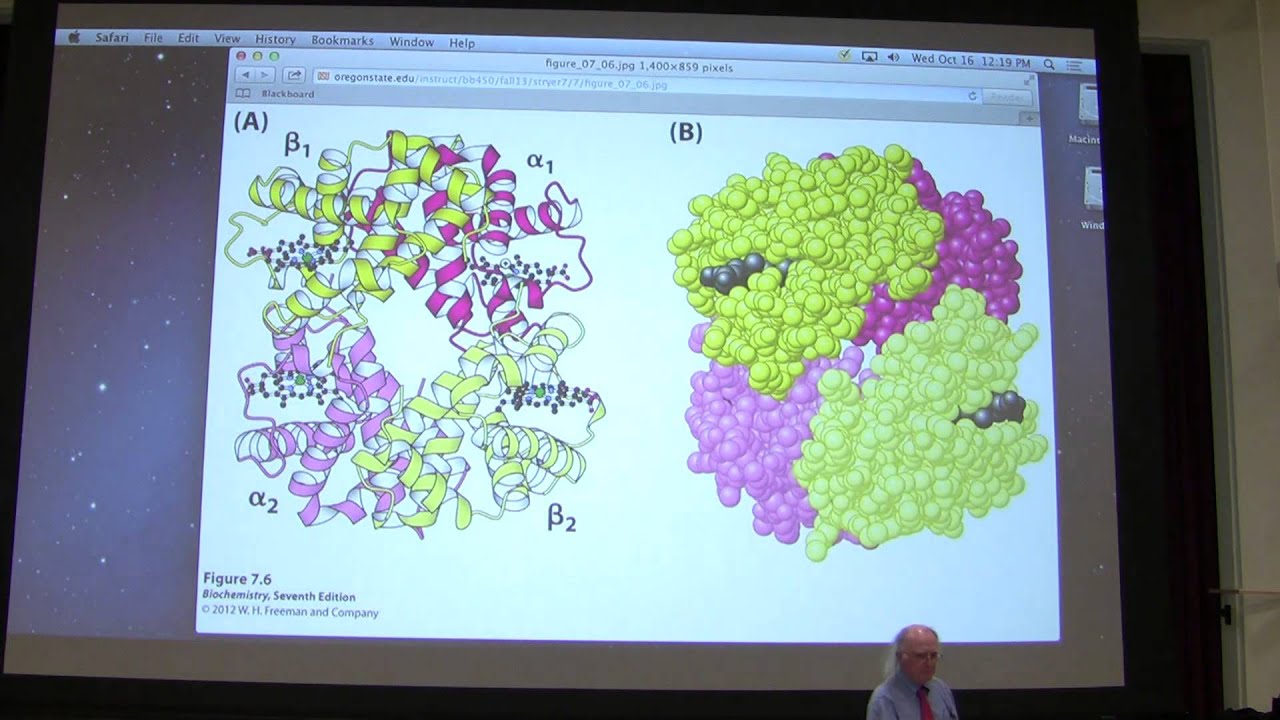
3. Hemoglobin is a four-subunit protein complex (two alpha subunits and two beta subunits) that carries oxygen from the lungs to the tissues.
4. Myoglobin and hemoglobin have porphyrin rings to hold ferrous iron.Heme is a term used to describe the protoporphyrin IX complexed with iron.
5. The heme iron held by four nitrogens of the protoporphyrin IX ring and a histidine. Oxygen is carried between the iron and an additional histidine not involved in holding the iron.
6. If one plots the percentage of oxygen sites bound versus partial pressure for myoglobin, a hyperbolic curve is generated, consistent with a molecule with a single binding site and a high affinity for oxygen. The P50 is very low for myoglobin, consistent with high affinity.
7. Hemoglobin is better designed to meet an organism's physiological needs for carrying oxygen than myoglobin. This is due to its four-subunit organization which behaves in a cooperative fashion in binding oxygen.
8. Binding of oxygen by iron causes it to be pulled up slightly. This causes the histidine attached to it to change position, which causes all the other amino acids in the subunit to change. The changes in shape result in the protein gaining affinity for oxygen as more oxygen is bound. The phenomenon is referred to as cooperativity.
9. Hemoglobin can exist in a "tight" state, called 'T', which exhibits low oxygen binding affinity. Hemoglobin in the T state will tend to release oxygen.
10. A second state of hemoglobin is the "relaxed" or R state, which exhibits increased oxygen binding affinity. Binding of oxygen by hemoglobin flips it from the T to the R state and release of oxygen by hemoglobin helps it to flip from R to T.
11. 2,3-bisphosphoglycerate (2,3 BPG) is produced by actively respiring tissues. It can bind in the gap in the center of the hemoglobin molecule and in doing so, stabilize the T state and favor the release of oxygen. Thus, tissues that are actively respiring get more oxygen. 2,3 BPG is in higher concentration in the blood of smokers.
12. Fetal hemoglobin differs from adult hemoglobin in having two gamma subunits in place of the two beta subunits that adults have. This changes the hemoglobin molecule such at 2,3BPG can't bind, so fetal hemoglobin exists more in the R state and thus has a higher affinity for oxygen than adult hemoglobin. Thus, the fetus can take oxygen from the mother's hemoglobin.
13. The Bohr effect describes physiological and molecular responses to changes in pH with respect to oxygen and carbon dioxide in the body. The oxygen effects arise from changes in the tertiary structure of hemoglobin arising from binding of protons to histidines in the molecule when under low pH.
14. Rapidly metabolizing tissues (such as muscle) generate low pHs, due to release of carbon dioxide and the conversion of this to carbonic acid by carbonic anhydrase. Carbonic acid readily loses a proton, becoming bicarbonate.
15. Thus, rapidly metabolizing tissues generate protons, which get absorbed by hemoglobin, which releases oxygen to feed the tissues.
16. CO2 can also be taken up by hemoglobin at amine residues, causing protons to be released. Note that CO2 binds hemoglobin at a site other than what oxygen binds. CO, however, can compete with oxygen for binding to the heme.
17. In the lungs, a reversal of this process occurs.
Повторяем попытку...
Доступные форматы для скачивания:
Скачать видео
-
Информация по загрузке:


