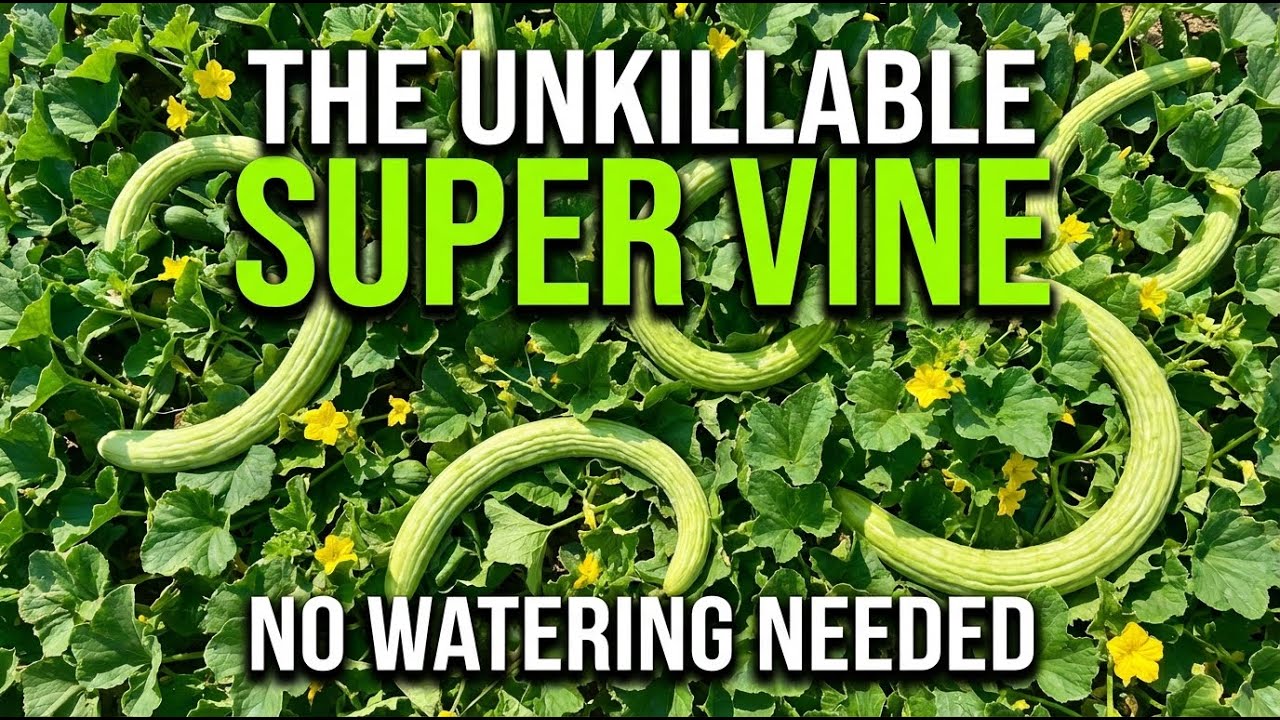
Better Than Cucumbers. The "Unkillable" Vine That Feeds You All Summer (No Watering)
Автор: Deeply Rooted Knowledge
Загружено: 2026-01-30
Просмотров: 99
Описание:
What if there was a cucumber-like vine that thrives in 110°F heat, needs watering only once a week, and never turns bitter?
In this video, we reveal the Armenian cucumber — a remarkable plant that's actually not a cucumber at all. It's a variety of musk melon (Cucumis melo var. flexuosus) that's been feeding gardeners in the Middle East and Mediterranean for over 600 years. While your neighbors are out watering their wilting cucumber plants twice a day, you could be harvesting crisp, sweet, foot-long fruits with almost zero effort.
We break down exactly why this plant is so resilient, including a head-to-head comparison showing how Armenian cucumbers outperform regular cucumbers in heat tolerance, bitterness resistance, watering needs, and size. You'll learn the best planting times, ideal soil temperatures, recommended varieties like Painted Serpent and Yard Long, plus harvesting tips for perfect flavor every time.
We also cover the nutritional benefits (over 95% water content, vitamins C and K, magnesium) and delicious ways to use your harvest — from fresh salads to homemade pickles to a simple Tajín-dusted snack.
But that's not all. We share three bonus "unkillable" summer vines that deserve a spot in your garden: Malabar spinach that thrives above 90°F, luffa gourds that double as food AND natural sponges, and chayote squash — a perennial that can produce 50-100 fruits per year with virtually no watering after establishment.
Whether you're gardening in a hot climate, trying to conserve water, or simply tired of babysitting demanding plants, these resilient vines will transform your summer garden.
Timestamps, resources, and seed sources in the comments!
🌱 Don't forget to subscribe for more low-maintenance gardening tips!
📚 SOURCES:
Ferrández-Gómez, B., et al. (2021). "Distinctive Traits for Drought and Salt Stress Tolerance in Melon (Cucumis melo L.)." Frontiers in Plant Science, 12, 777060. DOI: 10.3389/fpls.2021.777060
Pandey, S., et al. (2011). "Evaluation of melons and indigenous Cucumis spp. genotypes for drought tolerance." II International Symposium on Underutilized Plant Species: Crops for the Future – Beyond Food Security, 979, 335–339. DOI: 10.17660/ActaHortic.2013.979.35
Ansari, W.A., et al. (2019). "Drought mediated physiological and molecular changes in muskmelon (Cucumis melo L.)." PLoS ONE, 14(12), e0222647. DOI: 10.1371/journal.pone.0222647
Tanveer, A., et al. (2012). "Effect of temperature, light, salinity, drought stress and seeding depth on germination of Cucumis melo var. agrestis." Pakistan Journal of Weed Science Research, 18(4), 445–459.
Kumari, N., et al. (2021). "An updated review on Malabar spinach (Basella alba and Basella rubra) and their importance." The Pharma Innovation Journal, 10(2), 481-489.
Khan, M.I., et al. (2016). "Phytoconstituents and stability of betalains in fruit extracts of Malabar spinach (Basella rubra L.)." Journal of Food Science and Technology, 53(11), 4012–4018. DOI: 10.1007/s13197-016-2404-8
Stephens, J.M. (2003). "Cucumber, Armenian—Cucumis melo L. (Flexuosus group)." EDIS, University of Florida IFAS Extension. DOI: 10.32473/edis-mv056-1994
Повторяем попытку...
Доступные форматы для скачивания:
Скачать видео
-
Информация по загрузке: