Class (68)= Natural Resin (Part 05) | Identification Test for Resin | QualitativeTest for Resin
Автор: Solution- Pharmacy
Загружено: 2019-10-27
Просмотров: 12124
Описание:
Download "Solution Pharmacy" Mobile App to Get All Uploaded Notes, Model Question Papers, Answer Papers, Online Test and other GPAT Materials - https://play.google.com/store/apps/de...
1. Introduction to Natural Resin- Part 1 by Solution Pharmacy in Hindi • Class (64) = Natural Resin (Part 01) | Int...
2. Physical and Chemical Properties of Resin by Solution Pharmacy in Hindi • Class (65)= Natural Resin (Part 02) | Prop...
3. Classification of Resin Part-1 by Solution Pharmacy in Hindi • Class (66)= Natural Resin (Part 03) | Type...
4. Classification of Resin- Part 2 by Solution Pharmacy in Hindi
• Class (67)= Natural Resin (Part 04) | Type...
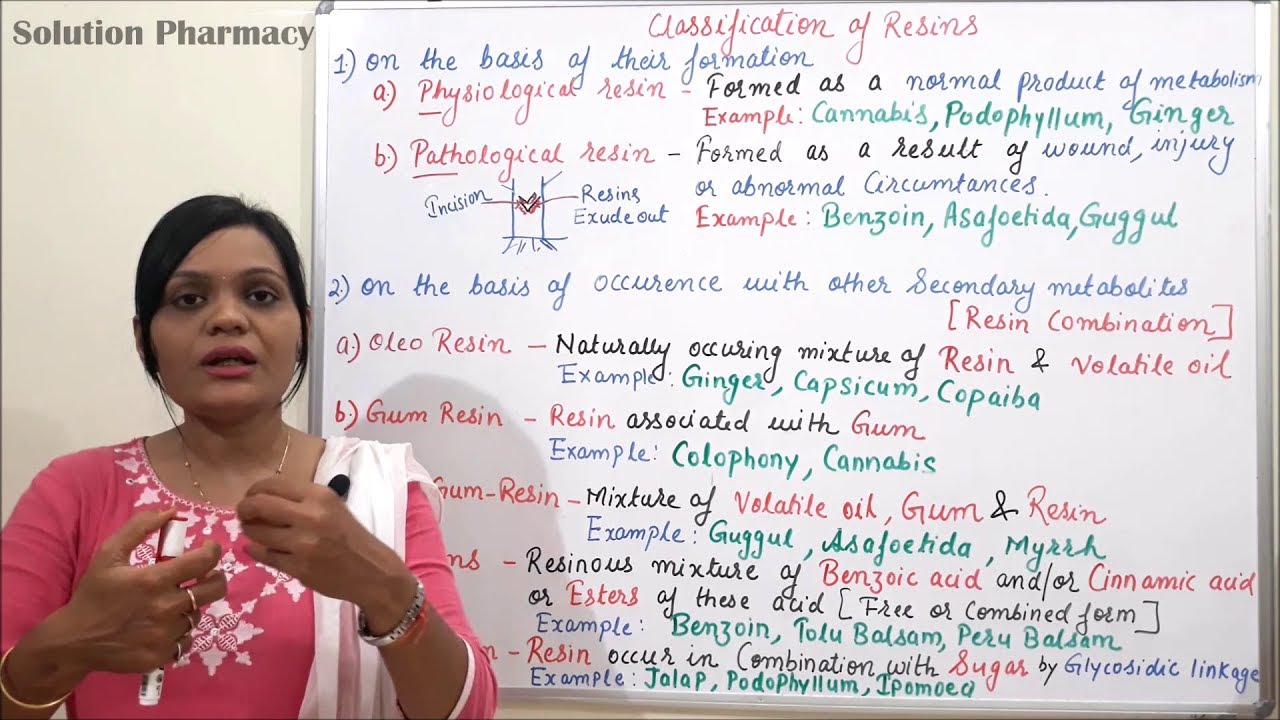
Resins are amorphous products of complex nature. These are amorphous mixtures of essential oils, oxygenated products of terpene and carboxylic acids found as exudations from the trunk of various trees. They are transparent or translucent solids, semi-solids or liquid substances containing large number of carbon atoms. Most of the resins are heavier than water. They are insoluble in water, but soluble in alcohol, volatile oils, fixed oils, chloral hydrate and non-polar organic solvents like benzene or ether. Chemically, they contain organic acids, alcohols, esters and neutral resins. Examples: Asafoetida, benzoin, guggul, Capsicum, cannabis, Turmeric ginger, podophyllum
Distribution of Resins in Plants: Distributed throughout the entire plant kingdom, specifically the Spermatophyta i.e., the seed plants, rare in the Pteridophyta i.e., the ferns and their allies.
Occurrence of Resins in plants: In the plants resins usually occur in different secretory zones or structures. A few typical examples:
i. Resin Cells: Ginger
ii. Schizogenous Ducts or Schizolysogenous Ducts or Cavities: Pine Wood
iii. Glandular Hairs: Cannabis
Resin is a hydrocarbon secretion of many plants, particularly coniferous trees. It is valued for its chemical constituents and uses, such as varnishes and adhesives, as an important source of raw materials for organic synthesis, or for incense and perfume. Fossilized resins are the source of amber. Resins are also a material in nail polish. While some scientists view resins only as waste products, their protective benefits to the plant. Many resinous products are not formed by the plant itself unless and until purposeful and methodical injuries in the shape of incisions are made on them and the secretions or plant exudates are tapped carefully, such as: Balsam of Tolu and Benzoin
Get in touch with the solution by just clicking following links-
Facebook Group- / solutionpharamcy
Facebook Page- / pharmavideo
New channel (Pharmacy Dictionary) - / @pharmacydictionary
Instagram- / solutionpharmacy
E-Mail for official and other work - [email protected]
LinkedIn- / pushpendrakpatel
#solutionpharmacy #Pharmacologyclass #GPATonlinetest
Повторяем попытку...

Доступные форматы для скачивания:
Скачать видео
-
Информация по загрузке:











![Эффект Джанибекова [Veritasium]](https://imager.clipsaver.ru/N9HlQ-XVnFk/max.jpg)