Do Animals Protect Human Babies?
Автор: Ask Qualia
Загружено: 2026-06-05
Просмотров: 506
Описание:
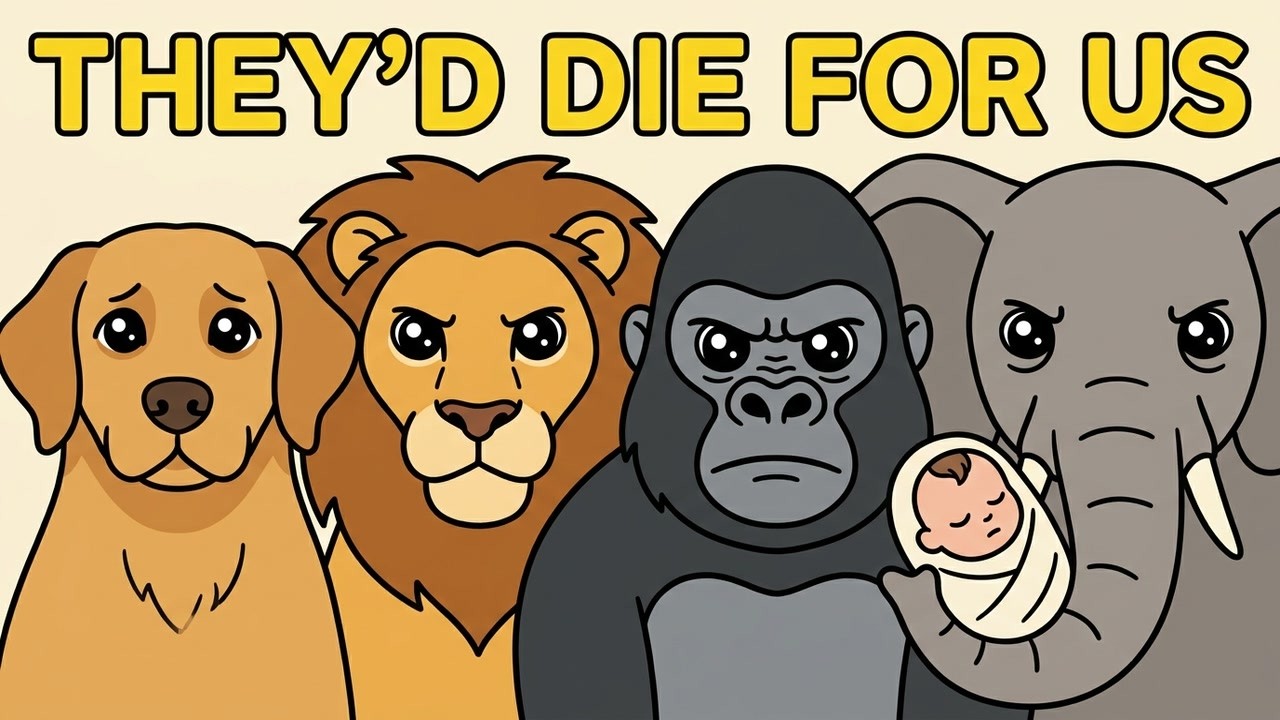
Do animals protect human babies? Not by accident — but on purpose, again and
again, in exactly the predators that should see a small, soft, helpless human
and find either a threat or a meal. A silverback gorilla stands guard over an
unconscious boy. A starving street dog carries an abandoned newborn to safety.
Dolphins build a living wall around swimmers while a great white circles
beneath. This video is about why that keeps happening — and the answer is
stranger, and older, than kindness.
It turns out "protect the baby" isn't a choice these animals make. It's a
system, running on three channels at once. SIGHT: the baby schema Konrad Lorenz
named in 1943 — big eyes, round head, tiny nose — proportions that trip the
caregiving circuits of almost any animal that raises its young, in under a fifth
of a second, even across species. SOUND: infant distress cries that hit the
amygdala harder than almost any sound in nature — the biologist Susan Lingle
found mother deer come running to the cries of marmots, seals, even human
babies. And SMELL: a chemical "white flag" that reads, to an experienced nose,
as I'm not a threat — stand down.
But there's a deeper mystery the science still hasn't closed. Tolerance is
cheap; these animals go further. A dolphin spends its own energy and puts its
own body between a human and a shark. Jambo stepped between a child and his own
troop. Evolution isn't supposed to pay costs to protect strangers — least of
all strangers from a species you could eat. So why do they? Nobody knows for
certain. What we do know is that the same circuit is running in you right now —
the one that won't let you walk past a shivering puppy in the rain. We are not
standing outside this system. We are its most extreme expression. And when the
moment actually comes… a lot of them would die for us.
CHAPTERS
0:00 The silverback who stood guard (Jambo, Jersey 1986)
1:28 You've felt this too — dogs and newborns
1:56 The stray dog that saved "Angel" (Nairobi, 2005)
2:45 Three lions guard a kidnapped girl (Ethiopia)
3:18 Dolphins, then a whale, in the open ocean
4:23 The question is: why?
4:33 Binti Jua and her own baby (Brookfield Zoo, 1996)
5:23 It isn't kindness — it's a system
5:26 Channel one: the baby face (Lorenz's "baby schema")
6:44 An honest caveat: animals kill babies too
7:35 Channel two: the cry the brain can't ignore
8:34 Channel three: smell
9:52 They're not tolerating us — they're taking a risk
10:21 So why? Three theories
11:16 The why is still wide open
11:21 We take it furthest — we adopt, raise, grieve
12:24 It's working on you right now
12:41 Three hundred million years — and "they'd die for us"
REFERENCES & FURTHER READING
The baby schema (Kindchenschema)
— Lorenz, K. (1943). Die angeborenen Formen möglicher Erfahrung. Zeitschrift für Tierpsychologie, 5(2), 235–409.
— Glocker, M.L. et al. (2009). Baby schema in infant faces induces cuteness perception and motivation for caretaking in adults. Ethology, 115(3), 257–263.
— Glocker, M.L. et al. (2009). Baby schema modulates the brain reward system in nulliparous women. PNAS, 106(22), 9115–9119.
The brain's rapid response to infant faces and cries
— Kringelbach, M.L. et al. (2008). A specific and rapid neural signature for parental instinct. PLoS ONE, 3(2), e1664.
— Parsons, C.E. et al. (2013). Minor structural alterations in the infant face disrupt neural processing.
Cross-species response to infant distress calls
— Lingle, S. & Riede, T. (2014). Deer mothers are sensitive to infant distress vocalizations of diverse mammalian species. The American Naturalist, 184(4), 510–522.
Infanticide in the wild (the "nature is not sentimental" caveat)
— Pusey, A.E. & Packer, C. (1994). Infanticide in lions: consequences and counterstrategies.
— Watts, D.P. et al. (2002). Lethal intergroup aggression and infanticide in chimpanzees.
Documented protection cases (reported events)
— Jambo, silverback at Jersey Wildlife Park (Durrell), 31 Aug 1986 — guarded a fallen 5-year-old (filmed).
— Binti Jua, western lowland gorilla, Brookfield Zoo, 16 Aug 1996 — carried an unconscious 3-year-old to keepers with her own infant on her back.
— Nairobi stray dog ("Angel"), 2005 — carried an abandoned newborn to safety.
— Ethiopian lions, 2005 — reportedly guarded an abducted 12-year-old until rescue (widely reported).
— New Zealand dolphins, 2004 — pod ringed lifeguard Rob Howes and three swimmers, shielding them from a great white.
— Humpback whale and diver Nan Hauser, 2017, Cook Islands — whale shielded her from a tiger shark (reported).
#animals #science #animalbehavior #psychology #didyouknowseries
Повторяем попытку...
Доступные форматы для скачивания:
Скачать видео
-
Информация по загрузке: