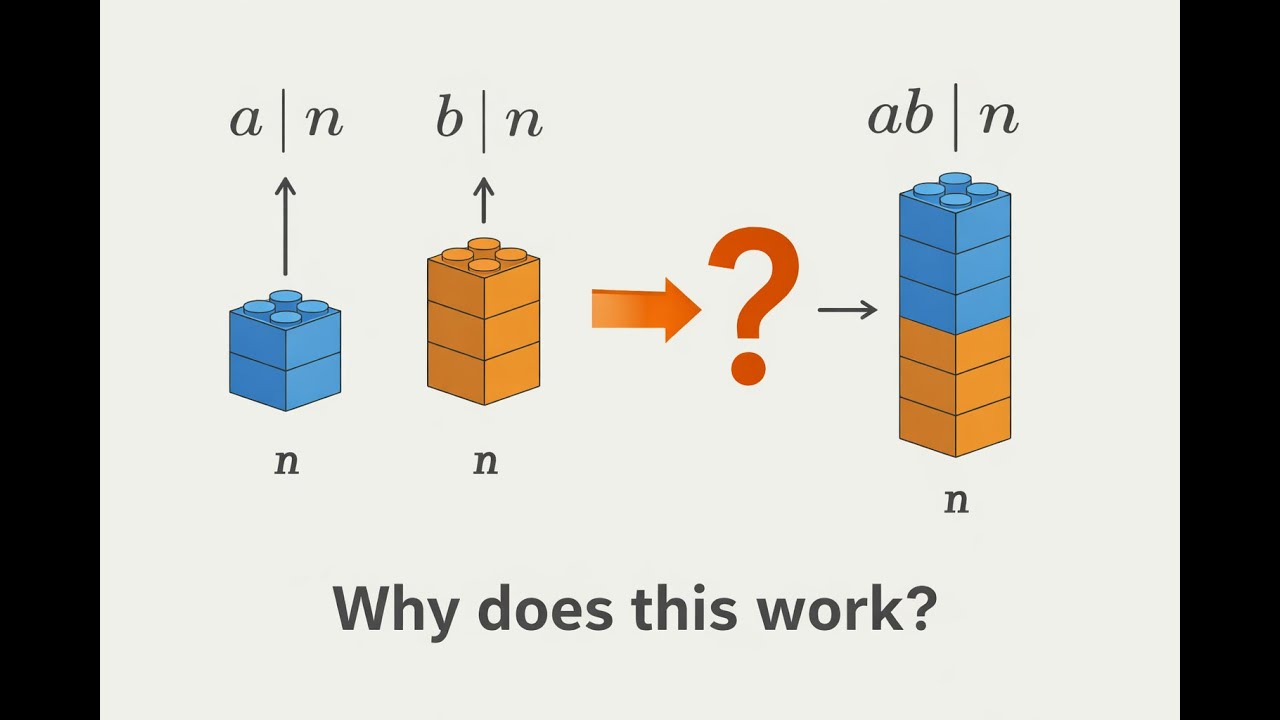
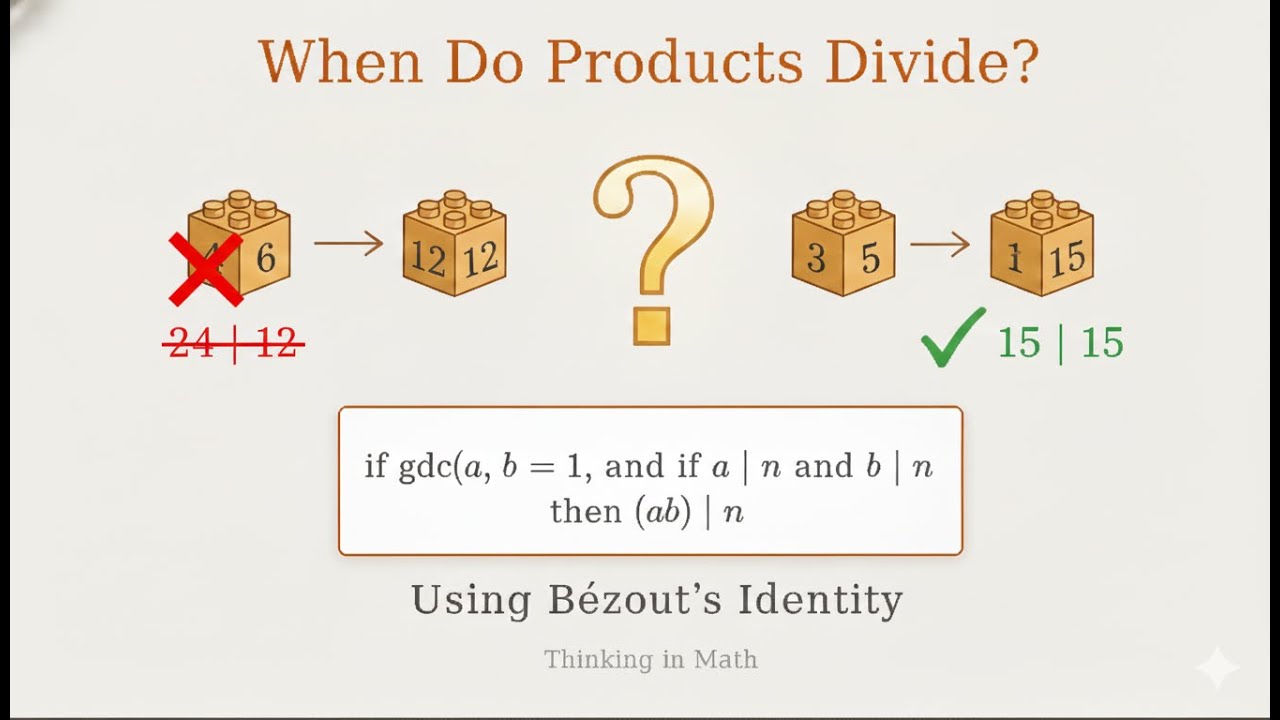
When do a∣n and b∣n imply ab∣n? (Using Bézout’s Identity)
Автор: Thinking In Math
Загружено: 2026-01-05
Просмотров: 23
Описание:
If a ∣ n and b ∣ n, does that always mean ab ∣ n? In this mini-lecture, we dig into a classic divisibility question and show exactly when the product rule works – and why Bézout’s Identity is the key tool behind the scenes.
We start with simple counterexamples like 4 ∣ 12 and 6 ∣ 12 but 24 ∤ 12 to see why the naive rule fails when gcd(a,b) ≠ 1. Then we introduce Bézout’s Identity (ax + by = 1 when gcd(a,b) = 1) and use it to build a clean, rigorous proof that
a ∣ n, b ∣ n, gcd(a,b) = 1 ⇒ ab ∣ n.
You’ll see how to:
Turn gcd(a,b) = 1 into an equation using Bézout
Multiply that equation by n to force an ab factor
Understand why coprime factors are essential
Turn the theorem into practical tricks for testing divisibility by 12, 15, 30, and more
This video is ideal for students studying number theory, contest math, or preparing for proofs courses, as well as anyone curious about the structure behind familiar divisibility rules.
Keywords: divisibility, Bézout’s Identity, gcd, coprime integers, number theory, proof, divisibility tests, ab | n, a | n and b | n, math lecture, integers
If you found this helpful, please like the video, subscribe for more short proof-based lessons, and share your own examples or questions about divisibility in the comments!
Повторяем попытку...
Доступные форматы для скачивания:
Скачать видео
-
Информация по загрузке: