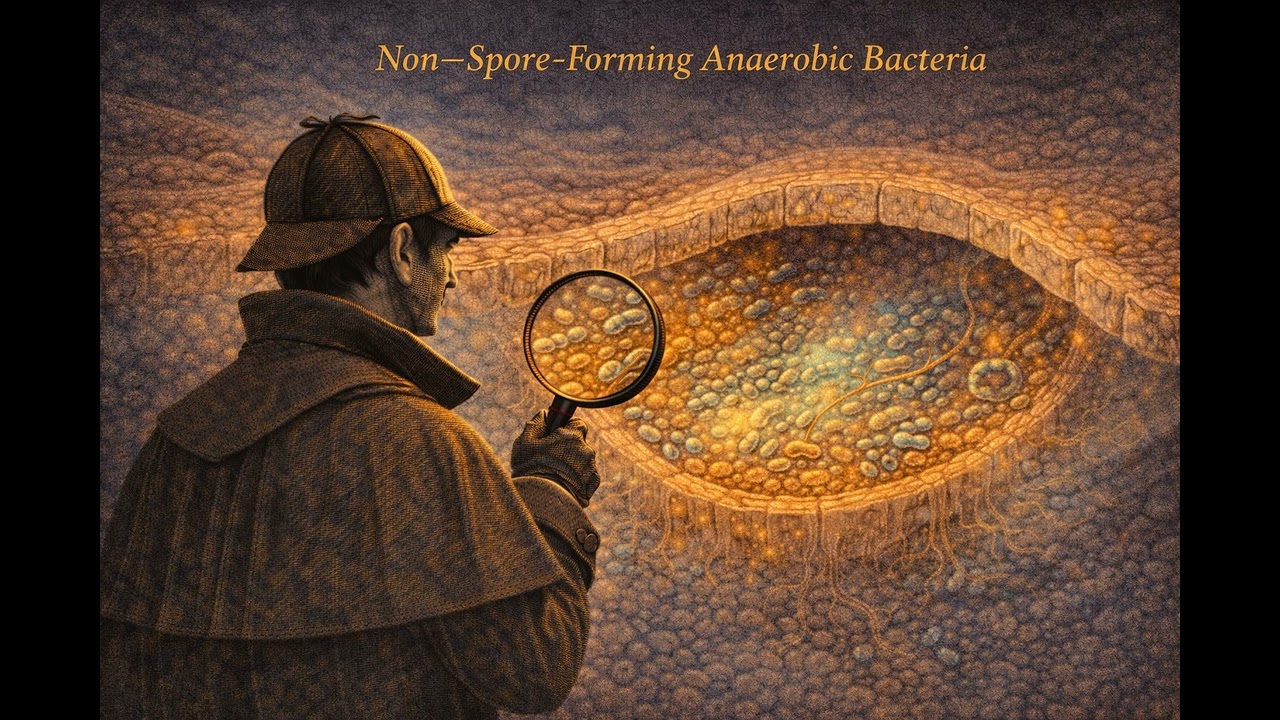
Micro 31: Non–Spore-Forming Anaerobic Bacteria
Автор: Medlock Holmes
Загружено: 2026-02-20
Просмотров: 1
Описание:
This episode explores the clinically significant anaerobic bacteria that do not form spores. Drawing from Murray’s Chapter 31, it focuses on organisms that are normal residents of mucosal surfaces yet become pathogenic when anatomical barriers are breached.
Key genera include Bacteroides, Prevotella, Fusobacterium, and anaerobic Gram-positive cocci. These organisms thrive in low-oxygen environments and frequently participate in polymicrobial infections - intra-abdominal abscesses, aspiration pneumonia, pelvic infections, and deep tissue necrosis.
The narrative emphasises ecological balance: these bacteria are harmless within their native niches but pathogenic when displaced. Their virulence mechanisms include capsule production, beta-lactamase secretion, and synergistic cooperation with facultative organisms that consume oxygen, creating ideal anaerobic conditions.
Clinically, this chapter reinforces three principles:
Anaerobic infections are often polymicrobial
Foul odour and abscess formation are common clues
Effective management requires both antimicrobial therapy and source control
Conceptually, non–spore-forming anaerobes illustrate community behaviour - disease emerging from cooperation rather than dominance by a single organism.
Key Takeaways
Many anaerobes are normal flora of mucosal surfaces
Infection often follows tissue disruption or aspiration
Polymicrobial synergy enhances virulence
Abscess formation creates protected anaerobic niches
Surgical drainage is often essential for cure
This is a public episode. If you'd like to discuss this with other subscribers or get access to bonus episodes, visit drmanaankarray.substack.com/subscribe (https://drmanaankarray.substack.com/s...)
Повторяем попытку...
Доступные форматы для скачивания:
Скачать видео
-
Информация по загрузке:








![Massive Attack • Portishead • Morcheeba • Chet Faker - Special Coffeeshop Selection [Seven Beats]](https://imager.clipsaver.ru/3Vz-oMrXkRs/max.jpg)