lesson 1 شرح Unit 1second term Science prep 1
Автор: ON SCIENCE
Загружено: 2026-02-02
Просмотров: 120
Описание:
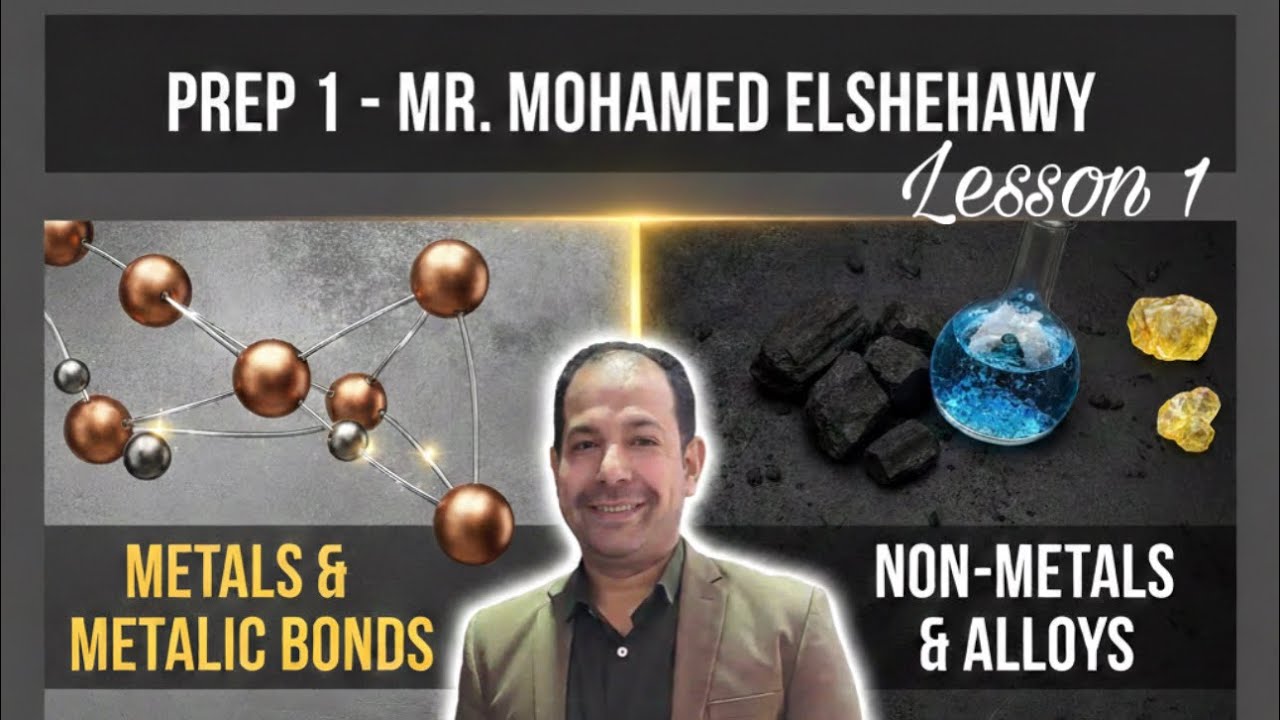
The video "Science Unit 1 lesson 1 second term prep 1" is an educational lecture by Mr. Mohamed El Shahawi for Prep 1 students (Grade 7). It covers the fundamental concepts of metals and non-metals, their properties, and advanced topics like metallic bonds and alloys.
Detailed Summary of the Video
1. Metals vs. Non-Metals [01:35]
Electronic Configuration: Metals typically have 1, 2, or 3 electrons in their outermost energy level, while non-metals have 5, 6, or 7 [01:48].
Physical States: Most metals are solids (except Mercury, which is liquid). Non-metals can be solids, liquids (Bromine), or gases [04:01].
Luster: Metals have a shiny "metallic luster," whereas non-metals appear dull (except for carbon/graphite in some forms) [05:02].
Malleability and Ductility: Metals are malleable (can be hammered into sheets) and ductile (can be drawn into wires). Non-metals are brittle and break apart when hammered [06:13].
Conductivity: Metals are excellent conductors of heat and electricity. Non-metals are poor conductors, with the notable exception of Graphite (Carbon), which conducts electricity [07:32].
2. Metallic Bonds [12:46]
The instructor explains that metallic bonds are formed by the attraction between positively charged metal ions and a "cloud" of free-moving valence electrons [16:17].
The strength of a metallic bond increases as the number of valence electrons increases (e.g., Aluminum has a stronger bond and higher melting point than Sodium) [20:35].
3. Alloys (سبائك) [24:14]
An alloy is a mixture of two or more elements, at least one of which is a metal. They are created to enhance properties like hardness or resistance to rust [26:21].
Steel: A mixture of iron and other elements to prevent rusting [26:05].
Bronze: An alloy consisting primarily of Copper (95%) and Tin (5%) [29:01]. It is harder than pure copper and resistant to corrosion [29:54].
4. Metal Recycling [30:38]
The video emphasizes the importance of recycling metals, noting that it is more cost-effective and easier than extracting new metal from ores (rocks) [32:54].
Recycling helps preserve natural resources as the availability of metals in the Earth's crust decreases over time [32:01].
The lesson is part of a series intended for the 2026 academic term, and the instructor encourages students to subscribe for the upcoming exercise-solving video for this lesson [33:48].
Watch the full video here: • lesson 1 شرح Unit 1second term Science prep 1
#أكاديمية_العبقري #تعليم_أونلاين #دروس_أونلاين #شرح_مبسط
Повторяем попытку...
Доступные форматы для скачивания:
Скачать видео
-
Информация по загрузке: