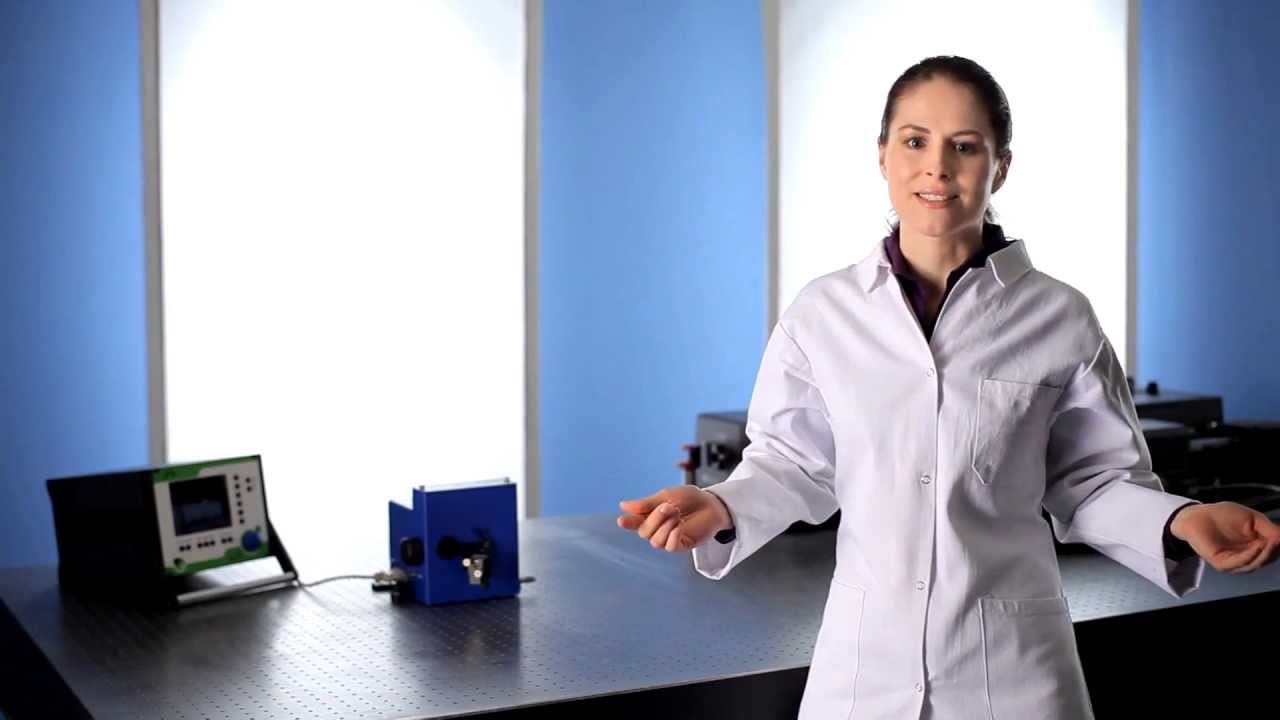
Prism Compressor for Ultrashort Laser Pulses
Автор: delmarphotonics
Загружено: 2020-08-28
Просмотров: 183
Описание:
Prism Compressor for Ultrashort Laser Pulses - request a quote at [email protected]
Aligning femtosecond Trestles Pulse stretcher compressor using near IR viewer
Pulse stretcher/compressor PSC_1020-1080 - request a quote [email protected]
Wavelength range, nm: 1020-1080
Introduced dispersion@1064 nm, min-max, fs2: (+1500) - (-4700)
Transmission: more than 90%@1064 nm
Input polarization, linear: horizontal
Maximum input beam diameter, mm: 4
http://www.dmphotonics.com/Pulse_Stre...
Del Mar’s pulse compressor is used for controlling dispersion of femtosecond laser pulses. The ability to change GVD (group velocity dispersion) at wide range allows to
pre-compress dispersion introduced by additional optics, for example, optical parts of the microscope and obtain minimal pulse duration directly at the irradiated sample. Input and output beams are located at the same height and have the same direction to considerably simplify the alignment of your setup. Scheme of the device supports possibility of direct beam
pass-through bypassing the dispersive elements. Two variants of the compressor possess different dispersion ranges for various possible setups.
For example, a transform-limited Gaussian-shaped pulse with duration of 100 fs at 800 nm is passing through microscope optics with total positive dispersion of 8000 fs2, that corresponds to pulse broadening to 254 fs. Our device helps to add negative dispersion to the fs pulse before injecting the pulse into the microscope. This ensures that you have the same 100 fs transform-limited pulse at the studied sample.
Optimal pulse management can be achieved by the combination of the pulse compressor and the Reef-RTD scanning autocorrelator (microscope-adapted version available).
• Ideal for multi-photon microscopy
• Simple adjustment and operation
• Bypass function
Pulse stretcher/compressor PSC_1020-1080 - request a quote
Wavelength range, nm: 1020-1080
Introduced dispersion@1064 nm, min-max, fs2: (+1500) - (-4700)
Transmission: more than 90%@1064 nm
Input polarization, linear: horizontal
Maximum input beam diameter, mm: 4
Reef femtosecond autocorrelators - request a quote at [email protected]
The autocorrelation technique is the most common method used to determine laser pulse width characteristics on a femtosecond time scale.
The basic optical configuration of the autocorrelator is similar to that of an interferometer (Figure.1). An incoming pulse train is split into two beams of equal intensity. An adjustable optical delay is inserted into one of the arms. The two beams are then recombined within a nonlinear material (semiconductor) for two photon absorption (TPA). The incident pulses directly generate a nonlinear TPA photocurrent in the semiconductor, and the detection of this photocurrent as a function of interferometer optical delay between the interacting pulses yields the pulse autocorrelation function. The TPA process is polarization-independent and non-phasematched, simplifying alignment.
Reef-RT autocorrelator measures laser pulse durations ranging from 20 femtoseconds to picosecond regime. It measures pulse widths from both low energy, high repetition rate oscillators and high energy, low repetition rate amplifiers.
Pismo pulse picker - request a quote at [email protected]
The Pismo pulse picker systems is as a pulse gating system that lets single pulses or group of subsequent pulses from a femtosecond or picosecond pulse train pass through the system, and stops other radiation. The system is perfectly suitable for most commercial femtosecond oscillators and amplifiers. The system can pick either single pulses, shoot bursts (patterns of single pulses) or pick group of subsequent pulses (wider square-shaped HV pulse modification). HV pulse duration (i.e. gate open time) is 10 ns in the default Pismo 8/1 model, but can be customized from 3 to 1250 ns upon request or made variable. The frequency of the picked pulses starts with single shot to 1 kHz for the basic model, and goes up to 100 kHz for the most advanced one.
The Pockels cell is supplied with a control unit that is capable of synching to the optical pulse train via a built-in photodetector unit, while electric trigger signal is also accepted. Two additional delay channels are available for synching of other equipment to the pulse picker operation. Moreover, USB connectivity and LabView-compatible drivers save a great deal of your time on storing and recalling presets, and setting up some automated experimental setups. One control unit is capable of driving of up to 3 Pockels cells, and this comes handy in complex setups or contrast-improving schemes. The system can also be modified to supply two HV pulses to one Pockels cell unit, making it a 2-channel pulse picker system. This may be essential for injection/ejection purposes when building a regenerative or multipass amplifier system.
Повторяем попытку...

Доступные форматы для скачивания:
Скачать видео
-
Информация по загрузке: