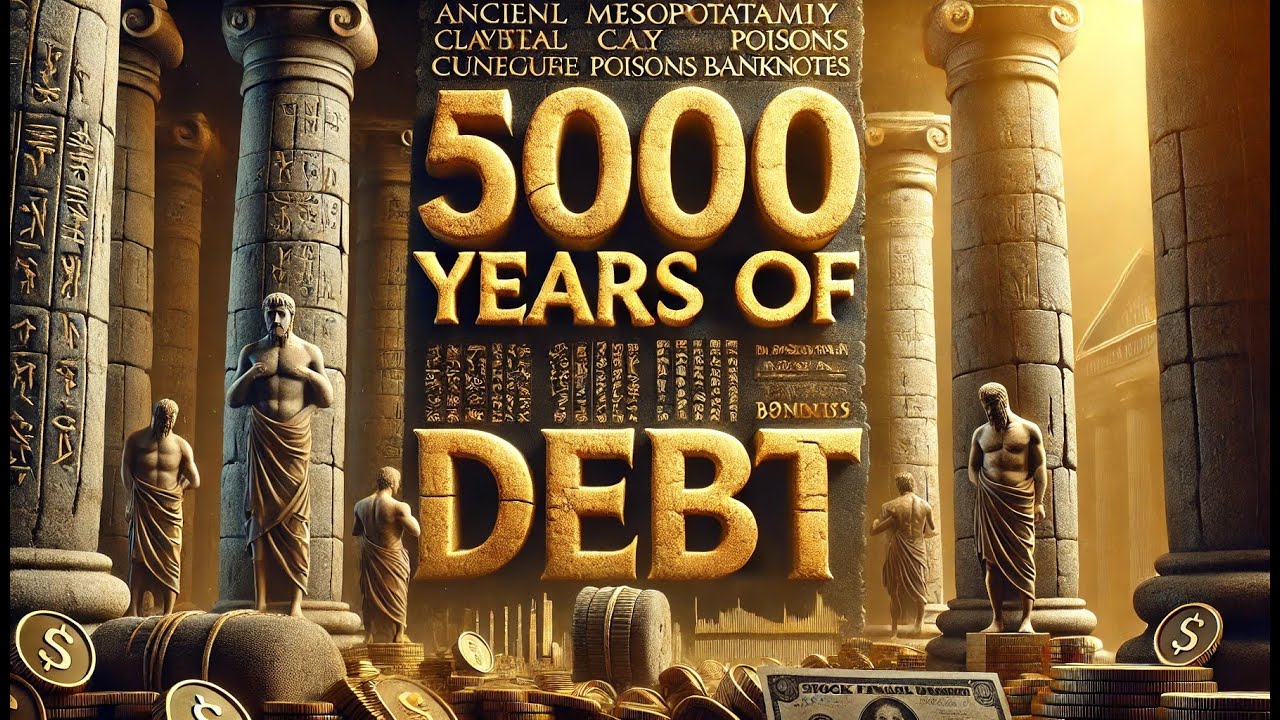
UNDERSTANDING ECONOMIC MANIPULATION | David Graeber's 'Debt: The First 5000 Years'
Автор: Creative Immigration Law
Загружено: 2025-03-16
Просмотров: 230
Описание:
#Debt #EconomicJustice #DavidGraeber #HistoryOfDebt #SurveillanceCapitalism #StudentDebtCrisis #MilitaryIndustrialComplex #FinancialInequality #DigitalEconomy #ReclaimTheFuture #SocialChange #EconomicFreedom #DecolonizeEconomics #FairEconomy #BreakTheCycle
David Graeber’s Debt: The First 5,000 Years reveals that debt has never been just an economic tool—it has always been a means of structuring power, morality, and society itself. Throughout history, debt has reinforced systems of control, binding people into obligations that extend far beyond financial transactions. Whether in ancient Mesopotamia, Rome, colonial empires, or caste-based societies, indebtedness has functioned as a mechanism of hierarchy, ensuring the continued dominance of ruling classes while justifying economic and social inequalities.
Graeber’s analysis shows that debt is not a neutral force; it operates in self-reinforcing cycles. In Mesopotamia, trust-based credit systems formed the backbone of economic and social stability, but when disrupted, they could lead to exclusion and economic collapse. In Rome, military expansion created taxation, taxation drove monetary dependence, and monetary dependence justified further conquest, creating an empire fueled by debt until it could no longer sustain itself. In colonial economies, European conquests led to the commodification of human beings, and the wealth derived from plantation labor financed the rise of capitalism, embedding economic control within systems of exploitation.
These historical patterns are not relics of the past—they are actively shaping our present. Today, digital reputation economies mimic ancient trust-based credit systems, but now controlled by algorithms rather than human relationships, making access to economic participation fragile and easily revoked. National debt fuels military-industrial complexes much like Rome’s expansionist policies, keeping nations locked in cycles of military spending justified by economic necessity. Big Tech monopolies extract and commodify personal data, creating a modern control economy where human behavior itself is turned into a source of profit. Educational debt, framed as a moral responsibility, continues to reinforce social stratification and economic dependence, limiting social mobility rather than expanding it.
Left unchallenged, these cycles will not merely persist but intensify. History has shown that debt-driven systems do not naturally self-correct; they escalate, deepening inequality and consolidating power until they either collapse under their own contradictions or are forcibly broken. The increasing dependence on digital reputation scores, the ever-expanding reach of corporate surveillance, the unchecked expansion of militarized economies, and the deepening burden of student debt all indicate that these structures are growing more entrenched, not less. If left to continue, they threaten to create a world where access, opportunity, and autonomy are dictated entirely by systems of debt and control.
However, Graeber’s work is not just a warning—it is an invitation to imagine alternatives. If debt is a social construct, then it can be reconstructed. Trust-based economies can be restructured to prioritize genuine human relationships over algorithmic gatekeeping. Public resources can be redirected from militarization to social well-being. Digital spaces can be reclaimed from corporate control to serve human communities rather than surveillance capitalism. Education can be liberated from debt dependency, reframed as a collective investment in the future rather than a personal financial burden.
The choice is stark and urgent. Inaction will allow these cycles to deepen, leading to even greater instability, inequality, and systemic failure. But by recognizing how these debt-driven structures reinforce themselves, we gain the power to intervene. Breaking these cycles requires not only understanding their mechanisms but actively reshaping economic and social systems in ways that prioritize fairness, equity, and human dignity.
Graeber’s ultimate lesson is that history does not move in one inevitable direction—debt is not destiny. The same forces that have been used to control and exploit can be dismantled and reimagined. A future beyond debt-driven hierarchies is possible, but only if we choose to break the cycles that have bound societies for millennia. By learning from the past, we can reclaim our agency and build a world where economic relationships serve people, rather than the other way around.
Повторяем попытку...
Доступные форматы для скачивания:
Скачать видео
-
Информация по загрузке:


![Как из хаоса рождается порядок? [Veritasium]](https://image.4k-video.ru/id-video/HmmYtopGx7Y)


![Global Capitalism: The Changing World Economy [May 2023]](https://image.4k-video.ru/id-video/WcI4XQA5nzA)