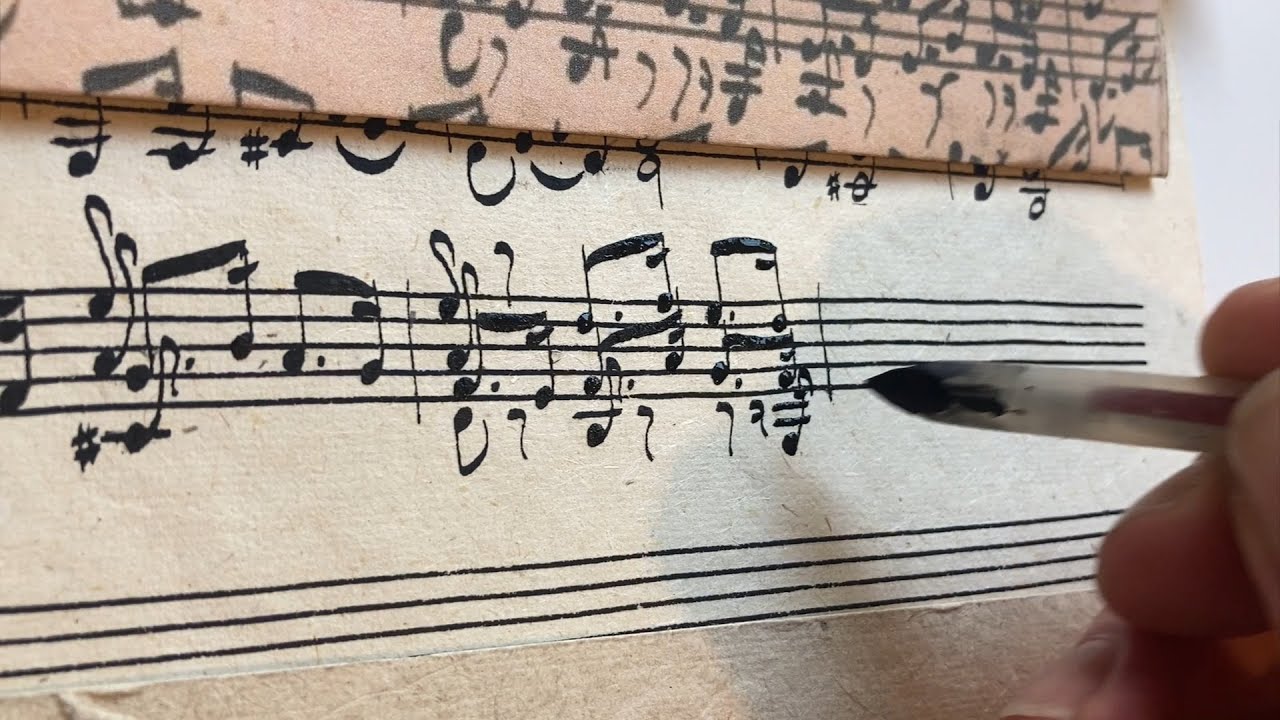
Bach Violin Partia BWV 1004 Calligraphy
Автор: Joost Witte
Загружено: 2025-10-30
Просмотров: 1039
Описание:
Calligraphy of the fourth solo BWV 1004, the second partita or Partia of the violin pieces Sei Solo from 1720 in the handwriting of Johann Sebastian Bach, played by violinist Diamanda La Berge Dramm.
00:00 Allemande
02:31 Corrente
04:00 Sarabanda
06:42 Giga
09:16 Ciaccona
On Diamanda La Berge Dramm's CD recording entitled Inside Out, chorale melodies sung along with the Ciaccona can be heard.
Helga Thoene has made an inventory of chorales in an analytical study. The recording largely follow Helga's findings and aims to connect the voices with the violin sound and register, a close glimpse into Bach's compositional cooking book and an opportunity to partly experience how the music could have resonated in his living audience.
The autograph folio of this Partita specifies : a Violin Solo senza Basso in the header. A broader concept than the one on the autograph cover: without accompanying bass. Harmonically speaking, the musical fabric consists of four parts, for soprano, alto, tenor and bass. This is music without bass, with a bass. The bass voice actually sounds, and with the broken-style technique, it even suggests that it can be experienced continuously. "With or without" is the core of the Sei Solo.
Thoene's publication was accompanied by a recording by Christoph Poppen and The Hilliard Ensemble, interweaving chorales with the violin solos. The Hilliard Ensemble was an a cappella male vocal quartet consisting of counter-tenor, high tenor, tenor and bass.
Bach's composition technique is grounded in improvisational harmonization of existing chorales. This was no different with a collection of instrumental music; there is a close connection with written texts that express religious beliefs and offer comfort in difficult times.
It is sometimes said that such connections have a secret meaning. But the chorale melodies that Bach used were very well known at the time, children sang them daily at school and they could also be heard in weekly church services. His audience was deeply familiar with it and carried all the melodies in their hearts. Just a few consecutive notes were enough to evoke the texts in the inner ear. Most of us no longer have the Lutheran chorales at our fingertips in such a way, but unfamiliarity with them does not mean that Bach's art played with secrets; rather, it was the opposite: it showed a deeper world beyond what was profoundly known and recognized.
Organists learned to compose while accompanying the chorales, using preludes freely to establish the correct initial tone, alternating consonant fingerings in different positions to harmonize the chorale melodies, phrasing and emphasizing the text by inserting dissonances, first by memorizing and using standard phrases and endings, then by truly creative tone combinations and sequences. This course of study familiarized organists in particular with the canon and formed the basis of their worldview and order, and their natural idiom for expression. Instrumental classical harmonic turns and tunes that were part of the standard tools were deeply connected text, the context could change with reuse, independent or referential.
The Ciaccona is a collage of choral melodies, which tell a special story. The chorales exuded an inspiring creative power, and they also held personal meaning. Derived motifs offer a kaleidoscopic image of the transformations and functions a note can have, creating a unity in diversity.
Check out my video Sei Solo: The Floor for more background on the personal meanings captured within, and the compositional quantum leap from organ to violin.
The calligraphy differs in many respects from the recent scholarly edition; much relevant musical information has been lost through the engraved copying techniques used since the early 19th century: phrasing, playing technique, and proportions. It's high time for a major clean-up and a renewed look at the autograph. This study is a practical investigation into this, and this channel also substantiates verbally what could be seen and expressed.
The Second Partita of Johann Sebastian Bach's solo violin music newly calligraphed by Joost Witte in 2025.
BWV 1001 - BWV 1003 Sei Solo calligraphy Joost Witte :
https://www.sonolize.com/en/music?arr...[194]=Joost%20Witte
Newly calligraphed (2024) Cello Suites scores BWV 1007 – 1012 edited by Chuck Herin, calligraphy by Joost Witte : www.pegheds.com
Joost Witte, October 2025
Joost Witte Instagram : @happy.sad.sad.happy.bach
Violinist Diamanda La Berge Dramm : https://diamandadramm.com/
Singer Michelle O'Rourke : https://www.michelleorourke.ie/
Soprano Katinka Fogh Vindelev : https://katinkafoghvindelev.dk/
Helga Thoene : https://dr-ziethen-verlag.eshop.t-onl...
2001 Album Morimur (Hilliard Ensemble - Christoph poppen) on Spotify : https://open.spotify.com/album/0SEOzK...
Tache de beauté schoonheidsvlek
Повторяем попытку...
Доступные форматы для скачивания:
Скачать видео
-
Информация по загрузке: