33. Examples of application of Reynolds-averaged Navier-Stokes equations
Автор: Milovan Peric
Загружено: 2025-05-19
Просмотров: 493
Описание:
In this lecture five examples of simulation of turbulent flows using Reynolds-averaged Navier-Stokes equations are presented. These examples are selected to show both the strengths and the weaknesses of RANS turbulence models.
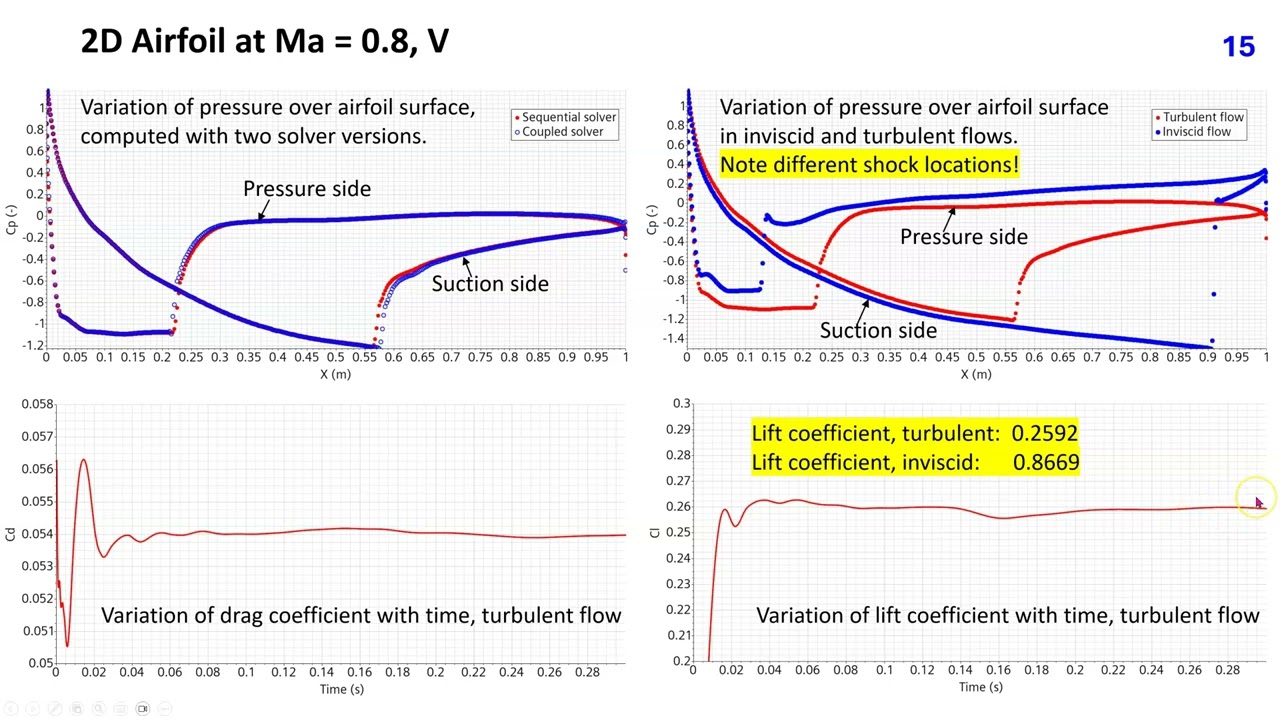
In the first example a steady-state flow around an airfoil is studied. It is the same test case that was used in Lecture 28 when solving the Euler equations (i.e., assuming that the fluid is inviscid). We’ll show how viscosity and turbulence change the solution.
The second test case is flow in the mixer used in Lecture 26, where the flow was assumed to be laminar (i.e., the fluid was very viscous). The flow is unsteady, and the unsteadiness is imposed by the rotational motion of the impeller. When the flow is turbulent, it takes several impeller rotations before a periodic solution is established.
The third example is the flow around an airplane wing at different angles of attack. The aim is to predict drag and lift variation with the angle of attack and find out when the stall happens.
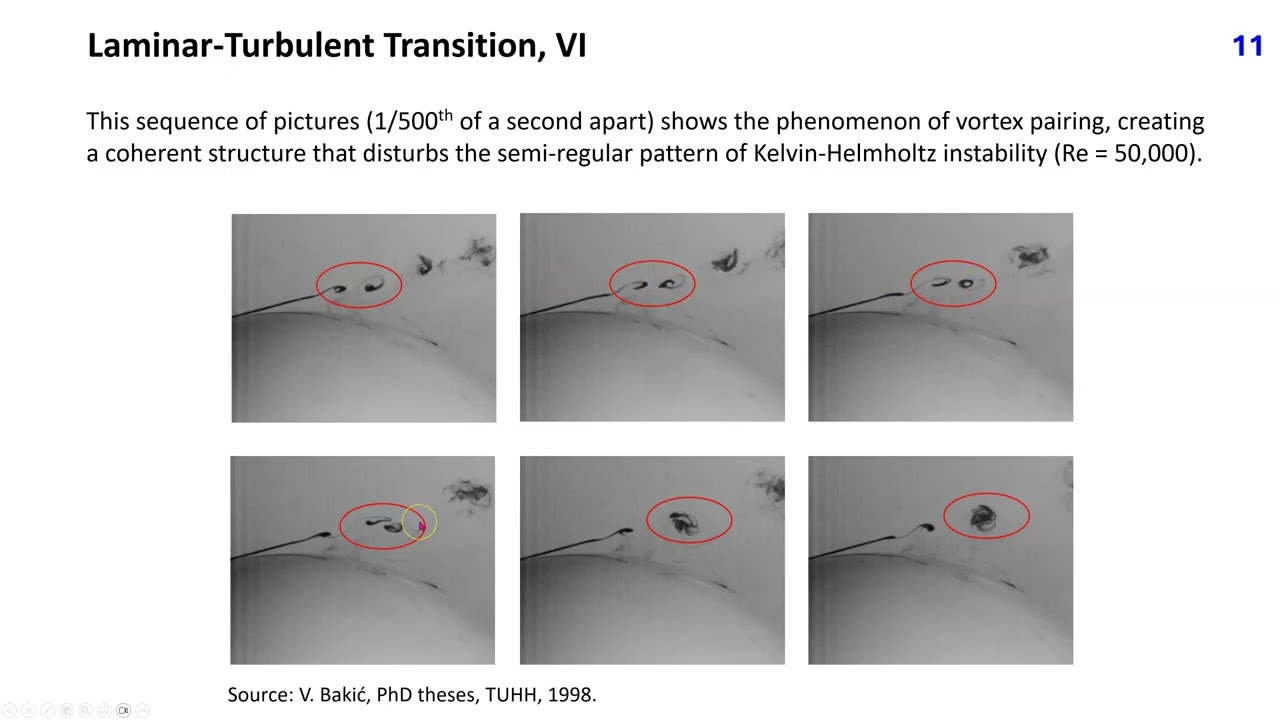
In the fourth test case turbulent flow around a sphere at a Reynolds number of 500.000 is computed. This is the kind of flow for which none of RANS turbulence models performs well.
The fifth test case is devoted to turbulence-driven secondary flow in a duct with a square cross-section. Here we demonstrate that linear eddy-viscosity types of models cannot predict such flows, while Reynolds-stress models can.
You can download this video, the transcript of its soundtrack, the PowerPoint presentation file, and the supplementary material from this site: https://sie.ag/6a3r6J
You are also encouraged to participate in the discussion by posting comments, questions, and suggestions for improvements in the dedicated space for "The Perić Lectures on CFD" at the above site.
Повторяем попытку...
Доступные форматы для скачивания:
Скачать видео
-
Информация по загрузке: