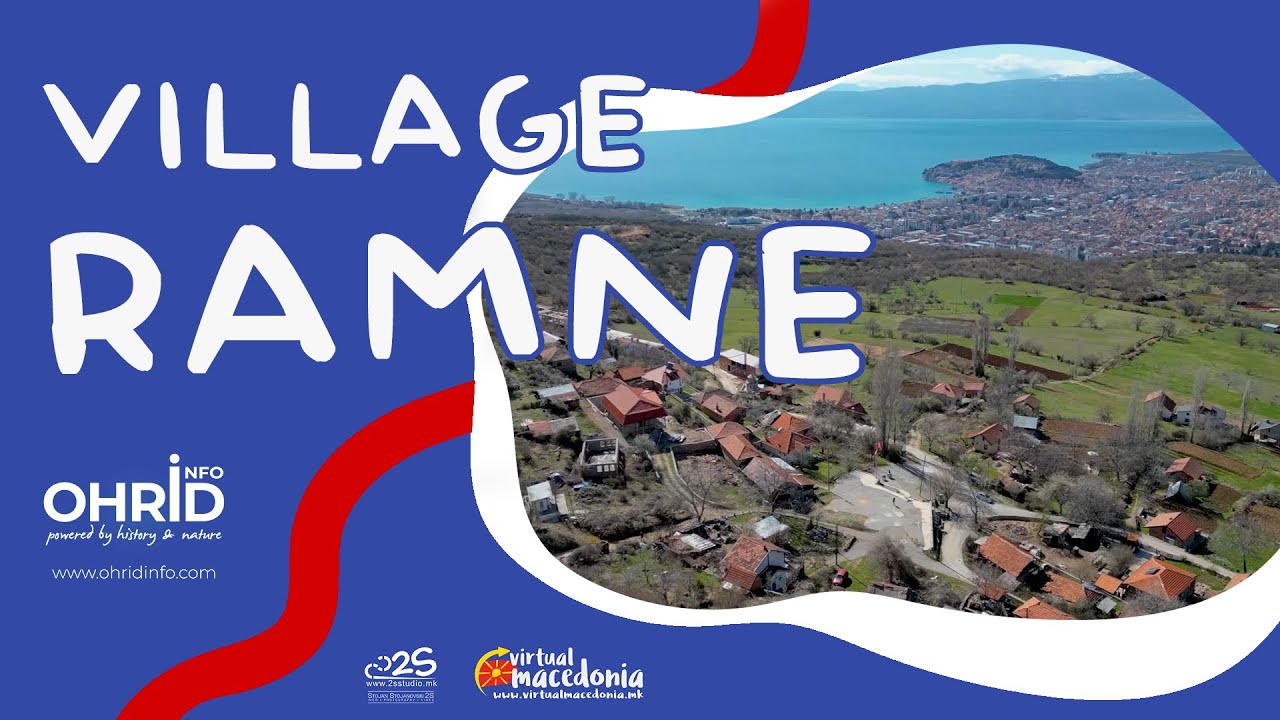
Village Ramne from Drone - Ohrid, Lake Ohrid, MK - Ep. 4
Автор: Ohrid Info by 2S
Загружено: 2023-03-30
Просмотров: 1303
Описание:
Village Ramne near Ohrid, Macedonia
(c) 2023 - 2S
#lakeohrid #ohrid #ramne #villageramne #village #drone #video
Folllow us on social media:
/ ohrid.info
/ stojanstojanovski2sphotography
https://www.virtualmacedonia.mk
https://www.stojanstojanovski.com
https://www.ohridinfo.com
Support us on paypal: [email protected]
Support us on patreon: / stojan2s
---------
Рамне — село во Општина Охрид, во околината на градот
Охрид.
Ова село се наоѓа во Охридското Поле, во источниот дел на
Општина Охрид
----------
This village is located in the Ohrid Field, in the eastern part of the
Municipality of Ohrid, not far from the city of Ohrid. The village is
mountainous, at an altitude of 960 meters above sea level.
The village is located on a terrace of Varovnica on the northwest
slope of the Galicica mountain, at an altitude of about 1,000 meters,
which is probably why it got its name Ramne. A small river is
formed above the village from several sources, which flows into
Lake Ohrid. The village's land extends to the Galicica mountain.
The Varovnica soil composition allows an abundance of water and
a strong and favorable water level at the village fountain, which
enables the water to be used for drinking and irrigation throughout
the summer. The rich water sources are also used for the water
supply of the city of Ohrid.
The village, first recorded as Ramne, was mentioned in written
documents in the year 1230. It is believed that the name itself
means "village". Originally, the village was called Ramna, but later,
under the influence of many names with the ending -e, the village
became Ramne
The area of Ramne has been inhabited since Roman times, as
evidenced by the Ramnenski Lozja site located approximately 1 km
north of the village.
Ramne is one of the oldest villages in Ohrid. It was likely founded
in the early Middle Ages, as evidenced by the written Ramnenski
Psalter from this period.
In the 19th century, Ramne was a village in the Ohrid district of the
Ottoman Empire.
The village covers an area of 19.2 km2. Grazing land predominates
on it with an area of 1,039 hectares, followed by forests with 634
hectares, and cultivated land with 163 hectares.
The village has a mixed agricultural function.
Until the Second World War, the inhabitants of Ramne cut wood
from Galichica, which they sold as firewood in Ohrid. Later, they
worked as day laborers and hired workers during the cultivation of
vineyards and vegetable gardens, as well as on the construction of
roads in the surrounding area. In the past, holes were dug on the
mountain slope around Ramne for the production of tar, which was
later transported by horses and sold in Ohrid and Resen.
Today, the majority of the inhabitants earn their income by being
employed in Ohrid. Exceptions are a few livestock farmers and
collectors of medicinal herbs and aromatic plants. Regarding
livestock, the most common animals are goats, cows, and sheep,
while in agriculture, wheat (both common and durum) is grown in
the Ramnicharski part of the terrace below the village, and a small
portion is dedicated to gardening (tomatoes, peppers) for personal
use.
In the book "Ethnography of the Vilayets of Adrianople, Monastir,
and Salonica" it is stated that in 1873, Ramne had 20 households
and 70 inhabitants.
According to the data of Vasil K'nchov ("Macedonia. Ethnography
and Statistics") from 1900, Ramne had 140 inhabitants, all
Macedonians. According to the Exarchic Secretary Dimitar Mishev
("La Macédoine et sa Population Chrétienne"), in 1905 Ramne had
144 inhabitants, under the authority of the Bulgarian Exarchate.
The village is of medium size. In 1961, it had 407 inhabitants, and in
1994 the number increased to 589 inhabitants, of which 563 were
Macedonians, nine were Turks, and three were Albanians.
According to the census from 2002, there were 632 inhabitants in
the village of Ramne, of which 594 were Macedonians, 11 were
Turks, 6 were Serbs, 2 were Vlachs, 2 were Albanians, and 17 were
others.
According to the latest census from 2021, there were 617
inhabitants in the village, of which 595 were Macedonians, 2 were
Albanians, 1 was Turkish, 2 were Vlachs, 7 were Serbs, 4 were
others, and 6 had no data.
Повторяем попытку...
Доступные форматы для скачивания:
Скачать видео
-
Информация по загрузке:







![Панорама на село Крушје, Ресен [Дрон Видео] Drone Footage village Krusje, Prespa, Resen, Macedonia](https://imager.clipsaver.ru/hIvtKVbAuUY/max.jpg)