Understanding Central Battery Systems CBS: AC vs. DC Emergency Lighting Design, Maintenance,
Автор: Waleed Fekry
Загружено: 2025-11-17
Просмотров: 97
Описание:
#CentralBatterySystems #EmergencyLighting #ACBatterysystems #DCBatterySystems`
#BS5266
#ElectricalSafety
#Honeywell
#LifeSafety
#SwitchTrippingSystems
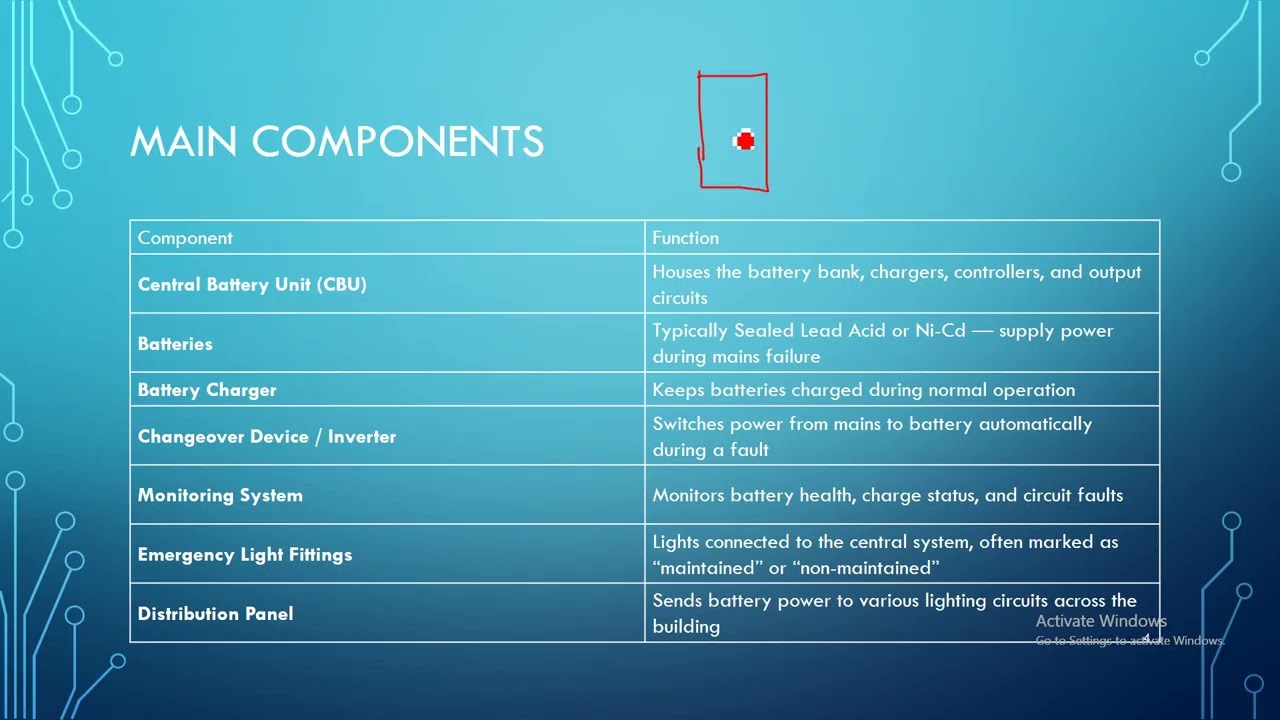
This video explores the essential components and benefits of Central Battery Systems (CBS) for emergency lighting, drawing on expert guidance from Honeywell.
*What are Central Battery Systems?*
Central Battery Systems offer a solution to power and test an array of emergency luminaires from one central point. The luminaires are wired back to a main cabinet housing the batteries and charger, often located in a secure area accessible only to authorized personnel.
*Key Advantages:*
One of the primary benefits of CBS is the **significantly longer battery design life, ranging from 5 to 25 years**, depending on the type chosen (e.g., Vented Lead Acid Planté). This contrasts sharply with self-contained fittings, which require battery changes every 4 years. Maintenance and regular testing, required in accordance with BS5266, are also easier because they can be controlled at one central point.
*Types of Systems:*
*AC Central Battery Systems:* These systems offer *high efficiency and reliability* with low operating costs. A major advantage is the use of a wide range of normal mains voltage fittings (including fluorescent and HID) with an inverter, resulting in *higher light levels achieved* compared to traditional low voltage emergency luminaires. The inverters are typically designed to comply with BS EN 50171 and operate in a passive standby mode.
*DC Central Battery Systems:* These systems automatically provide an alternative lighting supply in the event of AC supply failure and feature comprehensive instrumentation and monitoring. They offer an extensive choice of battery types. Modes of operation include Non-maintained (supply only during AC failure), Maintained (supply provided at all times), and Q Circuit (used where remote hold-off or changeover devices are applied).
*Battery & System Details:*
Central battery systems can utilize various battery types, including:
1. *Sealed Recombination Lead Acid:* Low initial cost, compact design, up to 10-year design life.
2. *Vented Lead Acid Planté:* Designed for 25 years life, provides full capacity throughout its life, but is relatively high cost, bulky, and requires a ventilated battery room and regular maintenance.
3. *Vented Nickel Cadmium Alkaline:* Long design life (25 years) and resistance to abuse/temperature variations, though it has the highest initial and maintenance costs, and requires topping up and a ventilated room.
*Important Design Considerations:*
Due to the life safety importance of emergency lighting, central battery systems must be wired in **fire-protected cables**. Cable sizing is crucial, as BS 5266-1: 2005 limits cable voltage drop to 4% of nominal voltage. Strategies to overcome excessive voltage drop include increasing the system voltage (e.g., to 50V or 110V), increasing distribution circuits, or reducing cable runs.
*Advanced Features:*
Systems can include optional features like:
*Sub-Circuit Monitoring (SCm):* Relays monitor local lighting sub-circuits, activating emergency lights if a local circuit fails.
*Phase Failure Monitor (PFm):* Activates emergency lighting if any phase of a three-phase incoming supply fails.
*Switch Tripping Systems:* A separate flexible range designed to provide cost-effective and secure DC power for intermittent loads like switch tripping, closing, engine starting, or continuous loads like telecommunications support.
Повторяем попытку...

Доступные форматы для скачивания:
Скачать видео
-
Информация по загрузке: