Kharosthi Script : Ancient India's Lost Legacy । खरोष्ठी लिपि : प्राचीन भारत की विरासत । Sundaram S
Автор: Pandulipi Sanvadah
Загружено: 2026-06-05
Просмотров: 168
Описание:
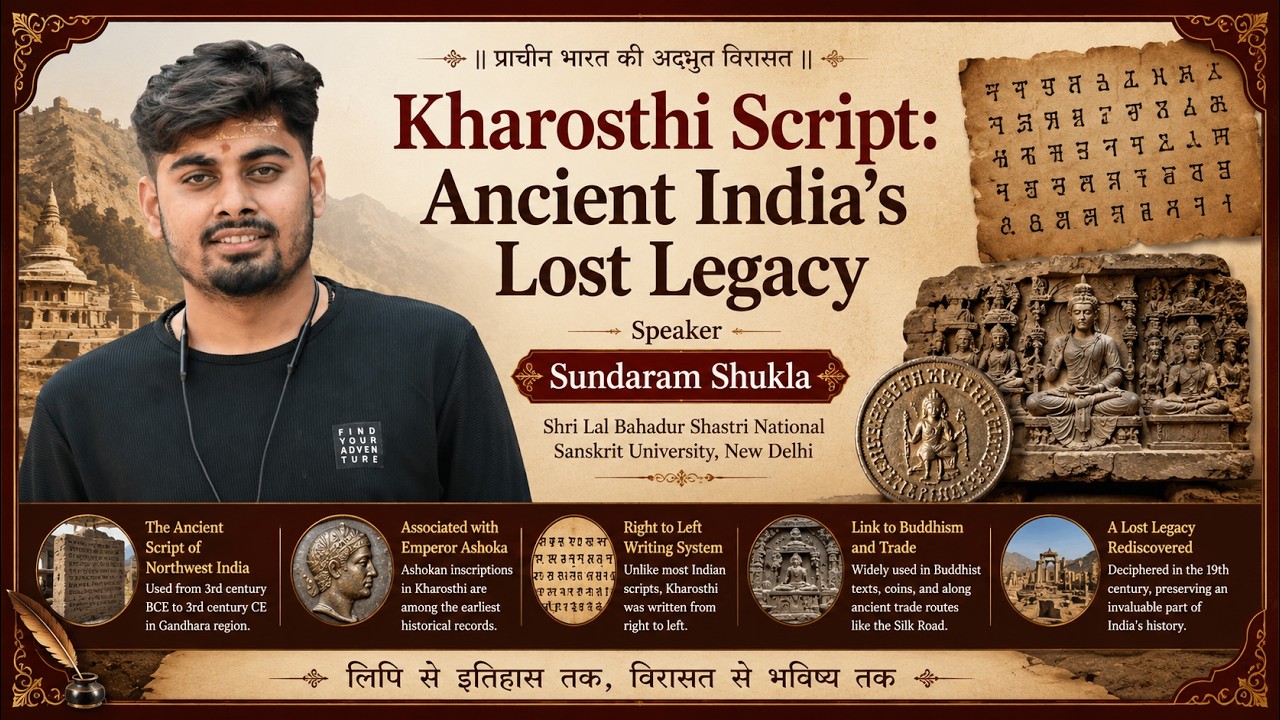
The Kharosthi Script is one of the most significant yet largely forgotten writing systems of ancient India. Once widely used across the northwestern regions of the Indian subcontinent, Kharosthi played a vital role in administration, trade, religion, and cultural exchange. Although it disappeared from regular use nearly two millennia ago, its inscriptions and manuscripts continue to provide valuable insights into the history of ancient India and Central Asia.
The origins of Kharosthi can be traced to the Aramaic script, which was introduced into the northwestern Indian region during the rule of the Achaemenid Persian Empire in the 6th–4th centuries BCE. Over time, local scribes adapted Aramaic characters to represent the sounds of Indo-Aryan languages, leading to the development of Kharosthi. Unlike most Indian scripts, which evolved from Brāhmī, Kharosthi possesses a distinct historical lineage and structural design.
Kharosthi was primarily used in the ancient region of Gandhāra, encompassing parts of present-day Pakistan and Afghanistan. The script flourished from approximately the 3rd century BCE to the 3rd century CE. It gained prominence during the reign of Emperor Aśoka, whose inscriptions in the northwestern provinces were written in Kharosthi. These inscriptions served as important instruments for communicating royal policies and Buddhist teachings to the people.
One of the most distinctive features of Kharosthi is that it is written from right to left, unlike Brāhmī and its descendant scripts, which are written from left to right. This characteristic reflects its Aramaic ancestry. The script consisted of consonants, vowel markers, and various diacritical signs, allowing it to represent the phonetic structure of local languages effectively.
Kharosthi became closely associated with the spread of Buddhism. Numerous Buddhist manuscripts, inscriptions, reliquaries, and coins bear Kharosthi inscriptions. The script was extensively used by monks, merchants, and administrators along the trade routes connecting India with Central Asia. Through these networks, Kharosthi carried religious texts and cultural ideas far beyond the Indian subcontinent.
The discovery of Gandhāran Buddhist manuscripts has greatly enhanced our understanding of Kharosthi. Written on birch bark and preserved in the dry climate of Central Asia, these manuscripts are among the oldest surviving Buddhist texts. They provide crucial evidence regarding the development of Buddhist literature and the linguistic history of the region.
The decline of Kharosthi began around the 3rd century CE as the Brāhmī script gained wider acceptance throughout northern India. Brāhmī's adaptability and growing political support gradually replaced Kharosthi in administration and literary activities. Over time, knowledge of the script disappeared, rendering many inscriptions unreadable for centuries.
Modern understanding of Kharosthi emerged during the nineteenth century when scholars successfully deciphered its inscriptions through comparative studies of coins and bilingual texts. Since then, epigraphists and historians have reconstructed much of its history and significance.
Today, Kharosthi is remembered as an invaluable component of India's cultural and intellectual heritage. As an ancient script that connected India with Persia, Central Asia, and the Buddhist world, it stands as a symbol of historical interaction, linguistic diversity, and scholarly achievement. Though no longer in use, Kharosthi remains an enduring legacy of ancient India's rich and interconnected past.
#Kharosthi #KharosthiScript #ancientindia #lostlegacy #indianscripts #paleography #manuscriptology #epigraphy #ancientwriting #historicalscripts #scriptevolution #brahmi #gandhara #gandhari #prakrit #ancientlanguages #indicscripts #archaeology #indianhistory #culturalheritage #historicallinguistics #scripthistory #ancientcivilizations #northwestindiana #afghanistan #centralasia #silkroad #buddhism #buddhiststudies #ashoka #mauryanempire #inscriptions #RockEdicts #ancientmanuscripts #writingsystems #philology #calligraphy #indianheritage #languageevolution #historicalresearch #textualstudies #academicresearch #indology #ancienttexts #heritagestudies #culturalstudies #ancientalphabet #ScriptAnalysis #historicaldevelopment #aramaic #AramaicInfluence #ancientculture #numismatics #coins #KushanEmpire #IndoGreek #scythians #traderoutes #ancienttrade #BuddhistManuscripts #BirchBark #AncientRecords #historicaldocuments #DocumentaryHeritage #archaeologicalfinds #ScriptDecipherment #JamesPrinsep #ancientknowledge #southasia #indiancivilization #culturalidentity #traditionalknowledge #historicallegacy #EpigraphicalStudies #ancientheritage #linguistics #languagehistory #WritingTradition #ScriptTradition #researchscholar #ancientinscriptions #bactria #taxila #peshawar #Shahbazgarhi #mansehra #culturalpreservation #heritageconservation #historicalevidence #ancientwisdom #regionalhistoryipt
Повторяем попытку...
Доступные форматы для скачивания:
Скачать видео
-
Информация по загрузке: