IJMF Spotlight V-Seminar Series: Sedimentation of dense suspensions in the inertial regime
Автор: IJMF Spotlight
Загружено: 2021-05-18
Просмотров: 974
Описание:
Abstract Sedimentation is a widespread phenomenon occurring both in nature and many industrial applications such as for example in rivers and settling basins for waste water treatment. Moreover, the tendency of particles to settle under gravity is directly relevant for turbulent sediment transport in e.g. dredging applications where it is counterbalanced by turbulent mixing. The settling of a single spherical particle under gravity is characterized by path instabilities dependent on the so-called Galileo number (a measure for the ratio of net gravity to viscous forces), and the particle-to-fluid mass density ratio (1). Sedimentation of particle suspensions is characterized by hindered settling in the dense regime (more than 1%) (2), whereas at dilute concentrations (less thanless than 1%) and in the inertial regime the formation of columnar structures may result in enhanced sedimentation (3). A thorough understanding of such behavior is of paramount importance for accurate modelling of (the tendency of) sedimentation in the aforementioned examples. In this seminar I will present results from experiments on a single settling spherical particle in a large settling tank for Galileo numbers in the range of 100-700 (inertial regime) and density ratios varying from 0.87 (moderately light) to 3.9 (heavy). The focus will be on characterization of path instabilities and the drag coefficient. Next, I will present results from Direct Numerical Simulation (DNS) (4,5) of sedimenting sphere suspensions for Galileo numbers in the range of 144-210 and concentrations varying from 0.5-30% at a fixed density ratio of 1.5 (6). I will discuss both macroscopic properties (e.g., the mean and rms particle velocity, kinematic waves) and the suspension micro-structure by means of particle-conditioned statistics.
References
(1) W. Zhou and J. Dusek. Chaotic states and order in the chaos of the paths of freely falling and ascending spheres. Int. J. Multiph. Flow., vol. 75, pp. 205-223, 2015.
(2) J.F. Richardson and W.N. Zaki. Sedimentation and fluidization: Part I. Transactions of the Institution of Chemical Engineers, vol. 32, pp. 35-53, 1954.
(3) M. Uhlmann and T. Doychev. Sedimentation of a dilute suspension of rigid spheres at intermediate Galileo numbers: the effect of clustering upon the particle motion. J. Fluid Mech., vol. 752, pp. 310-348, 2014.
(4) W.-P. Breugem. A second-order accurate immersed boundary method for fully resolved simulations of particle-laden flows. J. Comput. Phys., vol. 231, pp. 4469-4498, 2012.
(5) P.S. Costa, B.J. Boersma, J. Westerweel and W.-P. Breugem. A collision model for fully-resolved simulations of flows laden with finite-size particles. Phys. Rev. E, 053012, 2015.
(6) T. Shajahan and W.-P. Breugem. Influence of Concentration on Sedimentation of a Dense Suspension in a Viscous Fluid. Flow, Turbulence and Combustion, vol. 105, pp. 537–554, 2020.
About the Presenter
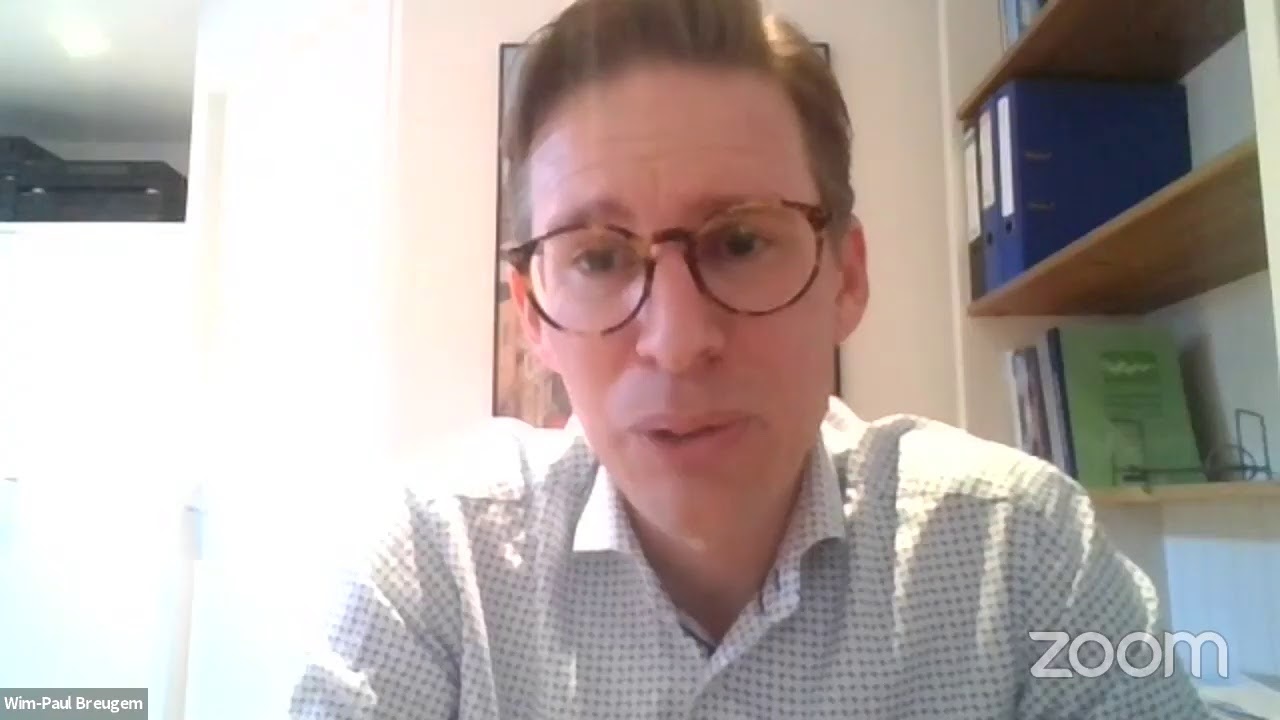
Wim-Paul Breugem studied Applied Physics at TU Delft from 1994-2000. After his studies, he did a Ph.D. research on Direct Numerical Simulation of turbulent flow over and through porous media under the supervision of Dr. B.J. Boersma, Dr. R.E. Uittenbogaard, and Prof. F.T.M. Nieuwstadt. He obtained his PhD cum laude in January 2005. From 2005-2007 he worked as a postdoctoral researcher at KNMI, the Dutch weather, and climate institute, on interannual variability of large-scale sea surface temperature patterns in the tropical Atlantic region. In 2008 he became Assistant Professor at the Laboratory for Aero and Hydrodynamics at TU Delft. Since 2016, he has been working as Associate Professor in the Multiphase Systems group. His research focuses on turbulence and multiphase flow using Direct Numerical Simulation techniques.
Повторяем попытку...
Доступные форматы для скачивания:
Скачать видео
-
Информация по загрузке: