Hydrodictyon Life-cycle || Thallus Structure Reproduction
Автор: Dr. Neha Binwal Biology
Загружено: 2023-04-29
Просмотров: 782
Описание:
Hydrodictyon or “Water- net”
Class- Chlorophyceae
Order- chlorococcales
Family- Hydrodictyaceae
Occurrence
Hydrodictyon or water net is a free floating water alga. It grows luxuriantly during late summer and spring season and sometimes covers the pond. The genus is represented by five species. H. indicum and H. reticulatum are common Indian species which occur in temporary or permanent water reservoirs.
Thallus structure
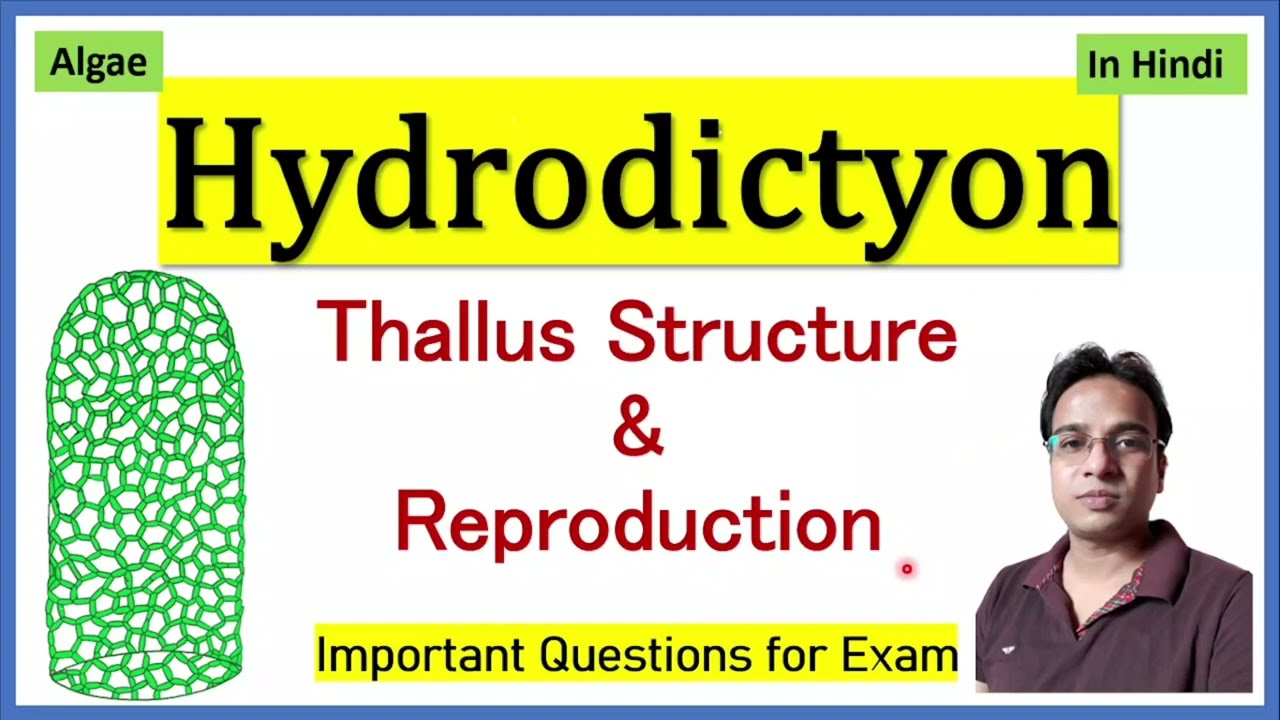
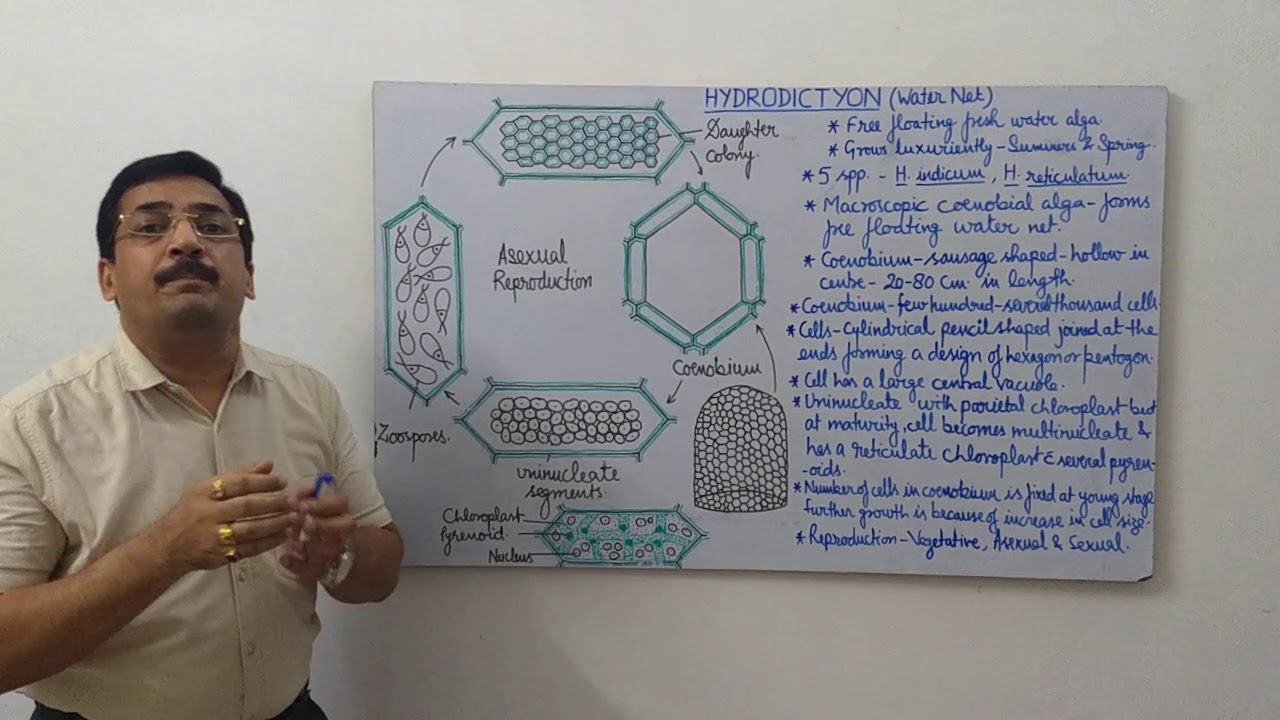
Hydrodictyon is a macroscopic coenobial alga, forming free floating ‘water net’ in fresh water reservoirs. The coenobium consists of few hundred to several thousands cells.
The long cylindrical and pencil shaped cells are joined at the ends forming a design of hexagons and pentagons.
The young cell is uninucleate but at maturity it becomes multinucleate.
The number of cells in a coenobium is fixed when it is young.
Further growth of the coenobium is due to the increase in cell size and not in number of the cells.
Reproduction
Hydrodictyon reproduces mainly by asexual and sexual methods, but vegetative multiplication may also take place by fragmentation of coenobium to small fragments.
Asexual reproduction
It takes place by means of small, uninucleate and biflagellate zoospores (swarmers).
All the cells of a coenobium are capable of forming zoospores which eventually develop into new coenobia.
The multiplication is very rapid. The multinucleated protoplast divides into 7000-20,000 uninucleated segments.
Each segment is surrounded by a cytoplasm and a thin layer of membrane. It eventually develops into a biflagellate zoospores.
Due to sudden contraction zoospores form a dense column in the center of the mother cell.
Once the zoospores tear loose from the central column, they swim freely inside the mother cell.
The wall of the mother cell, however, does not rupture and zoospores remain inside the mother cell.
After the period of rapid movement, the zoospores lose their flagella and settle down on the inner side of the cell wall.
They arrange themselves into characteristic hexagonal and pentagonal fashion to form a new net.
The young coenobium is liberated by softening of the wall of the mother cell.
Sexual Reproduction
Sexual rep. is isogamous type, vegetative cell of the mature coenobium is capable to form gametes.
The protoplast of the cell undergoes repeated cleavage and forms 30,000-1,00,000 segments.
Each segment metamorphoses into a motile biflagellate gamete.
The gametes are smaller than zoospores.
They are liberated from the parent cell through the pore in its wall. Species of Hydrodictyon are monoecious i.e. homothallic.
Two isogametes from the same coenobium fuses to form the zygospore.
The gamete loose their motility after the fusion and secrete thick wall.
The diploid nucleus of the zygospore divides meiotically into four nuclei, which is followed by the cleavage of the protoplast.
Each uninucleate segment develops into a biflagellate zoospore.
After the short period of motility the zoospore looses its flagella and comes to rest.
It secrete a thick spiny wall and develops into a polyhedral cell, called polyhedron.
The haploid nucleus of polyhedron divides to form 200-300 zoospore.
These zoospores arrange themselves into a new daughter net within the polyhedron.
The young net is liberated by the rupture of polyhedron wall.
Повторяем попытку...

Доступные форматы для скачивания:
Скачать видео
-
Информация по загрузке:



![Structure of Yeast [Fungi] Life Cycle of Saccharomyces | Reproduction Budding in Yeast Microbiology](https://imager.clipsaver.ru/FzuKH5Sz1R4/max.jpg)