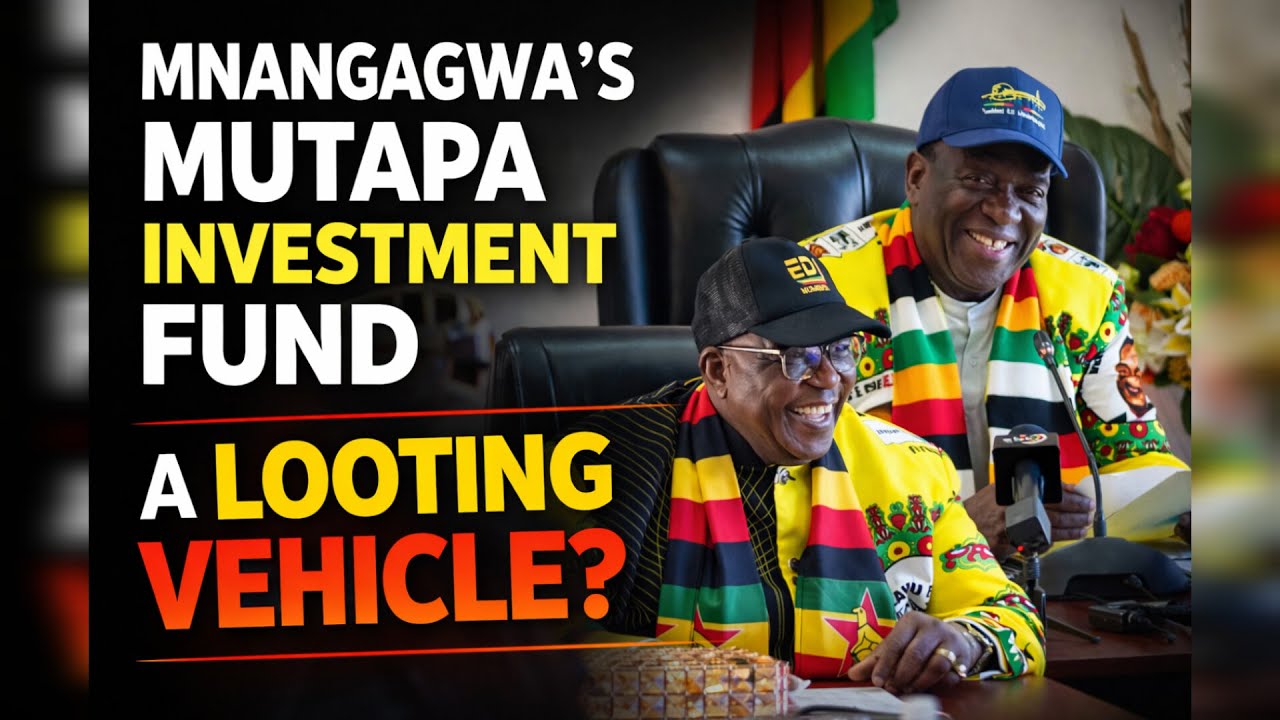
MNANGAGWA'S MUTAPA INVESTMENT FUND A LOOTING VEHICLE? WHAT DID THE AUDITORS FIND
Автор: AFRICA & BEYOND TV
Загружено: 2026-02-03
Просмотров: 557
Описание:
Auditors Flag Mnangagwa's MUTAPA INVESTMENT FUND as a looting vehicle?
Audit Raises Red Flags Over US$11.4 Billion in Mutapa Investment Fund Assets
A newly released audit of Mutapa Investment Fund, Zimbabwe’s sovereign wealth fund, has revealed serious governance and valuation concerns, including US$11.4 billion in assets that auditors say cannot be independently verified and the transfer of US$16 billion in public assets without a clear starting valuation.
The audit, conducted by Grant Thornton, issued a qualified opinion—a formal warning that signals material uncertainty in the financial statements. At the centre of the concern is the absence of reliable baseline valuations when state-owned enterprises and other public assets were transferred into the fund.
“The effects on the financial statements of this misstatement have not been determined,” the auditors state in their report.
In practical terms, this means that even the auditors could not establish how inaccurate the reported figures might be.
No Baseline, No Accountability
Grant Thornton found that Mutapa failed to measure its investments at fair value at the time of initial recognition, a breach of international accounting standards. Without an agreed starting value, it becomes impossible to determine whether the fund has created or destroyed value since its establishment.
As a result:
Auditors could not fully confirm the accuracy of the fund’s reported asset values.
Performance claims cannot be independently measured.
Accountability is weakened, as there is no credible reference point against which results can be assessed.
US$11.4 Billion in Unverifiable Valuations
One of the most significant findings relates to US$11.4 billion in unquoted subsidiaries, where valuations were based on unaudited financial information.
Grant Thornton reported that it was unable to obtain sufficient audit evidence to confirm the reliability of the data used, meaning that necessary adjustments—if any—could not be determined. The auditors also flagged improper currency translation practices, further compounding uncertainty around reported values.
These issues constitute breaches of IFRS 9 (Financial Instruments), IFRS 13 (Fair Value Measurement), and IAS 21 (Foreign Exchange Effects).
Opaque US$1.6 Billion Kuvimba Transaction
The audit and accompanying disclosures also draw attention to a US$1.6 billion transaction in which Mutapa acquired a 35% stake in Kuvimba Mining House, paid through Treasury Bills.
Crucially:
The fund has not publicly disclosed the ultimate beneficiaries of the transaction.
The implied valuation suggests a sharp increase compared to earlier government valuations.
The lack of transparency has raised questions about valuation methodology and conflict-of-interest safeguards.
For a sovereign fund managing public assets, such opacity presents a significant governance risk.
Returns Far Below Global Benchmarks
Mutapa reported comprehensive income of approximately US$8 million on assets claimed to be around US$16 billion—a return of roughly 0.05%.
By comparison, global sovereign wealth funds typically target annual returns between 6% and 13%. At the lower end of that range, a US$16 billion portfolio would be expected to generate close to US$960 million per year.
The gap—nearly US$1 billion annually in foregone returns—represents lost resources that could otherwise support infrastructure, healthcare, energy, or debt reduction.
Profitability Claims Disputed
Official government statements have claimed that 53% of entities under Mutapa’s control are now profitable. However, independent portfolio analysis suggests that only about 9% of these entities are generating profits.
The discrepancy raises concerns about the accuracy of information feeding into national policy documents and whether senior decision-makers are receiving a complete and reconciled picture.
Why the Findings Matter
The implications of the audit extend well beyond accounting technicalities:
Credibility Risk: International investors, lenders, and institutions such as the International Monetary Fund and World Bank rely on credible audits. A qualified opinion weakens confidence.
Currency Pressure: Sovereign funds are expected to support macroeconomic stability. Valuation uncertainty and opaque transactions undermine confidence in the ZiG and broader financial reforms.
Fiscal Exposure: Weak or unverifiable performance hides losses and opportunity costs that ultimately fall on the taxpayer.
Governance and Legal Risk: Undisclosed beneficiaries and unverifiable valuations expose the fund—and the state—to reputational and potential legal challenges.
Tighter Future Audits: Once a qualified opinion is issued, subsequent audits are likely to be more stringent, increasing the risk of even more severe findings if issues remain unresolved.
🎙️ New to streaming or looking to level up? Check out StreamYard and get $10 discount! 😍 https://streamyard.com/pal/d/45618707...
Повторяем попытку...
Доступные форматы для скачивания:
Скачать видео
-
Информация по загрузке: