How SpaceX Will Catch The Largest Spacecraft Ever Built Next Flight!
Автор: Tech Fans
Загружено: 2026-08-01
Просмотров: 2556
Описание:
How SpaceX Will Catch The Largest Spacecraft Ever Built Next Flight!
===
#techfans #spacex #starship #spacecraft
===
Intro: 0:00
Ship catch vs Booster catch: 0:46
Is Starship ready to be caught?: 4:27
Flight 14 could be coming soon: 7:10
Will Flight 14 catch both stages?: 8:37
How Starship reach 1 hour turn around time: 10:37
===
We would like to extend our special thanks to:
Evan Karen: / @evankaren
TijnM: / @tijn_m
SLS: https://x.com/ScottLikedSLS
Me & Grok: / @meandgrok
Avid Space: / labpadre
Starship Gazer: https://x.com/StarshipGazer
Starbase Surfer : https://x.com/cnunezimages
WAI: / @whataboutit
===
How SpaceX Will Catch The Largest Spacecraft Ever Built Next Flight!
“Unless we discover problems after mission data review, SpaceX will attempt to catch the ship with the tower on [the] next flight.”
Not long after Starship's upper stage touched down in the ocean, Elon Musk surprised everyone by announcing that SpaceX will attempt its first-ever Starship catch on Flight 14. But is the vehicle actually ready for that? What makes catching the upper stage so much more difficult than catching the booster that SpaceX needs 13 test flights before even considering it?
Well, let's answer all of those questions!
Catching a giant ship coming back from space is hard, but hitting that subscribe button is surprisingly easy, and it could also let you know when a cool thing in the spaceflight world happens, so don't be shy about hitting it. Now let’s get back to catching Starship.
How SpaceX Will Catch The Largest Spacecraft Ever Built Next Flight!
Ship catch vs Booster catch:
Okay, to begin, how hard would it be to catch the Starship upper stage?
I mean, SpaceX has already caught the Super Heavy booster multiple times. So catching a shorter upper stage should not be that difficult... right?
Well... not exactly.
In fact, even though Starship is shorter than the booster, most engineers would probably tell you it's actually the harder vehicle to catch.
And there are a few reasons why.
First, let's talk about the catch points themselves.
The booster was basically built around this idea. It has large, extremely robust hardpoints near the grid fin section that are specifically designed to take the enormous loads from the tower's chopsticks. On newer boosters, the grid fins themselves even double as part of the catch structure.
How SpaceX Will Catch The Largest Spacecraft Ever Built Next Flight!
Starship is a completely different story.
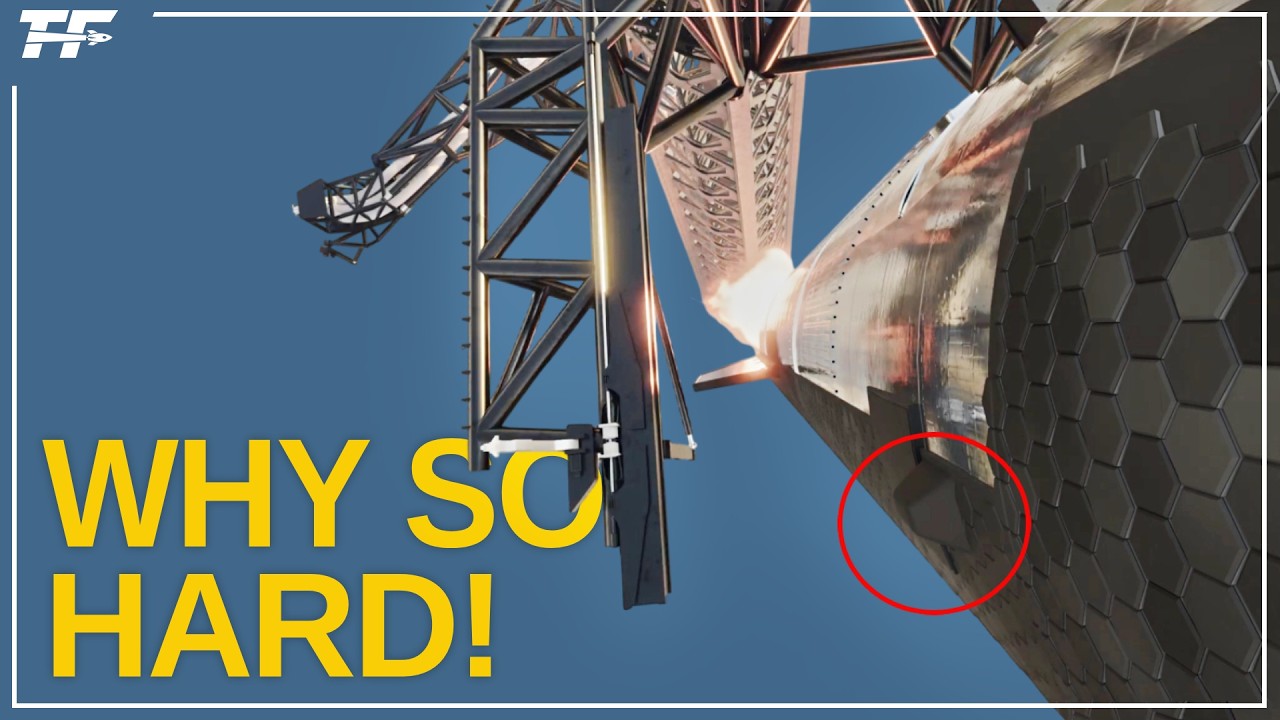
Instead, it uses dedicated catch pins. Early versions carried test pins mainly to collect data, but an operational catch means those pins have to support the weight of the entire vehicle while it's being grabbed by the tower. And unlike the booster, those pins also have to survive one small inconvenience...
...coming back from orbit.
That's because Starship doesn't just fall from a few hundred kilometers up. It slams into Earth's atmosphere at nearly 7.8 kilometers per second. The booster, by comparison, is only traveling around a couple of kilometers per second before it begins its return. It still moves incredibly fast, but it's nowhere near orbital velocity.
That difference is absolutely massive.
Even after atmospheric drag does most of the braking, Starship has to get rid of far more energy before it can even think about lining up with the tower. Depending on the exact masses, you're talking about roughly 10 to 20 times more kinetic energy than the booster has to deal with during recovery.
Повторяем попытку...
Доступные форматы для скачивания:
Скачать видео
-
Информация по загрузке: